Global Early Childhood Education Trends: What Changes Are Happening in Early Education Worldwide? (2026)
Five forces are reshaping early childhood education worldwide: rapid market growth and privatisation, a deepening teacher shortage, the entry of AI and digital tools, a renewed defence of play-based learning, and expanding policy commitments with lagging investment. The global ECE market will grow from $337.4 billion in 2026 to $482.07 billion by 2030, at a CAGR of 9.3% .
For an Indian edupreneur, these are not distant debates. They are the forces that will decide which franchise models survive the next five years.
The Direct Answer: Five Forces Are Reshaping Early Education Worldwide
The global ECE sector is expanding in revenue and shrinking in quality assurance. More children are enrolled than a decade ago, but the workforce is under strain, public funding is inadequate, and private providers are filling the gap — often without consistent standards.
The five trends below are not independent. Privatisation accelerates when public investment lags. Teacher shortages worsen when privatisation drives down pay and conditions. AI enters the classroom partly because there are not enough teachers. Play-based reform is a response to academic pushdown driven by market competition.
Why this matters to you: Every franchise you evaluate is exposed to these five forces. A model that ignores the teacher shortage, or treats AI as a gimmick, or undercuts on play-based quality, will not survive the next cycle.
Trend 1 — The Market Is Growing, and Privatisation Is Growing With It
The $482 Billion Market by 2030
The global early childhood education market was valued at $308.26 billion in 2025 and is projected to reach $482.07 billion by 2030, growing at a CAGR of 9.3% . Growth drivers include rising participation of working parents, expansion of preschool infrastructure, and increasing adoption of technology-enabled learning .
India’s preschool and childcare market alone reached USD 5.59 billion in 2025 and is expected to grow at a CAGR of 10.50% to USD 15.17 billion by 2035 . The growth is being driven by franchise-led expansion into Tier-2 and Tier-3 cities, NEP 2020-aligned curricula, and rising female workforce participation .
Private Providers Now Dominate in Many Countries
Privatisation is not a side effect. It is a structural feature of the global ECE landscape. In high-income countries, private institutions accounted for 57% of enrolment for children under three; in middle-income countries, the share is 46% .
The global median spending on pre-primary education is only 0.4% of GDP, far below the recommended 1% . When public funding falls short, private providers expand — and inequality deepens.
| Global ECE market indicator | Figure | Source context |
|---|---|---|
| Global ECE market size (2026) | $337.4 billion | Research and Markets |
| Projected market size (2030) | $482.07 billion | Same source |
| India preschool/childcare market (2025) | USD 5.59 billion | Expert Market Research |
| Private share of under-3 enrolment (high-income countries) | 57% | Childcare Canada / UNESCO data |
Why this matters to you: The market is growing, but so is the private sector’s responsibility. In India, franchise-led models are the primary vehicle for organised ECE expansion in Tier-2 and Tier-3 cities . The question is not whether private providers will grow. It is whether they will grow with quality.
Trend 2 — The Teacher Shortage Is Now a Global Crisis
6 Million More Educators Needed by 2030
To achieve universal pre-primary education by 2030, the world needs 6 million additional pre-primary educators in low- and lower-middle-income countries alone . The financing gap to meet national targets for at least one year of pre-primary education is estimated at US$21 billion annually .
In low-income countries, only 57% of pre-primary teachers have the necessary training . This is not only a numerical shortage. It is a quality shortage — and it directly affects learning outcomes.
Low Pay, High Stress, Poor Retention
The OECD’s TALIS Starting Strong 2024 survey, covering 17 countries and subnational entities, found that persistent, structural staff shortages, high levels of stress, and limited professional development are the reality of ECE teachers . Educators report high job satisfaction but deep dissatisfaction with pay, career prospects, and recognition .
The result is a revolving door. Without targeted action, some countries face the risk of fewer young people training to work in ECE, and many of those who do choosing to leave within a few years .
Why this matters to you: Teacher quality is the single largest variable in preschool outcomes. A franchise that treats teacher training as a one-time kit sale is not solving the shortage. A franchise that builds continuous training and career pathways is.
Trend 3 — AI and Digital Tools Are Entering the Preschool Classroom
Personalised Learning, Teacher Support, and Robotics
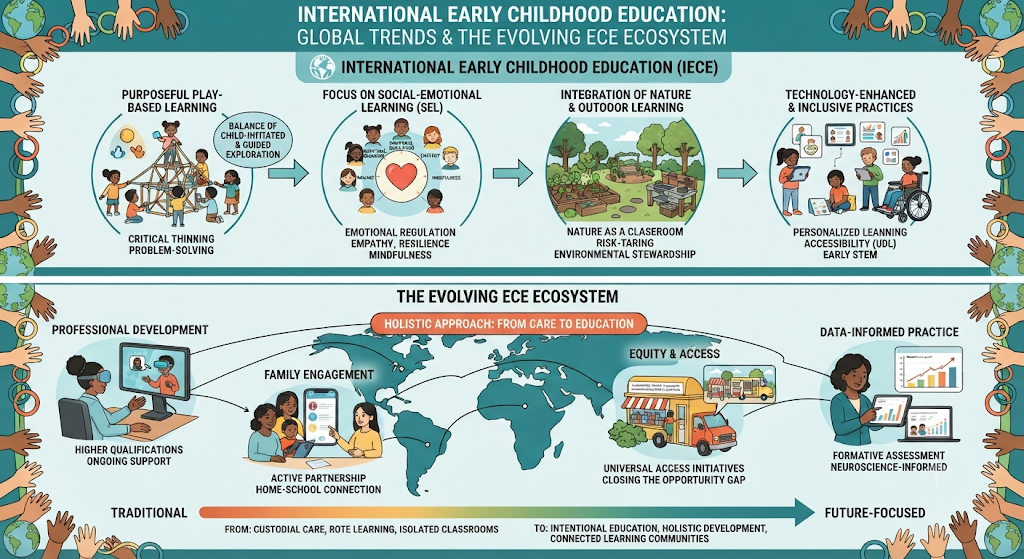
AI in early childhood education is no longer experimental. A 2025 review identifies three principal application areas: personalised learning and assessment, teacher support and administration, and AI-driven play and robotics . Adaptive learning platforms, computer-vision toys, and humanoid robots are moving from research labs into classrooms serving children aged 3–8 .
In India, the Vardhan Group launched Boost My Child (BMC) in July 2024 — an AI-driven platform designed to improve early childhood education for children aged 0–8, aligned to NEP 2020 and NCF guidelines .
Estonia’s Digital Competence Experiment
Estonia offers a live case study. A kindergarten in Paldiski evolved from a simple introduction to Beebots into a full integration of robotics into play-based learning within a few years, through patient, peer-led training . The country uses the DigCompEdu framework to assess educator digital competence .
But adoption is uneven. Approximately 30% of preschool and primary teachers in Estonia possess basic digital skills, and only 12% have advanced skills . The lesson is clear: technology without teacher capability does not improve quality.
Why this matters to you: AI will not replace teachers in the foundational years. It will support them — or expose the ones who are not supported. Evaluate any franchise on whether its “technology” is a genuine teaching aid or a marketing line.
Trend 4 — Play-Based Learning Is Being Defended Against Academic Pushdown
Finland’s Model: Delaying Formal Academics to Age 7
Finland is widely regarded as a global leader in early childhood education because of its strong emphasis on play-based pedagogy . The Finnish Playful Learning framework is credited with helping children develop confidence, collaborative skills, and a positive attitude toward learning . Formal academics are delayed until age seven, with the early years focused on transversal competencies — learning how to learn .
Japan takes a different but complementary approach. Its Hoikuen and Yochien systems prioritise social-emotional learning and “grit” — resilience, empathy, and collective responsibility . Recent Japanese research on the Second Step programme shows that classroom-based social-emotional learning can be effective in early childhood .
Social-Emotional Learning Moves to the Centre
Across countries, ECE educators place strong emphasis on children’s social and emotional development. TALIS Starting Strong found that many report helping children “express their feelings every day,” while practices such as daily reading vary widely .
This is a correction to the “school readiness” race. The evidence increasingly favours holistic development over early formal instruction — and parents in Tier-2 India are beginning to ask for it.
Why this matters to you: A franchise that promises “academics from age three” is selling a dying model. A franchise that can demonstrate play-based, social-emotional learning aligned to NEP 2020 is selling what the evidence supports.
Trend 5 — Policy Is Expanding, but Investment Is Lagging
SDG 4.2: Enrolment Up, Progress Slowing
Global pre-primary enrolment rose from 41% in 2003 to 54% in 2024, but most of that gain was banked before 2015. Growth since then has slowed by close to two-thirds . In sub-Saharan Africa, fewer than one in four children of pre-primary age are enrolled .
Fewer than half the world’s countries currently guarantee even one year of free pre-primary education . The policy commitment exists. The fiscal commitment does not.
India’s NEP 2020: Policy Legitimacy Without Delivery Capacity
India has moved faster on policy. NEP 2020 integrated three years of pre-school (Balvatika) into the 5+3+3+4 structure as part of the Foundational Stage . The National Curricular Framework for the Foundational Stage (NCF-FS), released in October 2022, provided the first integrated curriculum framework for ages 3–8 .
But implementation lags. The national average spend per child on ECE is approximately ₹8,300 (2020–21), against a recommended feasible cost of ₹32,531 for quality provision . India spends only 0.2% of GDP on ECED, compared with 0.5%–1.6% in innovation-leading countries .
| India ECE indicator | Figure | Source context |
|---|---|---|
| Per-child ECE spend (2020–21) | ₹8,300 | IIM Bangalore analysis |
| Recommended per-child cost for quality | ₹32,531 | Save the Children / CBGA |
| ECED spend as share of GDP | 0.2% | IIM Bangalore |
Why this matters to you: Policy legitimacy without delivery capacity is the franchise opportunity. Parents now expect structured early learning because NEP 2020 told them it matters. The state cannot meet that expectation alone.
What These Global Trends Mean for Indian Franchise Investors
The global trends converge on a single Indian reality: demand is rising, public supply is insufficient, and private franchise models are the primary expansion channel — especially in Tier-2 and Tier-3 cities.
India’s preschool market is growing at 10.50% CAGR, driven by franchise-led Tier-2 and Tier-3 expansion . Brands like EuroKids have expanded to over 2,200 centres across 500+ cities and towns, serving 300,000+ children . Kidzee operates 1,900+ centres, and Bachpan continues franchise growth in Tier-2 and Tier-3 cities .
But growth is not the same as quality. The Hindu’s 2025 investigation found that some franchisees were drawn by promises of ₹30–40 lakh annual income on ₹8–10 lakh setup costs, only to discover hidden royalties, mandatory purchases, and marketing contributions that eroded returns .
Why this matters to you: The global trends tell you where the market is going. They do not tell you which franchise will get you there profitably. That requires due diligence on unit economics, teacher training, and curriculum quality.
A Practical Checklist Before You Invest in an ECE Franchise in 2026
- ☐ Verify the total annual outflow. Add franchise fee + royalty + curriculum kit + training + marketing + mandatory purchases. Compare with projected fee income.
- ☐ Check NEP 2020 and NCF-FS alignment. The curriculum must be play-based and aligned to the Foundational Stage .
- ☐ Ask about continuous teacher training. One-time certification is not enough. Ask for the annual refresher schedule and trainer qualifications.
- ☐ Match fee ceiling to local paying capacity. In a Tier-3 city, model at ₹800–₹1,500 per child per month, not metro fees.
- ☐ Visit 3 existing franchisees. Ask for actual enrolment, actual royalty outflow, and actual payback period — not brochure figures .
- ☐ Know your break-even enrolment. Industry estimates cite a 30–36 student break-even for mid-market models. Know your number before you sign a lease.
- ☐ Evaluate the technology honestly. AI and digital tools should support teachers, not replace them. Ask what training comes with the platform.
The Bottom Line: Global Trends, Local Opportunity
The global ECE market is growing toward half a trillion dollars. Privatisation is expanding. Teacher shortages are deepening. AI is entering the classroom. Play-based learning is being defended. Policy commitments are outpacing investment.
For an Indian edupreneur, these trends are not abstractions. They are the demand signals behind every new preschool in Indore, Jaipur, Patna, and Coimbatore. The global shift toward quality, structured early learning is the same shift that makes a well-run franchise viable in a Tier-2 city.
The question is not whether the market will grow. It is whether the operator in your city will build a centre that meets the quality standard the world is moving toward — or another under-equipped playgroup that the next trend cycle will leave behind.
Next step: Explore verified ECE franchise opportunities on international-ece.com and compare investment bands, teacher-training support, and Tier-2/Tier-3 models before you commit capital.
Frequently Asked Questions (FAQ)
1. What is the biggest trend in global early childhood education in 2026?
The biggest trend is the convergence of market growth and privatisation with a deepening teacher shortage. The global ECE market is projected to reach $482 billion by 2030, but 6 million more educators are needed, and private providers now dominate in many countries .
2. How is AI changing early childhood education worldwide?
AI is entering preschools in three areas: personalised learning and assessment, teacher support and administration, and AI-driven play and robotics. Adoption is uneven — Estonia, for example, reports that only 12% of preschool teachers have advanced digital skills .
3. Why is there a global teacher shortage in early childhood education?
Low pay, high stress, limited career progression, and inadequate training are driving the shortage. The OECD’s TALIS Starting Strong 2024 survey found persistent staff shortages and high stress across 17 countries. Six million more pre-primary educators are needed in low- and lower-middle-income countries by 2030 .
4. Is play-based learning still the global standard?
Yes. Finland delays formal academics until age seven and prioritises play-based pedagogy. Japan emphasises social-emotional learning and “grit.” The global evidence increasingly favours holistic development over early formal instruction .
5. How does India’s NEP 2020 fit into global ECE trends?
NEP 2020 integrated three years of pre-school (Balvatika) into the Foundational Stage, aligning India with the global shift toward structured early learning. But implementation lags: India spends only 0.2% of GDP on ECED, against 0.5%–1.6% in innovation-leading countries .
6. Is a preschool franchise in Tier-2 India still a good business in 2026?
Yes, if the model matches local economics. India’s preschool market is growing at 10.50% CAGR, driven by Tier-2 and Tier-3 franchise expansion. But hidden royalties and mandatory purchases can erode returns, so due diligence on total costs is essential .
Strong CTA
Ready to build an ECE franchise that is aligned with where global early education is going?