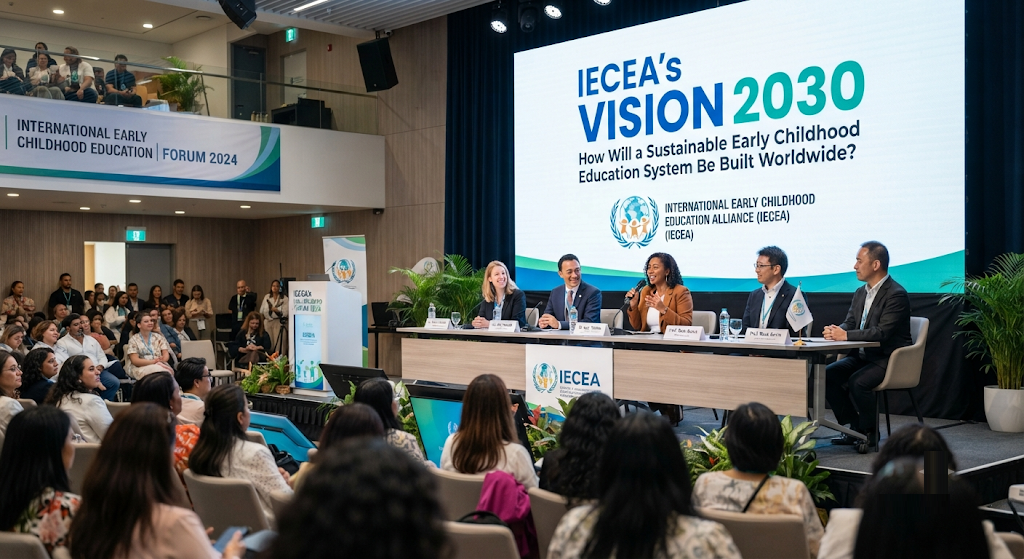
IECEA’s Vision 2030: How Will a Sustainable Early Childhood Education System Be Built Worldwide?
IECEA’s Vision 2030 aims to give every child access to standardised, high-quality early childhood education, regardless of race or location. A sustainable system requires three things: clear quality standards, a trained workforce, and a funding model that does not depend on charity.
For an Indian entrepreneur, that third requirement is the opening. Sustainability in ECE is not only a policy goal. It is a business discipline — and a market opportunity.
The Direct Answer: Sustainability Requires Standards, Teachers, and Funding — Not Just Enrolment
Most ECE systems measure success by enrolment. Sustainability requires more. A system is sustainable when it delivers quality consistently, trains and retains teachers, and pays for itself without perpetual emergency funding.
IECEA’s stated vision is “to enable all children in the world to enjoy a standardised, high-quality early childhood education, regardless of their races and locations” [reference:0]. Achieving that vision by 2030 depends less on new declarations and more on delivery infrastructure.
Why this matters to you: Every franchise you open is a delivery unit. It either strengthens the system’s sustainability or adds to the quality gap. The choice is operational, not ideological.
What IECEA’s Vision 2030 Actually Proposes
IECEA (International Early Childhood Education Association) is an international body formed by ECE experts, scholars, and entrepreneurs from the US, Canada, Europe, Australia, China, and other regions [reference:1]. Its work rests on four pillars: international exchange, research, promotion in developing countries, and an accreditation-and-training system [reference:2].
Standardisation Without Uniformity
The vision is not a single global curriculum. IECEA defines early childhood education as education for children aged 0–8, with particular focus on the 0–3 and pre-school years [reference:3]. Its standardisation agenda is about quality floors — minimum expectations for safety, pedagogy, and teacher competence — not about erasing local culture.
This distinction matters. A standardised franchise model that ignores local language, festivals, and food will fail in Patna or Indore. A model that adapts the quality floor without diluting it will scale.
Why this matters to you: When you evaluate a franchise, ask whether its “standardisation” is a rigid kit or a quality framework. The first limits you. The second protects you.
Accreditation and Teacher Training as the Backbone
IECEA has built an international training and accreditation system to improve the quality of educators [reference:4]. This is the least glamorous part of ECE reform — and the most decisive. A curriculum is only as good as the adult delivering it.
Why this matters to you: Teacher training is the single largest quality variable in any preschool. A franchise that trains your staff continuously is worth more than one that sells you imported toys.
The Global Picture: Why SDG 4.2 Is Off Track
The world already has a sustainability framework for ECE: SDG Target 4.2, which commits countries to ensuring all girls and boys have access to quality early childhood development, care, and pre-primary education by 2030 [reference:5][reference:6].
Progress is not on track. UNESCO’s 2024 assessment states plainly that achieving SDG 4.2 by 2030 “appears unlikely” [reference:7].
The $10 Trillion Cost of Inaction
UNESCO’s Price of Inaction report estimates that, by 2030, the annual social and private costs of failing to meet education targets will reach US$10 trillion [reference:8]. This is not a moral estimate. It is an economic one — lost productivity, higher social spending, and weaker growth.
Early learning enrolment declined globally from 75% in 2020 to 72% in 2022, with the sharpest drops among children from disadvantaged backgrounds [reference:9]. Thirty percent of children are not developmentally on track [reference:10].
Why this matters to you: The global gap is the long-term demand signal. As governments fall short, private and franchise providers fill the space — especially where parents have the ability to pay.
The 6 Million Teacher Shortage
To achieve SDG 4.2 by 2030, the world needs six million additional teachers, according to the 2024 Global Education Monitoring Report [reference:11]. The shortage is not only numerical. It is a training shortage. Many existing ECE educators have no formal early-childhood qualification.
| Global ECE indicator | Figure | Source context |
|---|---|---|
| Annual cost of failing SDG education targets by 2030 | US$10 trillion | UNESCO Price of Inaction [reference:12] |
| Global early learning enrolment (2022) | 72% (down from 75% in 2020) | UNESCO/UNICEF 2024 [reference:13] |
| Additional teachers needed by 2030 | 6 million | 2024 GEM Report [reference:14] |
India’s Role in a Sustainable Global ECE System
India has the largest cohort of young children in the world — roughly 160 million children aged 0–6 [reference:15]. No global ECE vision can succeed without India. And no sustainable Indian ECE system can be built by government alone.
The Policy Foundation: NEP 2020 and the Foundational Stage
NEP 2020 formally integrated preschool (ages 3–6) into the national curricular framework as the Foundational Stage [reference:16]. This gave structural legitimacy to early education. It also created a curriculum mandate: play-based, inquiry-driven, and aligned to the National Curricular Framework.
Policy is ahead of practice. A 2026 analysis of NEP implementation found persistent gaps: inadequate infrastructure, a shortage of trained educators, and coordination failures among stakeholders [reference:17].
Why this matters to you: NEP 2020 is a demand driver, not a guarantee. It tells parents that preschool is now “real school.” It does not guarantee that a quality preschool exists in their neighbourhood. That is the franchise gap.
The Implementation Gap: Teachers, Infrastructure, Regulation
India’s ECE delivery system faces three structural constraints.
- No statutory guarantee of free pre-primary education. Unlike primary education, ECE is not a constitutional right in India [reference:18]. This limits public accountability and funding stability.
- Chronic teacher vacancies and outdated pedagogy inside government schools [reference:19]. Even where infrastructure exists, the learning experience is uneven.
- Regulatory grey zones. Kerala’s crèche expansion, for example, operates without a binding framework for standards or safety, and oversight gaps pose risks to children [reference:20].
Why this matters to you: These gaps are not reasons to avoid the sector. They are reasons why organised, standardised, accountable providers are in demand. Parents are not waiting for the state to fix quality. They are paying for it.
The Business Model That Makes Sustainability Possible
A sustainable ECE system needs providers that can pay their teachers, maintain infrastructure, and survive a slow enrolment ramp. That requires a business model — not a grant cycle.
Franchise Investment Bands: ₹2 Lakh to ₹25 Lakh
The Indian preschool franchise market spans a wide investment band. Budget models advertise setup under ₹2 lakh [reference:21]. Mid-market franchises typically cost ₹12–20 lakh in one-time setup, plus ₹4–6 lakh in working capital [reference:22]. Premium brands can exceed ₹25 lakh.
But headline investment is misleading. A ₹2 lakh package usually covers the brand fee and a starter kit only. Rent, deposit, interiors, and working capital sit on top [reference:23]. Realistic all-in cash for a Tier-2 centre is closer to ₹18–24 lakh [reference:24].
| Cost component | Typical range (₹) | What it covers |
|---|---|---|
| Brand / franchise fee | 2–6 lakh | Brand rights, curriculum, launch support |
| Interiors and civil work | 4–8 lakh | Child-safe flooring, toilets, murals |
| Furniture and play equipment | 1.5–3 lakh | Child-sized furniture, outdoor play |
| Teaching material and kits | 0.5–1.5 lakh | Books, learning kits, classroom aids |
| Teacher training | 0.5–1.5 lakh | Initial certification, refreshers |
| Pre-launch marketing | 0.5–1.5 lakh | Local ads, open days, launch event |
| Licensing and registration | 0.5–1 lakh | Entity setup, trade licence, fire NOC |
| Rent security deposit | 2–6 lakh | 6–10 months’ rent, refundable |
| Working capital reserve | 4–6 lakh | Covers losses until enrolment catches up |
Source: Little Ville 2026 cost breakdown [reference:25]. Figures are planning ranges, not quotes.
Why this matters to you: Sustainability starts with honest unit economics. If your financial model assumes a ₹2 lakh all-in cost, you will run out of cash before enrolment stabilises.
Tier-2 and Tier-3 Cities: Where Sustainability Meets Demand
A parent in a Tier-3 city typically has a paying capacity of ₹800–₹1,500 per month [reference:26]. Premium franchises with high royalties and mandated interiors cannot sustain operations at that price point. This mismatch created a “value gap” that low-cost, NEP-compliant franchise models are filling [reference:27].
Demand is shifting. Parents in Indore, Jaipur, Patna, and Coimbatore are no longer settling for “just childcare.” They want the same rigour and brand trust that was once a metro-only expectation [reference:28].
Why this matters to you: The most sustainable ECE business in India is not a premium metro centre. It is a right-sized, fee-appropriate franchise in a Tier-2 city where the Anganwadi is overcrowded and the private school is full.
A Practical Checklist for Building a Sustainable ECE Centre
Use this checklist before committing capital to any ECE franchise or independent centre.
- ☐ Model the real all-in cost. Include rent deposit, interiors, working capital, and six months of operating losses — not just the franchise fee.
- ☐ Set fees to local paying capacity. In a Tier-3 city, model at ₹800–₹1,500 per child per month, not metro fees [reference:29].
- ☐ Verify teacher training is continuous. One-time certification is not enough. Ask for the annual refresher schedule and trainer qualifications.
- ☐ Check NEP 2020 and NCF alignment. The curriculum must be play-based, inquiry-driven, and aligned to the Foundational Stage [reference:30].
- ☐ Read the franchise agreement for hidden costs. Royalties, mandatory kits, branding upgrades, and marketing contributions can erode margins.
- ☐ Know your break-even enrolment. Industry estimates cite a 30–36 student break-even for mid-market models. Know the number before you sign a lease.
The Bottom Line: Sustainability Is a Business Discipline, Not a Slogan
IECEA’s Vision 2030 is achievable only if the delivery layer is financially sustainable. Standards without trained teachers are paper. Teachers without funding leave. Funding without accountability produces the quality gaps that India already has.
The global picture is urgent: SDG 4.2 is off track, the cost of inaction is measured in trillions, and six million additional teachers are needed [reference:31][reference:32]. India’s picture is specific: policy legitimacy without delivery capacity, and demand without adequate organised supply.
For an Indian entrepreneur, this is a rare alignment. The social return and the financial return run in the same direction. A sustainable ECE centre is not a charity. It is a business that pays its teachers, maintains its standards, and earns a margin — and in doing so, it does exactly what Vision 2030 requires.
Next step: Explore verified ECE franchise opportunities on international-ece.com and compare investment bands, teacher-training support, and Tier-2/Tier-3 models before you commit capital.
Frequently Asked Questions (FAQ)
1. What is IECEA’s Vision 2030?
IECEA’s vision is to enable all children worldwide to enjoy standardised, high-quality early childhood education, regardless of race or location. It pursues this through international exchange, research, promotion in developing countries, and an accreditation-and-training system for educators [reference:33].
2. What is SDG Target 4.2, and is it on track?
SDG Target 4.2 commits countries to ensure all girls and boys have access to quality early childhood development, care, and pre-primary education by 2030. UNESCO’s 2024 assessment states that achieving this target by 2030 “appears unlikely” [reference:34].
3. Why is there a global teacher shortage in early childhood education?
To achieve SDG 4.2 by 2030, six million additional teachers are needed globally, according to the 2024 Global Education Monitoring Report. The shortage is compounded by inadequate training, low pay, and unequal access to resources in many countries [reference:35].
4. How does NEP 2020 support sustainable ECE in India?
NEP 2020 integrated preschool (ages 3–6) into the national curricular framework as the Foundational Stage, mandating play-based, inquiry-driven learning. This gave structural legitimacy to ECE and created demand for NEP-compliant curriculum and teacher training [reference:36].
5. Is a preschool franchise a sustainable business in Tier-2 or Tier-3 India?
It can be, if fees match local paying capacity. Tier-3 parents typically pay ₹800–₹1,500 per month. Low-cost, royalty-light models can sustain operations at that price point, while premium models with high royalties and mandated interiors often cannot [reference:37].
6. How much capital is realistically needed to open a preschool franchise in India?
Headline figures range from ₹2 lakh to ₹25 lakh, but real all-in cash for a Tier-2 centre is closer to ₹18–24 lakh, including rent deposit and working capital. A ₹2 lakh package usually covers only the brand fee and starter kit [reference:38][reference:39].
Strong CTA
Ready to build an ECE centre that is sustainable, standards-aligned, and profitable?