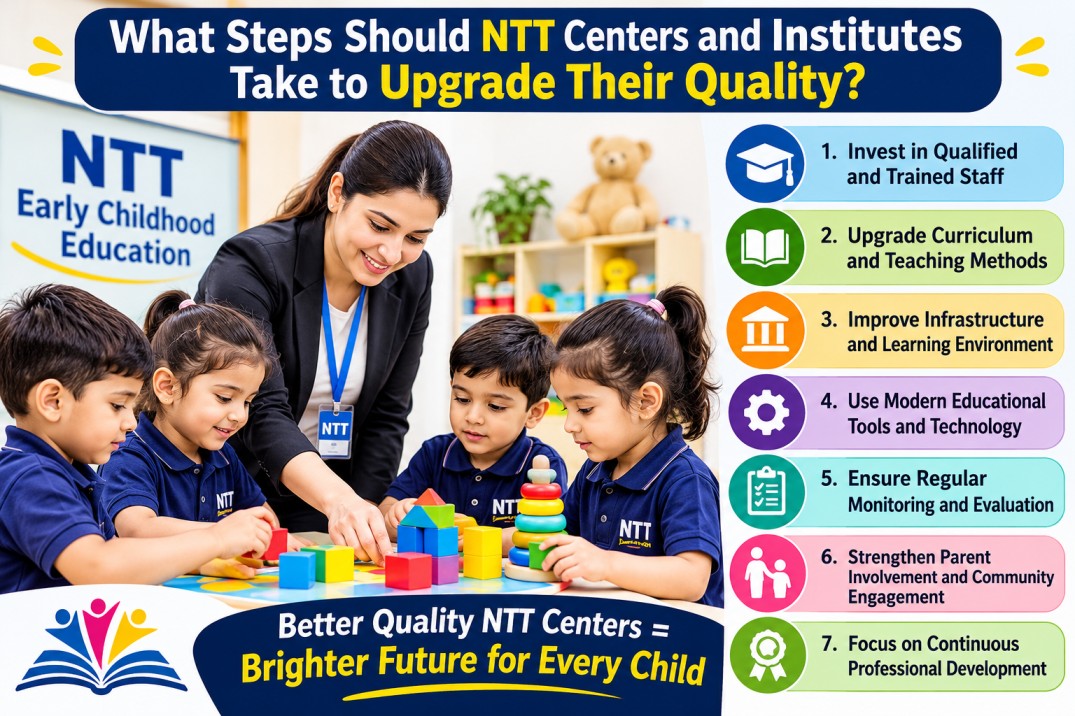
What Steps Should NTT Centers and Institutes Take to Upgrade Their Quality?
NTT centers and institutes should upgrade quality by fixing faculty training, aligning the curriculum with NEP 2020 and NCF-FS 2022, making practical classroom training compulsory, and running an independent quality audit. The first three changes—faculty, curriculum, and practical training—deliver the fastest visible improvement in student outcomes.
Most NTT centers in India are not failing because they lack students. They are failing because the quality of training has not kept up with what preschools now expect. Parents and school owners have become more selective. A certificate alone does not get a teacher hired anymore. Classroom readiness does.
Why NTT Quality Upgrade Cannot Wait in 2026
The early childhood education market in India is growing, but the supply of truly job-ready nursery teachers is still thin. Industry estimates suggest that quality NTT centers are “practically non-existent” in Tier-2 and Tier-3 cities and remain rare even in major metros[reference:0]. That gap is your opportunity—if you upgrade before others do.
At the same time, NEP 2020 has pushed early childhood education into the formal foundational stage. The National Curriculum Framework for Foundational Stage (NCF-FS) 2022 now sets clearer expectations for how young children should be taught[reference:1]. NTT centers that ignore this shift will produce teachers who look outdated in interviews.
Why this matters to you: If your NTT center still runs on 10-year-old notes and unpaid “practical exposure,” you are one admission cycle away from losing students to a better-positioned competitor.
9 Steps to Upgrade Your NTT Center Quality
Step 1: Fix Faculty Quality First
Faculty is the first thing a serious student checks—and the first thing a preschool owner questions when hiring your pass-outs. A quality NTT center needs trainers who have actually taught in early childhood classrooms, not only completed a B.Ed.
Start with a Training of Trainers (ToT) programme. Structured NTT partnership models in India now include a three-month ToT for faculty and coordinators as a standard quality feature[reference:2]. If a full ToT is not possible immediately, begin with monthly internal workshops on child development, classroom management, and activity-based learning.
Hire at least one senior faculty member with three or more years of direct preschool teaching experience. This single change improves student confidence faster than any new brochure.
Why this matters to you: Students judge your center by the faculty in the first week. Weak faculty triggers refund requests and bad word-of-mouth in local WhatsApp groups.
Step 2: Rewrite the Curriculum Around NEP 2020 and NCF-FS 2022
Your curriculum should reflect what preschools actually teach today—play-based learning, phonics, early numeracy, storytelling, and socio-emotional development. NCF-FS 2022 provides a ready reference for foundational-stage pedagogy[reference:3].
Audit your current syllabus module by module. Remove topics that have no classroom application. Add modules on inclusive education, health and safety, parent communication, and activity-based lesson planning. These are the areas preschool employers now ask about in interviews[reference:4].
If rewriting the entire curriculum feels heavy, adopt a structured NTT programme with ready modules and lesson plans. Several partnership models now provide 12 comprehensive modules with 12 hours of structured teaching plans for each module[reference:5].
Why this matters to you: An outdated curriculum is the silent reason students leave after one month. They compare notes with friends in other centers and realise they are not learning what matters.
Step 3: Make Practical Training Non-Negotiable
Theory without classroom practice produces teachers who freeze on day one. Most strong NTT programmes now include a compulsory internship or supervised practical training component, including classroom observation, assisting lead teachers, and conducting circle time and storytelling sessions[reference:6].
Set a minimum practical requirement: at least 60 hours of supervised classroom exposure before certification. Partner with 5–10 local preschools in your city—Mumbai, Indore, Patna, Jaipur, or any Tier-2 city—and rotate trainees through real classrooms.
Do not accept “observation only.” Trainees should plan and deliver at least three activity sessions under supervision. This is the difference between a certificate holder and a hireable teacher.
Why this matters to you: Preschool principals call your center to ask, “Can your student handle a class alone?” If the answer is no, your placement reputation drops quietly.
Step 4: Upgrade Infrastructure for Real Classroom Practice
An NTT center does not need marble floors. It needs a practice room that looks and feels like a preschool classroom. At minimum, create one activity room with child-sized furniture, storybooks, manipulatives, art materials, and a display wall for trainee-made teaching aids.
NCTE norms for teacher education institutions emphasize regular maintenance of furniture, equipment, and accessible facilities[reference:7]. Even if your NTT is not NCTE-recognised, the same logic applies: trainees learn best in a space that mirrors the classroom they will enter.
If space is limited, use one room for both theory and practice. A 300-square-foot room can work as a starter practice space for small batches[reference:8].
Why this matters to you: Parents who visit your center judge the practice room. A clean, child-friendly space signals competence before they read your syllabus.
Step 5: Build a Student Assessment System That Measures Teaching Ability
Most NTT centers still assess students through written exams only. That is a weak signal of classroom readiness. Add practical assessments: lesson plan demonstrations, activity facilitation, storytelling, and classroom management simulations.
Use a simple rubric with four criteria: planning, delivery, child engagement, and classroom control. Assess each trainee at least twice during the course, once in a peer-teaching setting and once in a real preschool classroom.
Share the rubric with students in advance. Transparent assessment reduces complaints and signals that your center takes quality seriously.
Why this matters to you: When a preschool asks for your student’s performance record, a practical assessment sheet is more persuasive than a mark sheet.
Step 6: Add Student Support and Career Guidance
New business starters and career-returning women need more than lectures. They need help with interview preparation, resume building, and understanding preschool job expectations.
Run a short career-readiness module in the final month. Cover topics like demo class preparation, parent communication, salary negotiation, and how to handle a multi-age classroom. Provide a simple portfolio template where trainees collect lesson plans, activity photos, and teaching aids.
If you cannot hire a dedicated placement officer, assign one faculty member to maintain preschool partnerships and share job leads.
Why this matters to you: Placement support is one of the top reasons students choose an NTT center. Even informal, honest placement help improves admissions through referrals.
Step 7: Use Technology Without Overcomplicating It
You do not need a full learning management system. Start with a WhatsApp group for each batch, a shared Google Drive folder for notes, and a simple attendance tracker. Record short video lectures for revision so students can revisit difficult topics.
More importantly, train your students to use basic digital teaching tools—smart-board basics, educational video clips, and simple activity apps. Preschools in metros and Tier-2 cities are increasingly using these tools, and teachers who can handle them have an edge[reference:9].
Why this matters to you: Technology adoption makes your center look current without requiring a large investment. Students talk about it in their networks.
Step 8: Run a Third-Party Quality Audit
Self-assessment is useful, but an external audit carries credibility. A structured quality audit reviews faculty qualifications, curriculum design, practical training hours, infrastructure, student assessment, and placement support.
Quality assurance frameworks for early childhood training now focus on measurable parameters rather than self-declared claims[reference:10]. An audit gives you a written gap report and a benchmark to show prospective students and partner preschools.
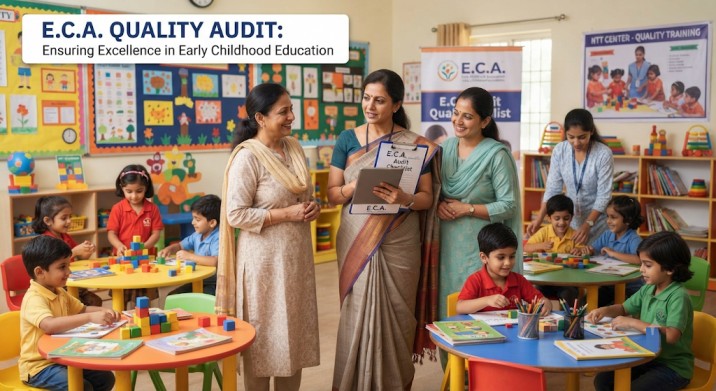
International Early Childhood Education (ECE) offers E.C.A Quality Audits for NTT Centers as part of its programme portfolio. An external audit can be completed in a few weeks and gives your improvement plan a defensible starting point.
Why this matters to you: A third-party audit certificate on your website and brochure is a trust signal that most local competitors do not have.
Step 9: Track Placement Outcomes and Publish Them
Measure what happens to your students after they finish. Track how many are placed within three months, in which type of preschool, and at what starting salary. NTT teacher salaries in India typically range from ₹15,000 to ₹28,000 per month depending on city and school type[reference:11].
Publish honest placement numbers on your website and social media. Do not inflate. Even a modest but verified number—such as “14 of 18 students placed within 60 days”—builds more trust than a vague “100% placement” claim.
Why this matters to you: Placement outcomes are the single strongest marketing asset an NTT center can build. They compound over time.
Quality Upgrade Investment: What It Actually Costs
Quality upgrade does not require a ₹10 lakh renovation. Most centers can make meaningful changes within ₹50,000–₹2,00,000, depending on what is already in place. Below is an estimated budget range for a small-to-mid NTT center (20–60 students).
| Quality Upgrade Area | Estimated Cost (₹) | Priority |
|---|---|---|
| Faculty ToT / internal workshops | ₹15,000 – ₹40,000 | High |
| Curriculum revision or structured module adoption | ₹10,000 – ₹30,000 | High |
| Practice room setup (furniture, materials, display) | ₹25,000 – ₹70,000 | Medium–High |
| Practical training partnerships and supervision | ₹5,000 – ₹15,000 (coordination cost) | High |
| Student assessment rubrics and printing | ₹3,000 – ₹8,000 | Medium |
| Third-party quality audit | ₹10,000 – ₹25,000 (estimated) | Medium |
| Placement tracking and portfolio support | ₹5,000 – ₹12,000 | Medium |
| Total indicative range | ₹73,000 – ₹2,00,000 | — |
Note: Figures are industry estimates based on publicly available NTT course fees, partnership models, and training costs in India as of 2026. Actual costs vary by city and scope.
Why this matters to you: A focused ₹75,000 upgrade in faculty and practical training can improve placements more than a ₹5 lakh interior renovation.
Before vs After: What a Quality Upgrade Changes
Quality upgrade is not an abstract idea. It changes what students experience, what preschools see, and what your center can charge. The table below compares a typical under-invested NTT center with one that has completed the nine-step upgrade.
| Quality Parameter | Before Upgrade (Typical) | After Upgrade |
|---|---|---|
| Faculty | Trainers with theory knowledge only | At least one trainer with 3+ years preschool experience; ongoing ToT |
| Curriculum | Outdated notes, little NEP alignment | NCF-FS 2022 aligned, activity-based, inclusive education included |
| Practical training | Observation only, no supervised teaching | 60+ hours supervised classroom practice with lesson delivery |
| Assessment | Written exams only | Practical rubrics for planning, delivery, engagement, control |
| Student support | No career guidance | Interview prep, portfolio, and placement tracking |
| Trust signal | Self-declared quality claims | Third-party quality audit report available |
| Fee positioning | ₹15,000–₹25,000 (price-driven) | ₹30,000–₹60,000 (value-driven, with placement evidence) |
Why this matters to you: The fee gap between a low-quality and a high-quality NTT center in the same city is often ₹15,000–₹35,000 per student. Quality upgrade pays for itself within one or two admission cycles.
NTT Center Quality Upgrade Checklist
Use this checklist to track your progress. Tick each item only when you have written evidence, not just an intention.
- ☐ At least one faculty member has 3+ years of direct preschool teaching experience
- ☐ Faculty ToT or monthly internal workshops scheduled for the next 6 months
- ☐ Syllabus reviewed against NCF-FS 2022 and updated
- ☐ Modules on inclusive education, health and safety, and parent communication added
- ☐ Written practical training policy with minimum 60 supervised hours
- ☐ Partnerships with at least 3 local preschools for trainee placement
- ☐ Practice room with child-sized furniture and activity materials
- ☐ Practical assessment rubric shared with students
- ☐ Career-readiness module included in the final month
- ☐ Placement tracking sheet maintained for every batch
- ☐ Third-party quality audit completed or scheduled
- ☐ Audit report summary displayed on website or brochure
Common Mistakes That Keep NTT Centers Stuck
Mistake 1: Spending on marketing before fixing faculty and practical training. A glossy brochure cannot fix a weak classroom experience.
Mistake 2: Treating placement as a promise instead of a process. Placement requires preschool partnerships, interview preparation, and tracking—not a line on a poster.
Mistake 3: Copying another center’s syllabus without checking whether it matches NEP 2020 expectations. A borrowed syllabus with no faculty training produces the same poor outcomes.
Mistake 4: Avoiding external audit because “we already know our gaps.” Self-assessment is useful, but external validation changes how students and preschools perceive your center.
Why this matters to you: Most NTT centers in Tier-2 and Tier-3 cities are stuck in at least one of these four mistakes. Fixing one mistake can separate you from the local competition within a single batch.
Build a Quality-First NTT Center Before the Next Admission Cycle
The NTT centers that will dominate admissions in 2026 and beyond are not the ones with the biggest buildings. They are the ones with trained faculty, real classroom practice, transparent assessment, and verified placement outcomes.
Start with the checklist above. Fix faculty and practical training first. Then schedule a quality audit to benchmark your progress.
If you run an NTT center and want an independent quality review, explore the E.C.A Quality Audit for NTT Centers or join the International Early Childhood Education association to access training, audit, and membership support.
Take the first step: Download the checklist, mark your gaps, and schedule your faculty workshop this month. Quality upgrade is a sequence of small, verifiable actions—not a one-time purchase.