E.C.A Quality Audits in Hospitals: How to Improve Healthcare Services for Children?
An E.C.A quality audit for hospitals reviews six crucial areas—child-friendly infrastructure, pediatric clinical safety, staff competency, infection control, parent engagement, and child rights—to improve healthcare services for children. These audits complement NABH and MusQan standards by focusing specifically on the child’s experience, safety, and developmental needs inside a hospital.
Children are not small adults. A hospital ward designed for adults can be frightening, unsafe, and clinically inappropriate for a child. Yet many Indian hospitals treat pediatric services as a subset of general medicine, with little attention to child-specific standards.
Why Children Need a Different Standard of Hospital Care
The gap between adult care and pediatric care
A child’s anatomy, communication ability, emotional needs, and safety risks are fundamentally different from an adult’s. A pediatric ward needs smaller beds, lower washbasins, child-height toilets, play areas, breastfeeding corners, and staff trained to handle children who cannot articulate pain or fear.
NABH’s pediatric standards explicitly require provisions for special care of children, including a child-friendly environment, play rooms, and breastfeeding rooms[reference:0]. These are not cosmetic additions. They are core clinical and safety requirements.
What Indian data tells us about child healthcare quality
A 2025 review in Preventive Medicine: Research & Reviews found that optimal child healthcare in urban India remains challenging due to fragmented public systems, limited planning capacity, and unequal access to quality care[reference:1]. India’s urban population includes 120 million children below age 18, and 36.5 million below age six[reference:2].
The MusQan initiative, launched by the Government of India, was designed specifically to improve quality of care for children up to 12 years in public health facilities. It acknowledges that child-friendly services require distinct standards, not generic hospital quality frameworks[reference:3].
Why this matters to you: If your hospital runs a pediatric ward, NICU, or pediatric OPD, generic hospital quality is not enough. Parents judge you on how your hospital feels and functions for their child.
What Is an E.C.A Quality Audit for Hospitals?
How it differs from NABH and MusQan
NABH provides the national accreditation framework for hospitals, with specific standards for pediatric services (COP.13 and related measurable elements)[reference:4]. MusQan is a government-led quality improvement program for public health facilities serving children up to 12 years[reference:5].
An E.C.A quality audit complements both. It applies the Early Childhood Association’s quality lens—developed for early childhood centres—to the hospital environment where young children receive care. The focus is on the child’s developmental, emotional, and safety experience, not just clinical compliance.
Where NABH asks “Is the pediatric ward compliant?” an E.C.A-style audit asks “Would a three-year-old feel safe, engaged, and protected here?”
Who conducts the audit
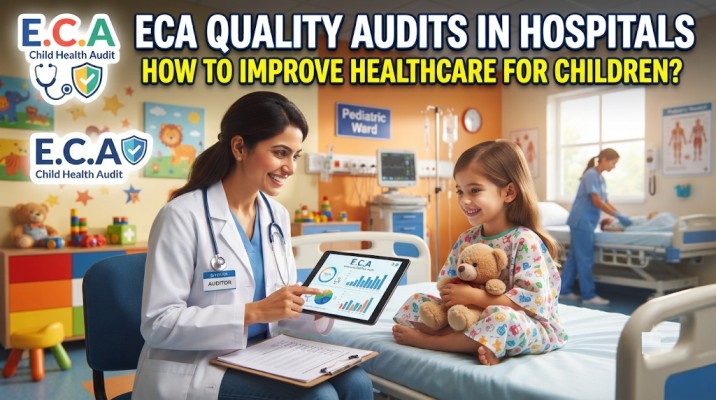
IECEA conducts E.C.A Quality Audits for NTT centres, schools, and hospitals. The audit reviews the physical environment, staff practices, child safety protocols, and parent communication systems. It produces a written gap report and a benchmark that hospital management can use for improvement.
Why this matters to you: A child-focused audit gives your hospital a language to talk about pediatric quality that goes beyond tick-box compliance. It speaks to what parents actually experience.
6 Crucial Areas an E.C.A Quality Audit Reviews in Hospitals
The table below gives an overview of the six audit areas, followed by detailed explanations.
| Audit Area | Core Focus | Key Compliance Point |
|---|---|---|
| 1. Child-Friendly Infrastructure | Physical environment and amenities | Play area, child-height toilets, breastfeeding room, colourful walls |
| 2. Pediatric Clinical Safety | Protocols and emergency readiness | Pediatric-specific protocols, emergency equipment, medication safety |
| 3. Staff Competency | Training and child handling | Pediatric BLS training, child communication skills, abuse recognition |
| 4. Infection Control | Hygiene and waste management | Hand hygiene compliance, isolation protocols, biomedical waste handling |
| 5. Parent Engagement | Communication and involvement | Parent accommodation, breastfeeding support, discharge counselling |
| 6. Child Rights | Protection and dignity | Abuse prevention protocols, consent, privacy, non-discrimination |
Area 1: Child-Friendly Infrastructure and Environment
A child-friendly hospital environment is not about expensive interiors. It is about whether a child can move, play, and feel safe. NABH standards require play rooms, breastfeeding rooms, and child-friendly amenities[reference:6].
MusQan assessment tools check for cartoon or animal paintings on walls, a child play zone with safe toys, child-height washbasins with lever-operated taps, and low WC seats in pediatric toilets[reference:7][reference:8]. These details matter because they reduce fear and improve cooperation during examinations.
An auditor will also check whether pediatric wards have cots large enough for a mother to stay with her child, a demarcated breastfeeding corner with privacy curtains, and wheelchair or ramp access for children with disabilities[reference:9].
Why this matters to you: Parents notice these details immediately. A child who feels safe in your ward is a child whose parents trust your hospital.
Area 2: Pediatric Clinical Protocols and Safety
Children require different medication doses, different emergency responses, and different monitoring than adults. NABH’s pediatric standard requires documented policies for pediatric services, including scope of care, neonatal policies aligned with WHO guidelines, and prevention of child abduction and abuse[reference:10].
An audit will review whether pediatric emergency equipment is age-appropriate, whether weight-based medication protocols are in place, and whether staff can respond to a deteriorating child within the required time frame. MusQan’s rapid improvement cycles specifically target timely initiation of emergency treatment for sick newborns and children[reference:11].
Why this matters to you: Pediatric clinical errors are rarely due to lack of knowledge. They are usually due to missing protocols and equipment that do not fit a child’s size or condition.
Area 3: Staff Training and Child Handling Competency
Handling a frightened child requires skills that are not taught in general nursing or medical training. Staff must know how to communicate at a child’s developmental level, recognise signs of distress, and respond without causing additional trauma.
An auditor will check training records for pediatric basic life support, child abuse recognition, and age-appropriate communication. MusQan’s implementation challenges include ensuring comprehensive training for healthcare workers as a core requirement[reference:12].
For hospitals in Tier-2 cities like Indore, Patna, or Jaipur, structured pediatric training is often the biggest gap. Audit findings here are actionable: schedule training, document attendance, and reassess.
Why this matters to you: A well-trained pediatric team reduces complications, shortens hospital stays, and improves parent satisfaction scores.
Area 4: Infection Control and Hygiene in Pediatric Wards
Children, especially newborns and toddlers, are more vulnerable to hospital-acquired infections than adults. MusQan’s rapid improvement cycles include specific targets for infection prevention practices and reduction in hospital-acquired infections[reference:13].
An auditor will review hand hygiene compliance, isolation protocols for infectious pediatric cases, sterilization practices for neonatal equipment, and biomedical waste segregation in pediatric areas. The CAG’s performance audit of district hospitals in Tripura assessed infection control and bio-medical waste management as core quality domains[reference:14].
Why this matters to you: A single neonatal infection outbreak can damage a hospital’s reputation permanently. Infection control in pediatric wards is non-negotiable.
Area 5: Parent and Attendant Engagement
In pediatric care, the parent is part of the care team. NABH standards require cots large enough for a mother to stay with her child throughout treatment[reference:15]. MusQan explicitly targets respectful care and improving engagement of mothers and attendants in newborn care[reference:16].
An auditor will check whether parents receive clear discharge instructions, whether breastfeeding support is available, and whether there is a system for capturing parent feedback. Patient satisfaction is a scored component of MusQan certification, with an 80% threshold required for national certification[reference:17].
Why this matters to you: Parent satisfaction scores are now part of government certification. Hospitals that engage parents well score higher and earn incentives.
Area 6: Child Rights and Abuse Prevention
NABH requires documented policies to prevent child abduction and abuse, with adequate security and surveillance such as CCTV cameras, and a defined rapid response process[reference:18]. An auditor will verify that these protocols exist, that staff know how to report concerns, and that the physical environment supports child protection.
Non-discrimination is also assessed. MusQan tools check that care to a child is not denied or deferred due to religion, caste, ethnicity, language, paying capacity, or disease condition[reference:19].
Why this matters to you: Child rights compliance is a legal and ethical obligation. It is also a growing area of parent awareness and media scrutiny.
How E.C.A Quality Audit Compares to NABH and MusQan
NABH is the national accreditation standard. MusQan is the government’s quality improvement program for public facilities serving children. An E.C.A quality audit is not a replacement for either—it is a complementary child-experience lens.
| Parameter | NABH | MusQan | E.C.A Quality Audit (Hospital) |
|---|---|---|---|
| Primary focus | Hospital-wide accreditation | Public facility child health quality | Child’s experience, safety, and development |
| Scope | All departments and services | Pediatric OPD, ward, SNCU, NRC | Pediatric spaces and child-facing services |
| Audit method | Document review + physical inspection | NQAS protocols + rapid improvement cycles | Observation + staff interview + parent feedback |
| Best for | Hospitals seeking national accreditation | Public facilities targeting government certification | Hospitals wanting a child-specific gap report |
| Certification | NABH accreditation | National certification with incentives | Audit report + quality approval (IECEA) |
Why this matters to you: The three frameworks answer different questions. NABH asks “Is this a good hospital?” MusQan asks “Is this a good public child health facility?” An E.C.A audit asks “Is this a good place for a child to receive care?”
Cost of a Hospital Quality Audit for Pediatric Services in India
A focused pediatric quality audit is not a major capital expense compared with the cost of a preventable incident or a failed certification. For a small-to-mid hospital (50–200 beds), an external child-focused audit typically falls in the range below. These are industry estimates based on quality audit pricing in India as of 2026.
| Audit Component | Estimated Cost (₹) | Frequency |
|---|---|---|
| Pediatric infrastructure and environment review | ₹10,000 – ₹25,000 | Annual |
| Clinical protocol and safety audit | ₹8,000 – ₹20,000 | Annual |
| Staff competency and training assessment | ₹5,000 – ₹15,000 | Annual |
| Infection control review (pediatric areas) | ₹5,000 – ₹12,000 | Annual |
| Comprehensive E.C.A-style child-focused audit | ₹30,000 – ₹75,000 | Annual or biennial |
Why this matters to you: The cost of a focused audit is a fraction of the cost of a single neonatal infection cluster or a parent complaint that reaches social media.
Hospital Pediatric Quality Checklist: What Auditors Actually Check
Use this checklist to self-assess before an external audit. Tick each item only when you have documentary or physical evidence.
- ☐ Pediatric ward has a designated play area with safe, age-appropriate toys
- ☐ Breastfeeding corner with privacy curtains and seating
- ☐ Child-height washbasins with lever-operated taps and low WC seats
- ☐ Cots large enough for a mother to stay with her child
- ☐ Wheelchair or ramp access for children with disabilities
- ☐ Child-friendly wall paintings or decor in pediatric OPD and ward
- ☐ Documented pediatric clinical protocols displayed and accessible
- ☐ Age-appropriate emergency equipment and weight-based medication charts
- ☐ Pediatric BLS training records for all pediatric ward staff
- ☐ Hand hygiene stations and compliance monitoring in pediatric areas
- ☐ Isolation protocols for infectious pediatric cases
- ☐ Parent discharge counselling documented
- ☐ Parent satisfaction feedback system in place
- ☐ Child abduction prevention protocol and CCTV surveillance
- ☐ Staff trained to recognise and report child abuse
- ☐ Non-discrimination policy displayed and practised
How to Prepare Your Hospital for a Child-Focused Quality Audit
Step 1: Conduct an internal walkthrough of your pediatric OPD, ward, and NICU using the checklist above. Photograph every gap and assign responsibility.
Step 2: Collect existing documents—pediatric protocols, staff training records, infection control logs, and parent feedback forms—in one indexed file.
Step 3: Verify that your pediatric environment meets NABH and MusQan infrastructure basics: play area, breastfeeding corner, child-height fixtures, and mother’s accommodation.
Step 4: Schedule pediatric BLS and child abuse recognition training for all staff who interact with children. Document attendance.
Step 5: Review parent communication. Ensure discharge summaries include follow-up instructions, diet, emergency contact numbers, and community care linkages[reference:20].
Why this matters to you: Auditors do not fail hospitals for having gaps. They fail hospitals for having undocumented gaps. A simple file and a scheduled training calendar turn most non-compliance into compliance.
Build a Child-First Hospital Before the Next Audit Cycle
Children cannot advocate for themselves in a hospital. The quality of their care depends on the systems adults build around them. An E.C.A quality audit gives your hospital a structured way to assess those systems—not just whether they exist, but whether they work for a child.
If you run a hospital with pediatric services and want a child-focused quality review, explore the E.C.A Quality Audit for Hospitals offered by International Early Childhood Education. You can also see how similar audits work for NTT centres and schools in India.
Take the first step: Download the checklist, schedule an internal pediatric walkthrough this month, and start building your child-friendly quality file. A hospital that is good for children is a better hospital for everyone.