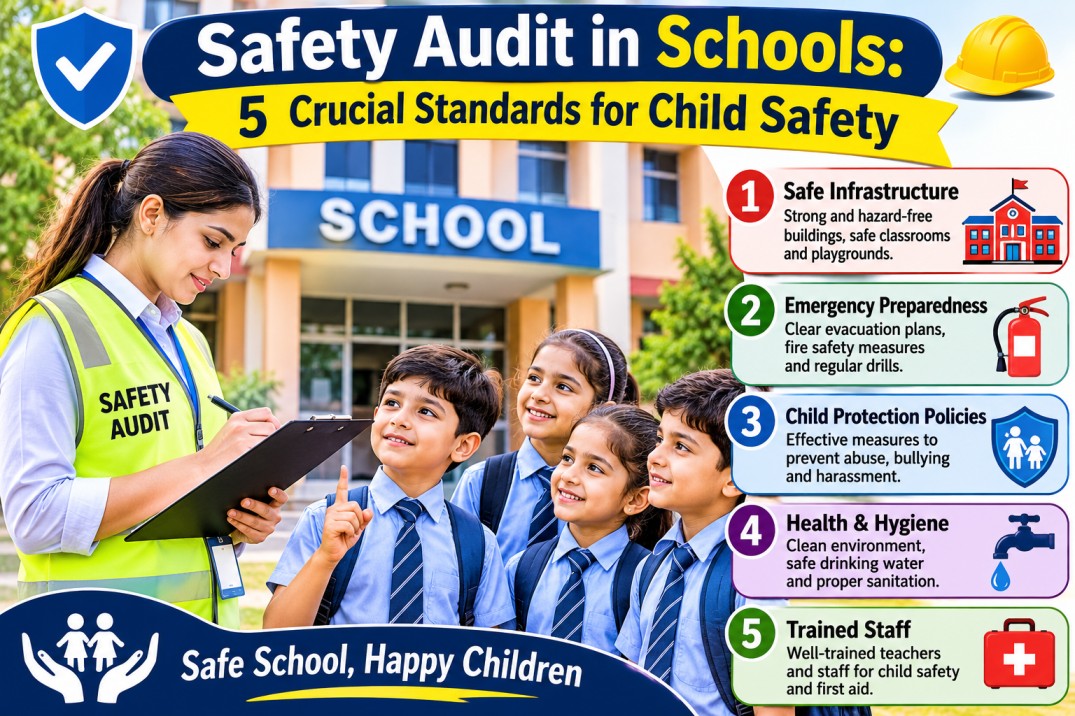
Safety Audit in Schools: 5 Crucial Standards for Child Safety
A safety audit in schools is a structured assessment of five crucial standards: structural safety, fire and electrical safety, POCSO compliance, emergency preparedness, and health and transport safety. The Ministry of Education directed all States and Union Territories on 26 July 2025 to conduct mandatory safety audits of schools and child-related facilities as per national safety codes.
The directive came after a government school building collapsed in Rajasthan’s Jhalawar district on 25 July 2025, killing seven children. The message to school administrators is clear: safety is no longer a “nice to have” line in the brochure. It is a legal and moral obligation.
Why School Safety Audits Are Now Mandatory in India
The Ministry of Education’s 7 August 2025 directive specifically required States and UTs to identify unsafe and dilapidated school buildings through safety audits, followed by demolition or repair, and a prohibition on use until certified safe[reference:0]. The Central Board of Secondary Education (CBSE) has also amended affiliation bye-laws to mandate CCTV cameras with real-time audio-visual recording at all entry and exit points, corridors, and classrooms[reference:1].
State-level enforcement is tightening too. Uttar Pradesh has launched a safety audit and risk assessment drive covering approximately 1.4 lakh government and aided schools, with priority given to buildings older than 30 years and schools in flood-prone or high-seismic-risk zones[reference:2]. Delhi has ordered schools to form child protection committees, preserve CCTV footage for 30 days after any incident, and conduct periodic safety audits[reference:3].
Why this matters to you: If you run a school in Mumbai, Indore, Patna, or Jaipur, a single safety incident can trigger regulatory action, reputational damage, and parent protests. A structured audit is your first line of defence.
5 Crucial Standards for Child Safety in Schools
Every safety audit in schools boils down to five standards. Each standard has specific compliance points that auditors assess. The table below gives an overview, followed by detailed explanations.
| Standard | Core Focus | Key Compliance Point |
|---|---|---|
| 1. Structural Safety | Building integrity and age | Structural fitness certificate; no dilapidated portions in use |
| 2. Fire & Electrical Safety | Fire NOC, wiring, extinguishers | Valid Fire NOC; no uncovered live wires; marked evacuation routes |
| 3. POCSO Compliance | Child protection and staff verification | Police verification; child protection committee; POCSO training |
| 4. Emergency Preparedness | Drills, plans, and response systems | Evacuation drills; first-aid training; 24-hour incident reporting |
| 5. Health & Transport Safety | Hygiene, water, and school bus safety | Safe drinking water; bus GPS; female attendant on buses |
Standard 1: Structural Safety and Building Integrity
Structural safety is the most basic standard—and the one with the most visible consequences when it fails. An estimated 22% of school buildings across 12 states are dilapidated, and 31% show visible structural cracks[reference:4].
An auditor will check whether your school has a valid structural fitness certificate, whether any portion of the building is unsafe or dilapidated, and whether older buildings (typically 30+ years) have been assessed by a structural engineer. The Ministry of Education has directed that structurally unsafe structures must be demolished or repaired, and cannot be used until certified safe[reference:5].
Why this matters to you: In Rajasthan alone, 32% of schools lack electricity, and 9% lack access to drinking water[reference:6]. If your building has visible cracks or water damage, a safety audit will flag it before a parent or regulator does.
Standard 2: Fire Safety and Electrical Safety
Fire and electrical safety are the traditional pillars of a school safety audit, and they remain non-negotiable. CBSE affiliation bye-laws require schools to follow the National Building Code 2005 and obtain fire safety compliance from local authorities[reference:7].
An auditor will verify your Fire NOC, check the condition of electrical wiring, look for uncovered live wires, and confirm that fire extinguishers are serviced and accessible. UP’s statewide audit explicitly covers fire and electrical safety, emergency preparedness, and marked evacuation routes[reference:8]. Schools must also display warning signs near electrical installations and restrict access to electrical areas[reference:9].
Why this matters to you: A missing Fire NOC is one of the easiest grounds for a school’s affiliation to be questioned. Fix it before the audit, not after.
Standard 3: POCSO Compliance and Child Protection Mechanisms
POCSO compliance has become the most scrutinised area of school safety in 2025 and 2026. The Protection of Children from Sexual Offences (POCSO) Act, 2012 obligates schools to protect children and report concerns promptly to authorities[reference:10].
A compliant school must have background verification for all teaching and non-teaching staff, contractual workers, and support employees. Employees must submit affidavits declaring no history of crimes against children or violent offences[reference:11]. Schools must form a Child Protection Committee headed by the principal, with a nodal teacher, parent representatives, counsellors, and a student representative. This committee must meet quarterly to review complaints and monitor protection measures[reference:12].
In Chengalpattu district, Tamil Nadu, schools have been directed to designate a School Child Protection Officer and a Lead Child Protection In-Charge, with staff training every four months on the POCSO Act and the Juvenile Justice Act[reference:13]. Confidential complaint boxes, child helpline number 1098, and the NCPCR POCSO e-Box must be displayed prominently[reference:14].
Why this matters to you: Failure to report a suspected offence can invite legal action, including imprisonment of up to one year for school heads under Delhi’s 2026 directive[reference:15]. POCSO compliance is not optional paperwork; it is personal legal risk.
Standard 4: Emergency Preparedness and Response Systems
An emergency plan that exists only on paper is not a safety standard. Auditors look for evidence of practice: evacuation drills, first-aid training, and a clear incident-reporting protocol.
The Ministry of Education’s 2025 directive requires training for staff and students in emergency preparedness, including evacuation drills, first aid, and safety protocols. It also mandates that any dangerous situation, near miss, or incident involving potential harm to children must be reported within 24 hours to the designated state or UT authority[reference:16].
An auditor will check whether your school has a written disaster management plan, marked evacuation routes, a trauma management team, and records of mock drills conducted with local fire services or civil defence authorities.
Why this matters to you: Schools that conduct drills regularly respond better in real emergencies—and auditors can ask for drill logs. If you cannot produce them, the standard is marked as non-compliant.
Standard 5: Health, Hygiene, and Transport Safety
The fifth standard covers the daily environment children experience: clean water, hygienic toilets, safe food, and secure transport.
Auditors check access to safe drinking water, separate toilets for boys and girls, and a sick room free from other activities[reference:17][reference:18]. Transport safety is equally critical. In Delhi, school buses must be painted yellow, fitted with GPS devices and two fire extinguishers, and display driver and emergency contact details. Drivers must have valid commercial licences, at least five years of experience, and no criminal record. Female attendants must remain on buses until the last child is dropped off[reference:19].
Maharashtra’s 2026 school bus rules go further, requiring a Vehicle Location Tracking Device with panic button, fire detection and alarm system, seat belts for every seat, and CCTV with 30-day footage retention[reference:20].
Why this matters to you: Transport is often the first point of contact between school and parent. A bus without GPS or a verified driver is a safety gap that auditors will catch and parents will notice.
School Safety Audit Checklist: What Auditors Actually Check
Use this checklist to self-assess before an external audit. Tick each item only when you have documentary evidence.
- ☐ Valid structural fitness certificate for all buildings in use
- ☐ No dilapidated or unsafe portion of the building occupied by students
- ☐ Valid Fire NOC from local fire authority
- ☐ No uncovered live wires; electrical areas restricted and marked
- ☐ Fire extinguishers serviced and accessible on every floor
- ☐ Police verification and affidavits for all staff, including contractual workers
- ☐ Child Protection Committee formed and meeting quarterly
- ☐ POCSO training conducted for teachers and staff
- ☐ Complaint box installed away from staff and CCTV coverage
- ☐ Child helpline 1098 and POCSO e-Box displayed prominently
- ☐ Written disaster management plan with marked evacuation routes
- ☐ Evacuation drills conducted and logged at least twice a year
- ☐ First-aid trained staff available during school hours
- ☐ 24-hour incident reporting protocol in place
- ☐ Safe drinking water tested and accessible
- ☐ Separate, clean toilets for boys and girls
- ☐ School buses with GPS, fire extinguisher, and verified drivers
- ☐ Female attendant on every school bus route
Cost of a School Safety Audit in India
A safety audit in schools is not a major capital expense compared with the cost of an incident. For a mid-sized school (500–1,000 students), an external audit typically falls in the range below. These are industry estimates based on audit service pricing in India as of 2026.
| Audit Component | Estimated Cost (₹) | Frequency |
|---|---|---|
| Structural safety assessment (engineer-led) | ₹15,000 – ₹40,000 | Every 3–5 years |
| Fire safety audit and NOC renewal | ₹10,000 – ₹25,000 | Annual |
| POCSO and child protection compliance review | ₹8,000 – ₹20,000 | Annual |
| Electrical safety inspection | ₹5,000 – ₹15,000 | Annual |
| Transport safety and bus fleet audit | ₹5,000 – ₹12,000 | Annual |
| Comprehensive third-party safety audit | ₹40,000 – ₹1,00,000 | Annual or biennial |
Why this matters to you: A comprehensive safety audit costs less than one month’s salary for a senior teacher. The cost of a safety failure—legal liability, closure, and loss of trust—is immeasurably higher.
Common Compliance Gaps That Schools Miss
Gap 1: Staff verification is incomplete. Schools often verify full-time teachers but skip contractual staff, bus drivers, and support workers. Delhi’s 2026 directive explicitly covers all categories[reference:21].
Gap 2: The Child Protection Committee exists on paper only. Auditors ask for meeting minutes. If the committee has not met in the last quarter, the standard is non-compliant.
Gap 3: CCTV storage is too short. Delhi requires footage preservation for at least 30 days after any incident, while Maharashtra requires 30-day retention for school buses[reference:22][reference:23]. A 7-day storage loop is a common failure.
Gap 4: Drills are not documented. Schools conduct evacuation drills but do not maintain logs. Without written records, the audit cannot verify compliance.
Why this matters to you: Most audit failures are not caused by missing infrastructure. They are caused by missing documentation. A simple file folder with certificates, minutes, and logs can turn a non-compliant school into a compliant one.
How to Prepare Your School for a Safety Audit
Preparation is not about last-minute scrambling. It is about building a safety file that stays current throughout the year.
Step 1: Collect all certificates—structural fitness, Fire NOC, health and sanitary certificates, and transport permits—in one indexed file.
Step 2: Conduct an internal walkthrough using the checklist above. Photograph every gap and assign a responsible person and deadline for each fix.
Step 3: Verify staff records. Ensure police verification and affidavits are on file for every employee, including contract staff.
Step 4: Convene the Child Protection Committee and record minutes. Schedule the next quarterly meeting.
Step 5: Conduct a mock drill and log it. Invite local fire services or civil defence to observe.
Why this matters to you: Schools that prepare systematically not only pass audits but also build parent confidence. A visible safety file in the principal’s office is a trust signal during admissions season.
Build a Safety-First School Before the Next Audit Cycle
The regulatory direction is clear: safety audits are mandatory, documentation is scrutinised, and non-compliance carries personal legal risk for school heads. The five standards above give you a practical framework to prepare.
If you run a school or an early childhood centre and want expert guidance on child safety standards, explore the quality and safety resources at International Early Childhood Education. You can also learn how structured NTT centre quality upgrades align with broader child safety expectations.
Take the first step: Download the checklist, schedule an internal walkthrough this month, and start building your safety file today. A safe school is not built on the day of the audit—it is built every day before it.