E.C.A Quality Audits: Why Are They Essential for Your Play School and NTT Center?
An E.C.A quality audit is essential for play schools and NTT centres because it provides third-party validation of safety, teaching quality, and child protection—something self-declared claims cannot do. Parents trust an external certification, and centres that display an audit certificate see higher enrolments and stronger reputation.
India has over 300,000 private preschools, but most operate without any mandatory affiliation or accreditation. There is no single board that certifies their curriculum, child safety, or teaching standards.[reference:0] This regulatory vacuum is exactly why a voluntary, credible quality audit matters.
The Quality Gap in Indian Early Childhood Education
No mandatory affiliation for preschools
Unlike Class I–XII schools, which must affiliate with a state, national, or international board, preschools in India are not required to affiliate with any accreditation authority. The Early Childhood Association (ECA), which has a membership of over 3,000 preschools, has publicly highlighted this lacuna and called for the creation of preschool affiliation boards.[reference:1]
The result is predictable. Some preschools build excellent, child-friendly curriculums. Many others follow age-inappropriate practices—making two-year-olds write on dotted lines and grading three-year-olds on rhyme recitation.[reference:2] Without external benchmarks, parents have no reliable way to tell the difference.
NTT course quality problems
The Nursery Teacher Training (NTT) sector faces a credibility crisis. Regulatory commissions have declared NTT diplomas from certain institutes invalid. In Himachal Pradesh, an institute’s NTT certificates were ruled invalid, and a Zirakpur-based institution was found running unapproved NTT courses across multiple colleges.
Even where NTT programmes run legally, quality varies widely. A study noted that early years teachers holding B.Ed. and NTT qualifications are often not well trained for early years education specifically.[reference:4] An NTT centre that cannot prove its quality is vulnerable to the same suspicion that affects the entire sector.
Why this matters to you: If you run a play school or NTT centre, your biggest business risk is not competition—it is the credibility gap created by unregulated operators. A quality audit is how you separate yourself from them.
What Is an E.C.A Quality Audit?
Who conducts it
The Early Childhood Association (ECA) is one of India’s premier early childhood bodies, with a membership base of over 3,000 preschools. It has designed a Quality Audit Tool specifically for early childhood centres, covering both structural and programme quality.[reference:5] The International Early Childhood Education Association (IECEA) offers E.C.A Quality Audits for NTT centres, schools, and play schools through its international framework.
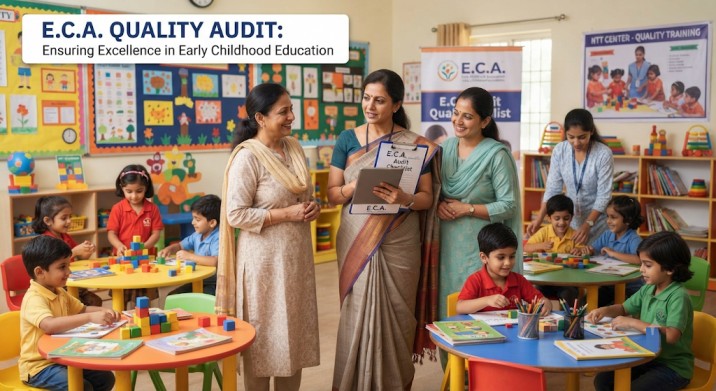
The audit is conducted by trained assessors who review your centre against a defined set of standards. The ECA audit is valid for three years, with options for renewal.[reference:6]
What areas it covers
An E.C.A quality audit is not a casual walkthrough. It assesses seven core areas that define a quality early childhood centre.
| Audit Area | What It Reviews |
|---|---|
| Programme Philosophy | Whether the curriculum aligns with age-appropriate, play-based early learning |
| Learning Environment | Physical space, safety, hygiene, and child-friendly infrastructure |
| Community Cooperation | Parent engagement, community links, and financial sustainability |
| Health, Nutrition & Safety | Drinking water, toilets, first aid, fire safety, and child protection |
| Staffing & Professional Development | Teacher qualifications, training records, and child-to-staff ratios |
| Involving Families | Communication systems, feedback mechanisms, and parent involvement |
| Child Assessment & Programme Evaluation | How children’s progress is tracked and how the programme improves |
Source: ECA quality audit framework.[reference:7]
7 Reasons an E.C.A Quality Audit Is Essential for Your Play School
Reason 1: Parent Trust and Higher Enrolments
Parents have immense faith in third-party certifications. When a parent sees an ECA Quality Audit certificate displayed at your centre, it gives them more trust and positively impacts enrolments.[reference:8] This is not marketing language—it is the documented experience of audited centres.
In a market where parents rely on amateur websites and word-of-mouth to choose preschools, an external certificate is a visible, verifiable signal that your centre meets defined standards.[reference:9]
Why this matters to you: A parent comparing two play schools in Indore or Jaipur will choose the one with third-party validation over the one that only makes claims.
Reason 2: NCPCR and State Compliance Readiness
The National Commission for Protection of Child Rights (NCPCR) has issued guidelines for private play schools covering infrastructure, hygiene, safety measures, trained staff, and child-friendly learning environments. State governments are increasingly enforcing these guidelines. In Panchkula, a district-wide inspection drive was launched in 2026 to identify unregistered play schools and those not complying with NCPCR norms, with closure as a consequence.
An E.C.A quality audit reviews the same areas that NCPCR and state inspectors check. It prepares you for external scrutiny before the inspector arrives.
Why this matters to you: A quality audit is not just a marketing tool. It is a compliance dry run.
Reason 3: Third-Party Validation vs. Self-Claims
Every play school claims to be safe and high-quality. Parents have learned to discount these claims. A third-party audit is different. The ECA audit is conducted by an external body, and the certificate carries the weight of an organisation that parents recognise.[reference:12]
Internal quality checks, no matter how sincere, lack the credibility of external validation. The audit helps you identify hidden loopholes that internal reviews miss.[reference:13]
Why this matters to you: When a competitor says “we are the best,” parents hear noise. When you show an audit certificate, parents see proof.
Reason 4: Identification of Hidden Safety Gaps
Play school safety is not just about fire extinguishers and CCTV. It includes child-to-staff ratios, bathroom hygiene, playground equipment condition, food handling, and emergency protocols. An audit surfaces gaps that owners overlook because they see the same space every day.
NCPCR guidelines explicitly cover pupil-teacher interaction, caregiver-to-child ratios, health and nutrition measures, and protection systems.[reference:14] An audit maps your centre against these parameters and gives you a prioritised fix list.
Why this matters to you: A single safety incident can end a play school’s reputation. An audit is cheaper than a crisis.
Reason 5: Competitive Advantage in Your City
If your competitor also has an ECA audit certificate, that is all the more reason for you to get one—because your competitor then has an edge on you.[reference:15] In most Tier-2 and Tier-3 cities, audited centres are rare. Being the first in your area to display a recognised quality certificate creates a durable local advantage.
Why this matters to you: Quality certification is not a one-time marketing spend. It is a positioning decision that affects how parents, preschools, and partners see your centre for years.
Reason 6: Staff Training and Professional Development
Post-audit, the ECA supports centres with workshops and training to help them rectify quality gaps. These cover both structural and programme quality.[reference:16] For NTT centres, this is particularly valuable because faculty training is often the weakest link in Indian early childhood programmes.
An audit does not just grade you. It gives you a roadmap and support to improve.
Why this matters to you: Faculty quality drives student outcomes and placements. Audit-linked training is a structured way to upgrade your team.
Reason 7: Listing as a Quality Approved Centre
When your centre undergoes the ECA Quality Audit, your centre’s name and logo are listed on the association’s website as a Quality Approved Centre.[reference:17][reference:18] The ECA has tie-ups with large parent communities, including India’s largest Facebook mothers’ group, which drives parent traffic to the Quality Audited Schools section.[reference:19]
This listing is a permanent, searchable trust signal that works for you even when you are not actively marketing.
Why this matters to you: Parents increasingly search online before visiting a play school. A listing on a recognised association website puts your centre in front of them at the decision moment.
Why NTT Centers Need an E.C.A Quality Audit Even More
The NTT certification credibility problem
The NTT sector has a trust problem. Invalid diplomas, unapproved courses, and inconsistent training quality have created widespread suspicion. When one institute’s NTT certificates are declared invalid, every NTT centre in the region feels the reputational ripple.
An E.C.A quality audit for an NTT centre does something that a diploma alone cannot do. It validates the quality of your training programme, your faculty, and your practical exposure—not just the certificate you issue.
How an audit separates your NTT centre from diploma mills
A diploma mill issues certificates with minimal training. A quality NTT centre invests in faculty development, supervised practical hours, and student assessment. Without an external audit, parents and students cannot easily tell the two apart.
An audit certificate tells prospective students: this centre has been independently reviewed. It reviews your faculty qualifications, curriculum design, and student support—the areas where weak NTT centres fail.[reference:21]
Why this matters to you: If you run an NTT centre in Patna or Indore, your biggest competitor is not the centre down the road. It is the suspicion created by bad actors. An audit is how you rise above that suspicion.
What an E.C.A Quality Audit Actually Reviews
An audit is structured, not subjective. The table below shows the specific parameters an auditor assesses, drawn from the ECA framework and NCPCR expectations.
| Review Parameter | What Auditors Check | Why It Matters |
|---|---|---|
| Curriculum & Philosophy | Age-appropriate, play-based, not drilling children for primary school | Determines whether children actually learn or just comply |
| Staff Qualifications | NTT/B.Ed. credentials, training records, police verification | Directly affects teaching quality and child safety |
| Child-to-Staff Ratio | Compliance with NCPCR norms (e.g., 20:1) | Affects individual attention and supervision |
| Infrastructure & Safety | Building safety certificate, fire NOC, child-friendly toilets, CCTV | Legal compliance and physical safety |
| Health & Nutrition | Drinking water, hygiene, food handling (if applicable) | Prevents illness and builds parent confidence |
| Parent Communication | Feedback systems, involvement opportunities, transparency | Retention and word-of-mouth referrals |
Sources: ECA audit framework; NCPCR play school guidelines; state inspection checklists.[reference:22][reference:23]
Estimated Cost and Validity of an E.C.A Quality Audit
An E.C.A quality audit is deliberately affordable because the goal is widespread quality improvement, not premium pricing. The ECA describes the audit fee as affordable, and the certification is valid for three years with renewal options.[reference:25]
For a small-to-mid play school or NTT centre, the indicative investment is well below the cost of a single month’s lost admissions. These are industry estimates based on audit service pricing in India as of 2026.
| Component | Estimated Cost (₹) | Notes |
|---|---|---|
| Initial quality audit | ₹15,000 – ₹40,000 | Varies by centre size and location |
| Follow-up training (optional) | ₹5,000 – ₹15,000 | Charged separately if needed |
| Renewal after 3 years | Similar to initial audit | ECA certification valid for 3 years |
Why this matters to you: The cost of an audit is a fraction of the cost of losing parent trust after a safety incident or a regulatory notice. It is one of the highest-ROI investments a play school or NTT centre can make.
Play School and NTT Center Quality Checklist: Are You Audit-Ready?
Use this checklist to self-assess before scheduling an E.C.A quality audit. Tick each item only when you have documentary or physical evidence.
- ☐ Written programme philosophy aligned with play-based early learning
- ☐ Age-appropriate curriculum (no formal writing or grading for children under 6)
- ☐ Valid building safety certificate and fire safety compliance
- ☐ Child-friendly toilets and safe drinking water
- ☐ CCTV coverage in corridors and play areas
- ☐ Police verification records for all staff, including helpers and drivers
- ☐ Child-to-staff ratio meets NCPCR norms
- ☐ Faculty training records and NTT/B.Ed. qualifications on file
- ☐ Parent feedback system and communication log
- ☐ First-aid kit and trained staff available during hours
- ☐ Emergency evacuation plan and drill records
- ☐ Written child protection policy aligned with POCSO
Common Objections (and Honest Answers)
“We already provide good quality. Why pay for an audit?” Good quality that cannot be proven is indistinguishable from average quality to a new parent. An audit converts your internal standards into external proof.[reference:26]
“Our centre is too small for an audit.” The ECA audit is designed for standalone preschools, standalone daycares, corporate daycares, branded chains, and preschools attached to high schools.[reference:27] Size is not a barrier.
“We cannot afford it.” The audit fee is explicitly described as affordable, and certification lasts three years.[reference:28] Compare that to the cost of one lost admission or one regulatory notice.
“What if we fail the audit?” The audit is not a pass-fail exam. It identifies your key areas of improvement and gives you a roadmap. Post-audit, the ECA supports centres with training and workshops to rectify gaps.[reference:29]
Why this matters to you: Every objection to an audit is really a question about ROI. The answer is the same: the cost of proof is always lower than the cost of doubt.
Quality Is the Only Moat That Lasts
Play schools and NTT centres compete on location, fees, and marketing. None of these create a durable advantage. A competitor can open across the street, undercut your fees, and run ads. But a third-party quality certification is not easily copied—it has to be earned.
An E.C.A quality audit gives you what marketing cannot buy: verified trust. It prepares you for NCPCR and state inspections. It identifies safety gaps before they become incidents. And it lists your centre as a Quality Approved Centre on a platform that parents actually visit.
If you run a play school or NTT centre and want to benchmark your quality, explore the E.C.A Quality Audit and IECEA membership options at International Early Childhood Education. You can also see how structured NTT centre quality upgrades work in practice.
Take the first step: Download the checklist above, mark your gaps honestly, and schedule your E.C.A quality audit this quarter. Your next parent enquiry is already comparing you to a centre that has proof. Be the one with proof.