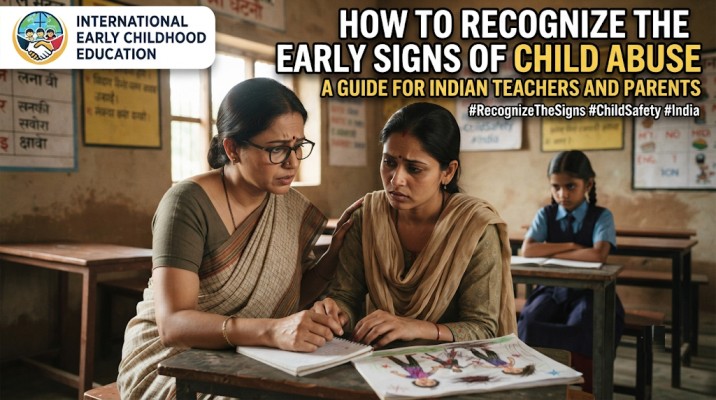
How to Recognize the Early Signs of Child Abuse: A Guide for Indian Teachers and Parents
The early signs of child abuse are often behavioural, not visible. A previously talkative child goes quiet, a toilet-trained preschooler starts wetting again, or a child flinches when an adult raises a hand. These changes are the earliest signals an adult can act on.
India recorded 1,87,702 crimes against children in 2024, a 5.9% rise from 2023. Of these, 69,191 were POCSO cases, with a crime rate of 15.6 per lakh child population[reference:0]. Most abuse happens at the hands of someone the child knows, not a stranger[reference:1]. That makes everyday adults — teachers, caregivers, parents — the most important line of defence.
Why Early Recognition of Child Abuse Matters in India
Fewer than 5% of child abuse victims show visible physical signs[reference:2]. The rest carry indicators that are easy to miss unless you know what to look for. Teachers see children for six to eight hours a day, five days a week — often more waking hours than working parents[reference:3].
Why this matters to you: If you work with children, you are not just an educator. You are a mandatory reporter under Indian law, and often the first adult a child tests with a disclosure[reference:4].
The Scale of the Problem: What the Data Shows
NCRB 2024 data shows crimes against children rose from 89,423 in 2014 to 1,87,702 in 2024 — an increase of nearly 110% over the decade[reference:5]. Maharashtra recorded the highest number of cases (24,171), followed by other high-population states[reference:6].
These are reported cases only. A large majority of abuse is believed to go unreported, because children fear blame, disbelief, or punishment for speaking up[reference:7].
Why this matters to you: Low reporting does not mean low prevalence. It means the signs are being missed or dismissed. Recognition is the first step to breaking that silence.
Why Teachers Are Often the First to Notice
Children frequently confide in a teacher before a parent. A teacher is present daily, notices routine changes, and may feel safer to test a disclosure with before speaking at home[reference:8]. NEP 2020 builds POCSO training directly into the system for this reason: mandatory staff training, counsellors in school complexes, background checks, and visible Childline 1098 numbers alongside the POCSO e-Box[reference:9].
Why this matters to you: A judgment-free, calm response from a teacher can be the difference between a child getting help and a child going silent.
The Four Main Types of Child Abuse (and What Each Looks Like)
The WHO defines child maltreatment as physical and emotional ill-treatment, sexual abuse, neglect, and exploitation that causes actual or potential harm to a child’s health, development, or dignity[reference:10]. In practice, the signs fall into four overlapping categories.
| Type of Abuse | Physical Clues | Behavioural Clues |
|---|---|---|
| Physical abuse (beating, burning, shaking) | Bruises on non-mobile infants; patterned injuries (belt marks, hand impressions); fractures at different healing stages; cigarette burns; delay in seeking care[reference:11][reference:12] | Fear of a specific adult; flinching at sudden movements; repeated “accidents”; wearing long sleeves in hot weather |
| Sexual abuse (contact or non-contact acts, grooming) | Genital symptoms, STI, pregnancy in a minor; difficulty walking or sitting; torn frenulum[reference:13][reference:14] | Sexualised behaviour; fear of a specific person; sudden withdrawal; regressive behaviour (bedwetting, thumb-sucking)[reference:15] |
| Emotional abuse (humiliation, threats, rejection) | No direct physical markers; failure to thrive may appear in severe cases | Anxiety, depression, aggression, sleep disturbance, poor self-worth, extreme clinginess[reference:16] |
| Neglect (failure to provide food, care, supervision) | Malnutrition, poor hygiene, untreated illness, missed immunisation, repeated accidents[reference:17] | Persistent hunger, hoarding food, frequent absence, unexplained exhaustion |
Why this matters to you: Abuse rarely announces itself with one obvious sign. It shows up as a cluster — a physical mark plus a behaviour change plus a caregiver story that does not add up.
Physical Abuse: Injuries That Don’t Match the Story
Bruises are the most common physical injury in Indian child abuse cases (43.9%), followed by fractures (29.8%) and burns (15.8%)[reference:18]. The location matters as much as the mark. Bruises on the back, buttocks, ears, genitals, and back of hands are highly suggestive of inflicted injury[reference:19].
Equally important is the explanation. A caregiver who gives a vague, changing, or delayed account of how an injury happened is a red flag. So is a caregiver who blames the child for the injury[reference:20].
Sexual Abuse: When Behaviour Changes Before Words Do
Most children do not disclose sexual abuse directly. They show it through behaviour. Sudden withdrawal, unprovoked aggression, unusual clinginess, a sharp drop in academic focus, frequent stomach aches or headaches, and regressive behaviours like bedwetting or thumb-sucking are common signals[reference:21]. Sexualised behaviour — rubbing against others, touching private parts of others — is a specific indicator that warrants immediate professional attention[reference:22].
Children with disabilities are at higher risk and may show signs that are wrongly attributed to their disability. Pay attention to new fears, new avoidance, or changes in sleep and eating that do not match their baseline.
Emotional Abuse: The Invisible Bruises
Emotional abuse includes humiliation, threats, rejection, isolation, and exposure to domestic violence[reference:23]. The signs are behavioural: anxiety, depression, aggression, sleep disturbance, and poor self-worth. In young children, watch for extreme withdrawal, fear of making mistakes, or a flattened, “good child” presentation that feels too quiet.
Neglect: The Absence That Harms
Neglect is the failure to provide food, health care, supervision, education, or protection when the caregiver has the means to do so[reference:24]. Teachers notice it as persistent hunger, poor hygiene, untreated medical needs, frequent absence, and a child who seems to have no adult checking on them[reference:25].
Physical Warning Signs of Child Abuse: What to Look For
Use this checklist as an observation guide, not a diagnostic tool. A single mark can be accidental. A pattern of marks, repeated across time, with inconsistent explanations, is the concern.
- Bruises on non-mobile infants — a red flag in any circumstance[reference:26].
- Patterned injuries — belt marks, hand impressions, loop marks, bite marks[reference:27].
- Burns with clear boundaries — cigarette burns, immersion burns (glove or stocking pattern)[reference:28].
- Fractures in different stages of healing — suggests repeated trauma[reference:29].
- Injuries to protected areas — back, buttocks, genitals, ears, back of hands[reference:30].
- Delay in seeking medical care — or a caregiver who seems unconcerned about a significant injury[reference:31].
Why this matters to you: You are not expected to diagnose. You are expected to notice, document, and report. The checklist gives you language to describe what you see without overstepping.
Behavioural and Emotional Warning Signs in Young Children
In preschoolers and early primary children, behaviour is the loudest communicator. The following changes — especially when they appear suddenly and cluster together — deserve attention.
- Sudden change in behaviour — a talkative child goes quiet; a calm child becomes aggressive[reference:32].
- School refusal or fear of a specific adult — crying before school, refusing to enter a room, or naming a specific person as frightening[reference:33].
- Regression — bedwetting after being toilet-trained, thumb-sucking, baby talk, clinginess[reference:34].
- Sleep disturbances — nightmares, night terrors, refusing to sleep alone[reference:35].
- Unexplained physical complaints — chronic stomach aches, headaches, frequent illness with no medical cause[reference:36].
- Sexualised behaviour — developmentally inappropriate for the child’s age[reference:37].
- Self-harm or risk-taking — head-banging, scratching, pulling hair, biting hands[reference:38].
Why this matters to you: Behaviour is a child’s first language. When words are unavailable or unsafe, the body and behaviour speak. Your job is to listen to that language without demanding a verbal disclosure.
Caregiver Red Flags: When the Adult’s Behaviour Is the Signal
Abuse is rarely visible in the child alone. The caregiver’s behaviour often provides the missing context. Watch for:
- An explanation that does not match the injury — vague, changing, or delayed accounts[reference:39].
- Blaming the child for the injury or for “provoking” discipline[reference:40].
- Describing the child in harsh, rejecting terms — “he is useless,” “she is always trouble”[reference:41].
- Refusing to allow the child to speak alone — answering for the child, hovering during interviews.
- A child who is frightened of the caregiver — does not want to go home, flinches at the caregiver’s approach[reference:42].
- Excessive one-on-one time with a child outside normal settings — private rehearsals, off-campus meetings, gift-giving, special favours[reference:43].
Why this matters to you: A child’s injury plus a caregiver’s inconsistent story is a more reliable signal than either alone. Document both.
What to Do If You Suspect Abuse: A Step-by-Step Teacher’s Checklist
Recognition without action protects no one. Follow this sequence. Do not investigate on your own, and do not confront the alleged abuser.
- Stay calm and listen. If a child begins to disclose, listen without probing. Use open prompts like “Tell me more” or “What happened next?” Do not ask leading questions or ask the child to repeat the story to multiple adults.
- Reassure the child. Say: “Thank you for telling me. You are not in trouble. I will help keep you safe.”
- Document exactly what you saw and heard. Use the child’s words in quotation marks. Note the date, time, and context. Record physical marks with a body map if your school has one.
- Report to your designated Child Protection Officer or Principal immediately, as per your school’s POCSO policy.
- Report to the authorities. Under POCSO Section 21(1), any person — including school personnel — who fails to report a suspicion of child sexual abuse commits an offence[reference:44]. Report to the police or the Special Juvenile Police Unit (SJPU).
- Use Childline 1098 for immediate guidance and support. The POCSO e-Box on the NCPCR website allows confidential reporting[reference:45].
- Do not confront the family or the alleged abuser. This can place the child at greater risk and compromise the investigation.
- Maintain confidentiality. Share information only on a need-to-know basis, with the Child Protection Officer, Principal, and authorities.
Why this matters to you: The law does not require you to be certain. It requires you to report a reasonable suspicion. Your report starts a process; it does not pronounce a verdict.
Your Legal Duty Under POCSO and NCPCR Guidelines
India’s legal framework is clear, and it places schools at the centre of protection.
| Law / Guideline | What It Requires from Schools and Teachers |
|---|---|
| POCSO Act, 2012 — Section 21(1) | Mandatory reporting of suspected child sexual abuse. Failure to report is a punishable offence for school personnel, parents, and doctors[reference:46]. |
| POCSO Act — Section 19 | Any person who suspects abuse must report to the SJPU or police. The child must not be detained at the school or asked to confront the accused[reference:47]. |
| NCPCR Manual on Safety and Security of Children in Schools | Requires a child protection policy, a grievance committee for CSA, staff training on warning signs, and mandatory reporting protocols[reference:48][reference:49]. |
| NEP 2020 | Mandates POCSO training for teachers, counsellors in school complexes, background verification, and visible Childline/POCSO e-Box display[reference:50]. |
| Juvenile Justice Act, 2015 | Establishes Child Welfare Committees (CWCs) and District Child Protection Units (DCPUs) for post-report care and rehabilitation[reference:51]. |
Why this matters to you: Compliance is not optional, and ignorance of the law is not a defence. A school without a trained Child Protection Officer and a written POCSO policy is exposed both legally and reputationally.
Planning to start a play school, NTT center, or franchise? View franchise opportunities on International ECE or fill the enquiry form to speak with a counselor about child-safety-ready early childhood programs.