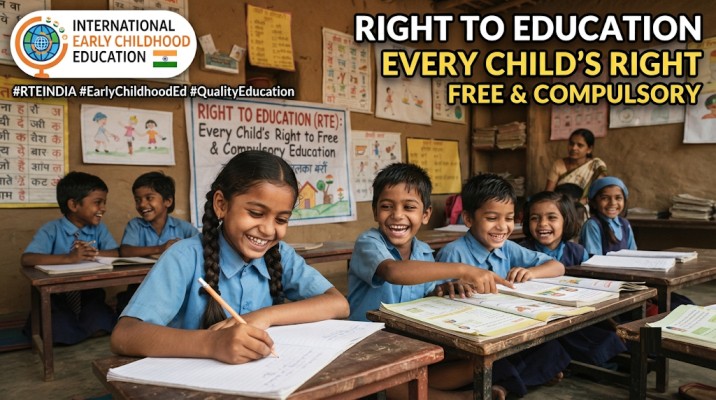
Right to Education (RTE): Every Child’s Right to Free and Compulsory Education
The Right to Education (RTE) Act, 2009 makes free and compulsory elementary education a fundamental right for every child in India aged 6 to 14. It also mandates that private unaided schools reserve at least 25% of entry-level seats for children from economically weaker sections (EWS) and disadvantaged groups.
If you are a parent trying to understand the admission process, or a school owner checking compliance, this guide breaks down the law, the 2026 updates, and the practical gaps you need to know.
What Is the Right to Education Act, 2009?
The RTE Act was passed by Parliament and received presidential assent on 26 August 2009. It came into force on 1 April 2010, making India one of over 130 countries with a legal guarantee of free and compulsory education.
Why this matters to you: Before 2009, education was a directive principle, not an enforceable right. The RTE Act turned it into a legal obligation on the State.
The Constitutional Foundation: Article 21A
The 86th Constitutional Amendment inserted Article 21A, which states that the State shall provide free and compulsory education to all children aged six to fourteen years. The RTE Act is the legislation that operationalises this Article.
The Supreme Court has repeatedly held that denying admission to an RTE-selected child violates Article 21A. In April 2026, the Court called RTE implementation a “national mission” and warned that obstruction would render the right “an empty promise.”[reference:0]
Key Features of the RTE Act
Beyond free seats, the Act sets binding norms for every elementary school:
- No detention until Class 8. The original Act prohibited holding back or expelling a child until elementary education was completed. This was amended in December 2024 to allow detention in Classes 5 and 8 after a re-examination.[reference:1]
- No screening. Schools cannot conduct entrance tests or interviews for children or parents.
- Teacher qualifications. All teachers must possess the minimum qualifications prescribed by the academic authority and clear the Teacher Eligibility Test (TET).
- Infrastructure norms. Pupil-teacher ratio, separate toilets for boys and girls, a kitchen for mid-day meals, a playground, and a boundary wall.
- 25% reservation. Private unaided, non-minority schools must reserve at least 25% of Class I (or entry-level) seats for EWS and disadvantaged-group children in the neighbourhood.[reference:2]
- No capitation fees. Schools cannot charge donations or fees that block a child’s access.
Why this matters to you: These are not optional guidelines. Violations can lead to derecognition, and the Supreme Court has made clear that schools cannot hide behind procedural technicalities.[reference:3]
RTE 25% Reservation: How It Works for Private Schools
Section 12(1)(c) of the RTE Act requires every unaided, non-minority private school to admit children from weaker and disadvantaged sections to at least 25% of the strength of Class I. Minority institutions are exempt.[reference:4]
The Supreme Court has upheld the constitutional validity of this provision. In its 2026 rulings, the Court emphasised that the quota is a deliberate strategy for social integration, not a concession.[reference:5]
Who Is Eligible for the 25% Quota?
Eligibility is defined by state rules, but the broad categories are:
- Economically Weaker Section (EWS): Families below the state-prescribed annual income limit. Gujarat, for example, caps eligibility at ₹6 lakh annual family income.[reference:6]
- Disadvantaged Group: Children from Scheduled Castes, Scheduled Tribes, and other notified socially disadvantaged communities.
- Children with disabilities: Covered under the RTE disability quota, though implementation varies by state.
Age criteria differ by state and class. For Uttar Pradesh’s 2026–27 cycle, children aged 3–4 years are eligible for nursery, 4–5 for LKG, 5–6 for UKG, and 6–7 for Class I, calculated as of 1 April 2026.[reference:7] Gujarat requires the child to be at least six years old for Class I.[reference:8]
Step-by-Step RTE Admission Process (2026)
Most states now run admissions entirely through online portals, with selection by computerised lottery. Here is the typical flow, using the UP and Gujarat models:
- Check your state’s RTE portal. Examples include rte.orpgujarat.com for Gujarat and the UP Basic Education Department portal.
- Verify age and income eligibility. Keep the child’s birth certificate, parent’s Aadhaar, income certificate, residence proof, caste certificate (if applicable), and ration card ready.[reference:9]
- Fill the online application. Select and rank preferred schools within the allowed radius.
- Document verification. District education officers verify applications.
- Lottery allotment. Eligible children are selected through a computerised lottery. No interviews, no screening.
- School admission. Once the state forwards the list, the school is legally bound to admit the child. The Supreme Court has held that schools cannot question or override the state’s eligibility decision.[reference:10]
Why this matters to you: Missing a document or a deadline means losing the seat. Start the paperwork at least two weeks before the window opens.
RTE Act in 2026: Supreme Court Push and State-Level Updates
2026 has been an active year for RTE enforcement. The Supreme Court has moved from interpreting the law to actively monitoring its implementation.
Why the Supreme Court Is Monitoring Implementation
On 13 January 2026, a Bench of Justices P.S. Narasimha and A.S. Chandurkar delivered the Dinesh Biwaji Ashtikar v State of Maharashtra judgment. The Court found that Section 12(1)(c) had survived constitutional challenges but remained poorly implemented. It directed the NCPCR to coordinate with national and state advisory councils and to frame enforceable rules under Section 38 of the RTE Act.[reference:11]
By September 2026, the Court pulled up the NCPCR for “inaction” and summoned its Chairperson and Director to appear in person. Justice Narasimha remarked, “Without enforceable rules and regulations, the object of Article 21A and Section 12(1)(c) shall be rendered meaningless.”[reference:12]
Some states have responded. Telangana assured the NCPCR in October 2026 that it would implement the 25% quota, prioritising habitations without a government school within one kilometre.[reference:13]
Ground Reality: Gaps Between Law and Delivery
The law is strong on paper. The delivery is uneven. Key gaps documented in 2025–2026 include:
- Digital illiteracy and language barriers. The Supreme Court itself noted that parents often cannot navigate online portals, defeating the purpose of the right.[reference:14]
- Lack of transparency. Authorities have failed to communicate the number of available seats, creating room for arbitrary refusals.[reference:15]
- Reimbursement delays. Private schools in Chhattisgarh threatened to boycott RTE admissions in 2026 over a 14-year freeze in reimbursement rates: ₹7,000 annually for Classes I–V and ₹11,400 for Classes VI–VIII.
- Stigmatisation of EWS children. Reports continue to document social alienation of quota students in elite schools, undermining the integration objective.[reference:17]
Why this matters to you: If you are a parent, know that the law is on your side, but you may need to escalate to the district education officer or the NCPCR. If you are a school owner, compliance is legally mandatory even when reimbursement is delayed.
RTE Act: Benefits and Criticisms
The RTE Act has expanded access. It has not yet guaranteed learning. Both facts matter for anyone evaluating the law in 2026.
| Dimension | What the RTE Act Has Achieved | What Remains Weak |
|---|---|---|
| Enrollment | Over 5 million cumulative admissions through 25% quota across 20+ states/UTs[reference:18] | Over 8.1 million children from urban slums remained out of school in early 2026 (NAC Implementation Report)[reference:19] |
| Infrastructure | Binding norms for toilets, kitchens, playgrounds, and pupil-teacher ratio | Many schools still fall short; infrastructure gaps persist in Bihar and UP[reference:20] |
| Learning outcomes | ASER 2024: ~43% of Class V students can read a Class II-level text[reference:21] | Learning poverty remains high; no-detention policy was rolled back in 2024 to address accountability[reference:22] |
| Social integration | 25% quota designed to bring children across caste and class into shared classrooms[reference:23] | Stigmatisation of EWS students in elite schools continues[reference:24] |
Why this matters to you: The RTE Act is a floor, not a ceiling. Parents should use it to secure admission, then hold schools accountable for learning. School owners should treat compliance as a baseline, not a marketing badge.
RTE Reimbursement: What Schools Actually Get
The RTE Act does not require private schools to bear the cost of the 25% quota. The government is obligated to reimburse schools at the lower of either the per-child expenditure in government schools or the actual fee charged by the private school.
In practice, reimbursement rates vary widely and are a constant source of friction.
| State / Context | Reimbursement Rate (Recent Cycle) | Source / Note |
|---|---|---|
| Maharashtra | ₹17,670 per student (2024–25) | Approved rate; schools have protested that it has not changed for three years[reference:26] |
| Chhattisgarh | ₹7,000 (Classes I–V); ₹11,400 (Classes VI–VIII) | Unchanged since 2011–12; schools threatened boycott in 2026 |
| Madhya Pradesh (example) | ₹5,792 (pre-primary); ₹6,099 (primary) | State-approved annual caps; schools seek a minimum of ₹10,000[reference:28] |
Note: These are state-specific rates for recent academic years. Always check your state’s current reimbursement notification.
Why this matters to you: If you run a private school, RTE compliance is mandatory, but the reimbursement may not cover your full cost. Plan your finances accordingly.
How RTE Affects Play Schools, NTT Centers, and Early Childhood Education
The RTE Act applies to elementary education, defined as Classes I to VIII. It does not directly regulate standalone play schools or pre-primary sections that operate independently of a recognised elementary school.
However, the boundary is shifting. NEP 2020 treats early childhood care and education (ECCE) as part of the learning continuum. Several states now include nursery, LKG, and UKG in the RTE admission cycle. Indore’s 2026 RTE notification, for example, requires private schools to reserve 25% of seats in Nursery, KG-1, KG-2, and Class I for eligible students.
For NTT training centers, the RTE Act matters indirectly. The demand for qualified early-years teachers rises when schools expand pre-primary sections. The Act’s teacher-qualification norms also signal that informal, uncertified teaching is no longer acceptable.
Why this matters to you: If you are planning a play school or NTT center, build quality and documentation from day one. RTE-linked expectations are moving downward into the early years.
Frequently Asked Questions About RTE
The full FAQ section follows below.
Planning to start a play school, NTT center, or franchise? View franchise opportunities on International ECE or fill the enquiry form to speak with a counselor about RTE-ready early childhood programs.