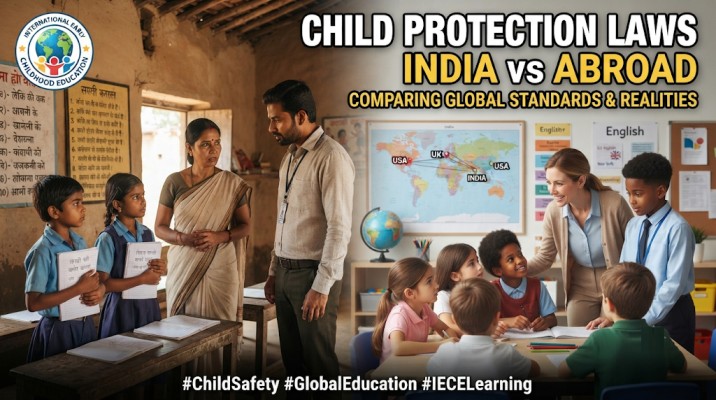
What Is the Difference Between Child Protection Laws in India and Abroad (US, Canada, Switzerland)?
The core difference is structural. India relies on a single central statute—the POCSO Act, 2012—that mandates reporting of sexual offences only. The US, Canada, and Switzerland combine federal funding conditions or civil codes with state or provincial laws that cover physical abuse, emotional abuse, and neglect as well as sexual abuse.
For an Indian play school owner or NTT trainer, that gap matters. Your legal duty under POCSO is narrow but criminal. A teacher in Switzerland or Canada faces a broader duty that includes neglect and emotional harm. Understanding the difference helps you build a child protection policy that meets Indian law and international quality benchmarks.
The Core Difference: One Central Law vs. Many Provincial Frameworks
India has one national criminal law for child sexual abuse. The other three countries distribute power between national and sub-national governments.
Why this matters to you: If you franchise or partner with an international early-years brand, you will be asked for a child protection policy that goes beyond POCSO compliance.
India: POCSO and a Sexual-Offence-Specific Mandate
The Protection of Children from Sexual Offences Act, 2012 creates a mandatory duty under Section 19 to report suspected sexual offences against a child. Section 21 punishes failure to report.[reference:0] The Supreme Court has upheld that anyone failing to report child sexual abuse can face action, and in 2026 it allowed prosecution of a headmistress under POCSO for failing to report.
POCSO does not create an equivalent mandatory reporting duty for physical abuse, emotional abuse, or neglect. Those are addressed through other laws and NCPCR guidelines, but the criminal reporting trigger remains sexual offences.
United States: CAPTA Sets the Floor, States Build the Walls
The Child Abuse Prevention and Treatment Act (CAPTA) is a federal funding statute, not a direct criminal code. It requires states to maintain mandatory reporting laws for certain professionals—typically teachers, doctors, and social workers—as a condition of receiving federal child abuse prevention funds.[reference:2][reference:3]
Each state defines its own list of mandated reporters, its own reporting procedures, and its own penalties. CAPTA also directs national data collection through the National Child Abuse and Neglect Data System (NCANDS).[reference:4] In 2024, the US recorded 532,228 confirmed child victims of abuse and neglect, with 9% sexually abused.[reference:5]
Canada: 13 Provinces, 13 Child Protection Systems
Canada has no single federal child protection law. Each province and territory has its own child protection statute, and mandatory reporting of suspected child abuse is universal across jurisdictions.[reference:6][reference:7] Penalties for failure to report range from fines to imprisonment depending on the province.[reference:8]
The age of protection varies from under 16 in Newfoundland and Labrador, Saskatchewan, Northwest Territories, and Nunavut to under 19 in other jurisdictions.[reference:9] A 2024 national study found that 60.9% of respondents reported experiencing some form of child maltreatment.[reference:10]
Switzerland: The KESB and a Civil Protection Model
Switzerland’s child protection system is civil, not primarily criminal. The Kindes- und Erwachsenenschutzbehörde (KESB)—the Child and Adult Protection Authority—acts only when a report is filed.[reference:11] Any person may report a concern. Teachers, police, schools, and subsidised institutions are legally obliged to report when they detect a risk in the course of their duties.[reference:12][reference:13]
The protection age is 18. In 2025, Swiss paediatric clinics treated 2,380 children and adolescents for suspected or confirmed maltreatment—a 14.2% increase over 2024 and the highest since national data collection began.[reference:14]
Mandatory Reporting: Who Must Report, and What Happens If They Don’t?
All four jurisdictions punish failure to report, but the scope and severity differ sharply.
| Country | Who Must Report | What Must Be Reported | Penalty for Failure |
|---|---|---|---|
| India | Any person, including school staff; institutional heads face aggravated penalty | Suspected sexual offences against a child under POCSO | Up to 6 months (general) or up to 1 year and fine (institutional head) under Section 21[reference:15] |
| United States | Professionals defined by state law (teachers, doctors, social workers) | Known or suspected child abuse and neglect, as defined by state law and CAPTA | Varies by state; misdemeanour to felony, fines and possible imprisonment[reference:16] |
| Canada | All persons in most provinces; professionals in some | Suspected child abuse and neglect under provincial legislation | Fines (e.g., up to CAD 1,000 in some provinces) to imprisonment, depending on jurisdiction[reference:17][reference:18] |
| Switzerland | Teachers, police, schools, subsidised institutions; any person may report | Concrete indications of physical, psychological, or sexual endangerment | Professional duty under Art. 314c ZGB; failure can trigger disciplinary and civil consequences[reference:19][reference:20] |
Why this matters to you: In India, a teacher who suspects physical abuse but not sexual abuse is not criminally liable under POCSO. In Switzerland or Canada, the same teacher may have a legal duty to report. If you train teachers for international placement, teach the broader duty, not only POCSO.
India’s POCSO Section 21: Six Months to One Year
The POCSO Act’s penalty structure is tiered. A general failure to report carries up to six months’ imprisonment, a fine, or both. An institutional head who fails to report an offence committed by a subordinate faces up to one year and a fine.[reference:21] Children who fail to report are exempt from punishment.[reference:22]
US State Penalties: Misdemeanour to Felony
CAPTA requires states to have reporting procedures, but it does not set penalties. State laws vary widely. Some classify failure to report as a misdemeanour; others escalate to felony charges depending on the harm that followed. Civil liability is also possible.[reference:23]
Canada: Fines and Imprisonment Under Provincial Law
Canada’s cross-jurisdictional review notes that mandatory reporting of suspected child abuse is universal, and penalties range from fines to imprisonment. Some provinces specify fines of up to CAD 1,000 for failing to report.[reference:24][reference:25]
Switzerland: A Professional Duty Under the Civil Code
Switzerland’s duty is grounded in the civil code (Art. 314c ZGB). Teachers and other professionals with regular contact with children must report concrete indications of endangerment to the KESB. The KESB then investigates and decides whether protective measures are needed.[reference:26][reference:27] In Zurich, about one-third of reports come from the police, often linked to domestic violence, and around 20% from counselling and social services.[reference:28]
Age of Protection: Who Counts as a Child?
The definition of “child” changes the scope of every duty.
| Country | Age of Protection / Childhood | Source / Note |
|---|---|---|
| India | Under 18 | POCSO defines a child as any person below 18 |
| United States | Varies by state and programme; CAPTA covers children under 18 for most purposes | State child protective services typically cover under 18; some extend to 21 for youth in care |
| Canada | Under 16 to under 19, depending on province/territory | Newfoundland and Labrador, Saskatchewan, NWT, and Nunavut use under 16; most others use higher ages[reference:29] |
| Switzerland | Under 18 | Child protection measures apply until age 18; adult protection law applies after 18[reference:30] |
Why this matters to you: A 17-year-old in Canada’s Saskatchewan is not covered by child protection law, but a 17-year-old in Switzerland is. If your NTT curriculum includes child rights, use the age definition of the country where your trainees will work.
What Schools and Teachers Are Legally Required to Do
Beyond reporting, each jurisdiction imposes different institutional duties on schools.
- India: NCPCR’s school safety manual requires a child protection policy, a grievance committee for sexual abuse, staff training on warning signs, and display of Childline 1098 and the POCSO e-Box. NEP 2020 mandates POCSO training for teachers and counsellors in school complexes.
- United States: CAPTA-funded states must have procedures for screening and responding to reports. Schools receiving federal funds must comply with state mandatory reporting laws and, in some states, train staff annually.[reference:31]
- Canada: Provincial child protection laws create the duty to report. Schools are expected to have protocols for responding to disclosures and cooperating with child welfare authorities. Some provinces require serious occurrence reporting to the ministry.[reference:32]
- Switzerland: Schools and subsidised institutions are explicitly obliged to report under cantonal law. The KESB is the receiving authority, and teachers are named as mandatory reporters.[reference:33]
Why this matters to you: Indian schools often treat child protection as a POCSO poster on the wall. International frameworks expect a written policy, documented training, and a named responsible person. Build those three elements to be audit-ready.
Child Abuse Statistics: What the Data Shows in Each Country
Data definitions differ, so cross-country comparison is imperfect. The trend, however, is consistent: reported cases are rising or remaining high.
| Country | Key Statistic (2024–2025) | Source |
|---|---|---|
| India | 187,702 crimes against children in 2024; 67,809 POCSO cases; 512 crimes against children every day | NCRB 2024[reference:34][reference:35] |
| United States | 532,228 confirmed child victims of abuse and neglect in 2024; ~48,000 sexually abused (9%) | Child Maltreatment 2024 (released January 2026)[reference:36] |
| Canada | 60.9% of a national sample reported any child maltreatment; 44.9% emotional abuse, 39.4% exposure to caregiver IPV | 2024 CARe-YEARS study, published 2026[reference:37] |
| Switzerland | 2,380 children treated for suspected/confirmed maltreatment in 2025; +14.2% over 2024 | National Child Protection Statistics 2025[reference:38] |
Why this matters to you: India’s absolute numbers are large, but its reporting infrastructure is younger. The US and Canada have longer data series and broader reporting duties. Switzerland’s smaller numbers reflect a smaller population and a civil, KESB-centred system, not a lower underlying rate of harm.
What Indian Play Schools and NTT Centers Should Learn from Abroad
Three lessons stand out for early childhood operators in India.
- Broaden the policy beyond sexual abuse. POCSO is your criminal baseline. But a quality child protection policy should also cover physical abuse, emotional abuse, and neglect, with clear reporting pathways for each. International parents and franchise partners will ask for this.
- Name a Child Protection Officer and document training. NCPCR already expects this. The US and Canadian models assume designated professionals and annual training. Make it visible in your staff handbook and admission pack.
- Use the KESB “any person may report” principle as a cultural signal. Switzerland’s system encourages reports from any source and filters them through a specialist authority. Indian schools can adopt the same culture: every staff member is encouraged to raise a concern internally, without fear of overreacting.
Why this matters to you: Compliance is the floor. Parent trust and franchise credibility are built on the systems you can show, not just the law you cite.
Planning to start a play school, NTT center, or franchise? View franchise opportunities on International ECE or fill the enquiry form to speak with a counselor about child-protection-ready early childhood programs.