What Role Should NGOs and Schools Play in Stopping Child Labour?
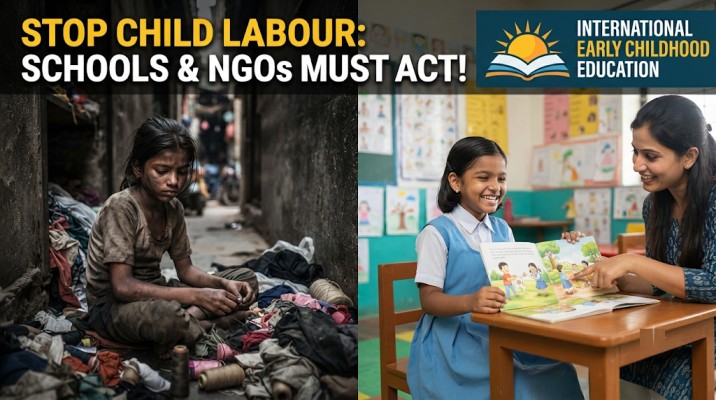
NGOs and schools play complementary roles. NGOs identify, rescue, and rehabilitate children already trapped in labour through raids, bridge courses, and family support. Schools prevent child labour by ensuring enrolment, tracking attendance, and creating a learning environment so stable that work becomes unnecessary and unattractive.
India had an estimated 10.1 million child labourers aged 5–14 in 2025, representing 3.9% of the child population in that age group[reference:0]. In 2024–25 alone, a network of over 250 NGOs rescued 53,651 children nationwide, with nearly 90% found in sectors classified as the worst forms of child labour[reference:1]. The rescue numbers show NGO effectiveness. The persistence of the problem shows why school-based prevention matters just as much.
The Division of Labour: Rescue vs Prevention
The child labour ecosystem has two distinct moments: the child is in labour, or the child is at risk of entering labour. NGOs are strongest in the first moment. Schools are strongest in the second.
Why this matters to you: If you run a school or an NGO, confusing these roles leads to duplication and gaps. A school cannot conduct raids. An NGO cannot replace daily classroom attendance tracking.
Why NGOs Are Built for Rescue and Rehabilitation
NGOs have the field presence, community trust, and legal coordination needed for rescue operations. They work with district task forces, police, and the NCPCR to identify children in workshops, quarries, spas, and homes. They then provide immediate shelter, counselling, and bridge education before mainstreaming the child into a formal school.
The MV Foundation in Andhra Pradesh, for example, has withdrawn over 15 lakh children from child labour and mainstreamed them through residential bridge courses[reference:2]. This is rescue at scale, and it is an NGO function, not a school function.
Why Schools Are Built for Prevention and Retention
Schools prevent child labour by doing what NGOs cannot do daily: keeping every enrolled child in a classroom, noticing absence patterns, and creating a learning experience that competes with the economic pull of work. The RTE Act guarantees free and compulsory education for children aged 6–14[reference:3]. A functioning neighbourhood school is the single strongest structural deterrent to child labour.
Why this matters to you: A school that loses a child to absenteeism for two weeks may lose that child to labour permanently. Prevention is a daily, local act.
What NGOs Actually Do: Rescue, Rehabilitation, and Mainstreaming
NGO interventions follow a predictable sequence. Understanding this sequence helps schools know when to expect a rescued child and what support that child will need.
1. Identification and Rescue Operations
NGOs run rescue operations in coordination with District Child Labour Task Forces and law enforcement. In 2024–25, the Just Rights for Children network conducted 38,889 rescue operations across 24 states, leading to 38,388 FIRs and 5,809 arrests[reference:4]. Telangana (11,063 rescues), Bihar (3,974), Rajasthan (3,847), and Uttar Pradesh (3,804) recorded the highest numbers[reference:5].
Rescued children are produced before Child Welfare Committees and placed in temporary shelters or rehabilitation centres.
2. Bridge Courses and Residential Camps
Children who have missed years of schooling cannot walk directly into a Class 5 classroom. NGOs run bridge courses—short, intensive programmes that bring a child up to age-appropriate learning levels before mainstreaming. Residential camps provide shelter, nutrition, and counselling alongside education.
The National Child Labour Project (NCLP) scheme, which NGOs often implement, provides rescued children with education, vocational training, and stipends through special training centres[reference:6]. After the bridge period, the child is enrolled in a formal government or government-aided school.
3. Parent Skill Development and Community Mobilisation
Rescue without family economic support often leads to re-entry into labour. NGOs address this root cause through parent skill development—sewing, pottery, stitching, and other livelihood training—and through community mobilisation to change social norms that normalise child work[reference:7].
Bal Raksha Bharat, for example, works with disadvantaged families to build adult earning capacity so that children can attend school instead of supplementing household income[reference:8]. NGOs also run awareness campaigns on Childline 1098 and the long-term economic cost of child labour[reference:9].
Why this matters to you: If you are a school receiving a rescued child, ask the NGO what family support is in place. Without it, the child may return to work within months.
What Schools Must Do: Enrolment, Attendance Tracking, and Safe Learning
Schools are the prevention engine. Their duties are less dramatic than a rescue raid but more continuous.
The NCPCR 15-Day Absence Rule
NCPCR’s nationwide child labour campaign explicitly directs teachers to monitor school attendance closely and report cases where a child remains absent for 15 consecutive days to the concerned authorities for timely intervention[reference:10]. This is the single most actionable prevention tool available to a teacher.
A child who disappears from school for two weeks is not necessarily in labour. But the 15-day rule creates a mandatory check before the trail goes cold.
RTE Act and Free Seats for Vulnerable Children
The RTE Act requires private unaided schools to reserve at least 25% of entry-level seats for children from economically weaker sections and disadvantaged groups. It also prohibits screening and capitation fees[reference:11]. A school that quietly discourages EWS admissions is weakening the prevention net, regardless of its academic reputation.
Schools must also maintain a Village Education Register or equivalent enrolment mapping to identify out-of-school children, dropouts, and never-enrolled children in their catchment area[reference:12]. Odisha’s 2026 advisory went further: teachers must visit the homes of absent students to ascertain whether dropout, child marriage, or child labour is the cause[reference:13].
Why this matters to you: Attendance tracking is not administrative paperwork. It is child protection. A register entry is often the first signal that a child has moved from “at risk” to “in labour.”
NGOs vs Schools: A Side-by-Side Comparison of Roles
| Function | NGO Role | School Role |
|---|---|---|
| Primary focus | Rescue, rehabilitation, mainstreaming | Prevention, enrolment, retention |
| Core activity | Raids, bridge courses, shelters, family livelihood support | Daily attendance tracking, classroom learning, SMC engagement |
| Time horizon | Short-term crisis intervention (weeks to months) | Long-term prevention (years of schooling) |
| Legal trigger | Child found in labour; rescue operation launched | Child absent for 15 days; NCPCR reporting rule |
| Key output | Child removed from work and placed in bridge education | Child retained in school and protected from entering work |
| Failure mode | Child rescued but re-enters labour due to family poverty | Child drops out silently and enters labour unnoticed |
Why this matters to you: The handoff between NGO and school is where most interventions succeed or fail. A rescued child needs a school that is ready to receive, not just a shelter that is ready to release.
India’s Child Labour Problem in Numbers (2024–2026)
| Indicator | Figure | Source / Year |
|---|---|---|
| Estimated child labourers (5–14 years) | ~10.1 million (3.9% of age group) | Projected estimate for 2025[reference:14] |
| Children rescued nationwide by NGO network | 53,651 in 2024–25 | Just Rights for Children / C-LAB report, June 2025[reference:15] |
| Rescued children in worst forms of labour | ~90% (spas, massage parlours, orchestras, etc.) | JRC report, 2025[reference:16] |
| Top rescue states (2024–25) | Telangana (11,063), Bihar (3,974), Rajasthan (3,847), UP (3,804) | Indian Express / JRC, June 2025[reference:17] |
| MV Foundation cumulative withdrawals | Over 15 lakh children from child labour | MV Foundation press note[reference:18] |
Why this matters to you: The numbers show that rescue capacity exists, but it is concentrated in a few states and a few large NGO networks. Schools in Tier-2 and Tier-3 cities—Indore, Patna, Jaipur, Coimbatore—are often the only formal institution watching a vulnerable child every day.
How NGOs and Schools Can Work Together: A Practical Checklist
Use this checklist to build a working relationship before a crisis, not after one.
- Map the catchment. Schools should know which habitations, brick kilns, quarries, and workshops feed into their enrolment. NGOs can provide this mapping.
- Share a single referral number. Every teacher should have the district Childline 1098 number and the local District Child Labour Task Force contact on their phone.
- Agree on a bridge-course handoff. NGOs should tell schools when a rescued child is ready for mainstreaming, and schools should designate a teacher to receive and assess the child.
- Run joint parent awareness sessions. NGOs bring community trust; schools bring institutional credibility. Together they can address the economic arguments families make for child work.
- Track re-entry, not just rescue. An NGO rescue is not a success until the child stays in school for at least one full academic year. Schools should report retention data back to the NGO.
- Document everything. Attendance registers, home-visit notes, and referral slips are the evidence base for district task force action.
Why this matters to you: Collaboration is not a feel-good extra. The 15-day absence rule only works if a teacher knows whom to call, and a rescue only lasts if a school is ready to teach the child.
Legal Framework Every NGO and School Must Know
Both institutions operate under the same legal architecture. The Child and Adolescent Labour (Prohibition and Regulation) Act, 2016 prohibits employment of children below 14 in all occupations and adolescents (14–18) in hazardous occupations[reference:19]. The RTE Act links the prohibition age to the age of compulsory education[reference:20]. The Juvenile Justice Act governs the care and protection of rescued children. The Pencil Portal (Platform for Effective Enforcement for No Child Labour) is the government’s monitoring mechanism[reference:21].
NCPCR’s school-level guidance is the operational bridge: teachers monitor attendance, report 15-day absences, and participate in district task force campaigns[reference:22]. NGOs operate under the same task force structure, often as implementing partners for NCLP centres and rescue operations.
Why this matters to you: A school that does not report a 15-day absence is not just failing a child. It is failing a legal and policy expectation that the district administration is now actively monitoring.
Planning to start a play school, NTT center, or franchise? View franchise opportunities on International ECE or fill the enquiry form to speak with a counselor about child-protection-ready early childhood programs.