Online vs Offline Teacher Training Program: Which One to Choose and Why? (2027 Guide)
The right choice between an online and offline teacher training program depends on three things: whether the course is recognised for the jobs you want, how much practical classroom experience it provides, and your current schedule and location. Online programs offer flexibility and lower cost; offline programs offer live classroom practice and stronger employer confidence.
India has 9.6 million teachers serving 260 million students across 1.5 million schools, and the teacher training market is estimated at $8 billion. NEP 2020 has made structured ECCE certification a national priority and mandates 50 hours of annual CPD for every teacher. But not all training programs are equal — especially when it comes to online vs offline. This guide gives you the honest comparison, not the brochure version.
One-Line Answer: It Depends on Three Things
Recognition: Is the program accepted by the schools or boards you want to work for? NCTE does not recognise fully online B.Ed or D.El.Ed programs. However, short-term certificate and diploma courses (NTT, ECCE) are often accepted by private preschools in online or distance mode.
Practical experience: Offline programs give you live classroom practice with real children and immediate feedback. Online programs may require you to arrange your own practice teaching or offer simulated/video-based practice.
Your situation: If you are working, have family commitments, or live in a city without good training institutes, online is often the only realistic option. If you are starting fresh and want maximum employer confidence, offline is stronger.
Why this matters to you: Choosing the wrong format can mean spending money on a certificate that employers do not value, or missing out on the practical skills that make you effective in a classroom. The right choice is the one that matches your goals, not the one that is cheapest or fastest.
The Core Difference: Flexibility vs. Classroom Immersion
What Online Training Gives You
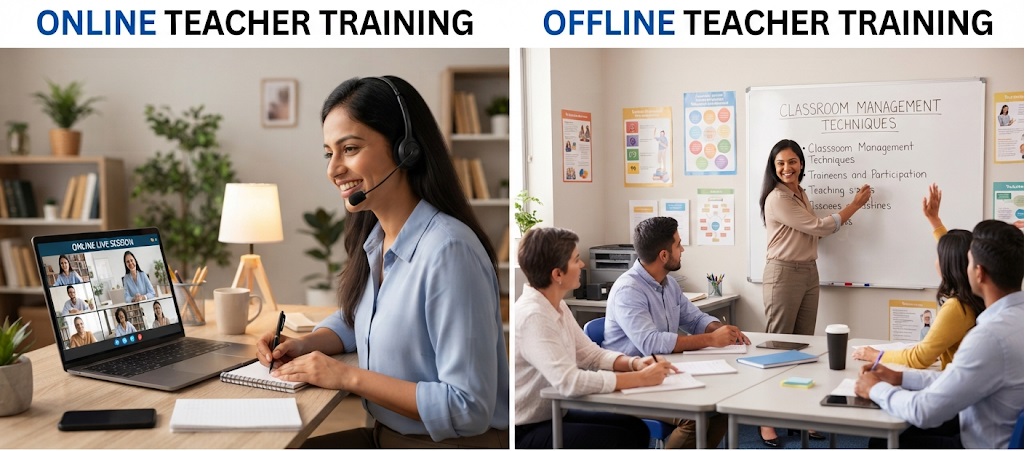
Online teacher training programs offer flexibility and accessibility. You can study from anywhere, at your own pace (in self-paced programs), and at a lower cost. There is no commute, no fixed class schedule, and no need to relocate. For working teachers completing Continuing Professional Development (CPD), online is often the only practical option. Online courses also give you access to institutes and trainers outside your city.
However, online programs vary widely in quality. Some are live, interactive, and well-structured. Others are recorded videos with minimal support. The best online programs include live sessions, discussion forums, and supervised practice teaching — but you must verify this before enrolling.
What Offline Training Gives You
Offline (face-to-face) training offers immersion and immediate feedback. You sit in a real classroom, practise with real children (or peers), and receive instant correction from an experienced trainer. You also build a peer learning community — a group of fellow trainees who discuss challenges, share ideas, and support each other. Research on teacher training consistently notes that offline mode provides “good opportunities to engage in a group discussion, which forms a supportive learning community”[reference:0].
Offline training also gives you structure and accountability. You attend classes, meet deadlines, and complete supervised practicum. For someone who struggles with self-discipline or needs hands-on guidance, this structure is a significant advantage.
Why this matters to you: Online gives you convenience. Offline gives you confidence in front of a real classroom. Neither is inherently “better” — they serve different needs.
Recognition and Validity: What NCTE and Employers Actually Accept
NCTE Rules on Fully Online vs Blended Programs
The National Council for Teacher Education (NCTE) is the body that decides which teacher training qualifications are valid for school jobs in India. The rules are clear:
- Fully online B.Ed or D.El.Ed (100% online, no attendance): Not recognised by NCTE. A B.Ed with zero attendance and zero practical component is not an NCTE-recognised qualification, regardless of how official it looks[reference:1][reference:2].
- Distance or ODL (Open and Distance Learning) B.Ed: Allowed by NCTE, but only in blended mode — online study plus compulsory face-to-face contact sessions and school-based practical work. NCTE norms require at least a quarter of the course to be hands-on practicum and internship. Admission is also restricted mainly to in-service teachers already working, not fresh graduates[reference:3].
- Short-term certificate and diploma courses (NTT, ECCE, Montessori): There is no single national rule for these. Many private preschools accept online or distance NTT/ECCE certifications, but government schools and some premium international schools may prefer or require face-to-face training. Always check with the specific employer or school chain you are targeting.
What Schools and Preschools Look For
Private preschool chains (Kidzee, EuroKids, Bachpan, Shemrock, Podar Jumbo Kids) generally accept recognised NTT or ECCE certification, whether completed online or offline, as long as the institute is credible and the practical component is covered. Government schools and recruitment boards (KVS, DSSSB, state TET bodies) verify qualifications against NCTE and UGC-DEB records — for these, fully online qualifications are not accepted[reference:4].
Why this matters to you: If your goal is a private preschool job or starting your own preschool, an online NTT/ECCE certification may be sufficient. If your goal is a government school job or a formal B.Ed pathway, you need a recognised, face-to-face or blended program. Check the specific employer requirement before you pay for any course.
Cost Comparison: Online vs Offline Teacher Training Fees
Online Course Fees in India
Online teacher training programs are generally cheaper. A 6–12 month online NTT or ECCE diploma from a reputable institute can cost ₹10,000–₹40,000. Government-supported online courses (like NCERT’s diploma) can be as low as ₹2,000 (enrolment fee only). Self-paced courses on platforms like Coursera or Udemy can cost ₹3,500–₹6,000 for a full year of access.
Offline Course Fees in India
Offline (face-to-face) NTT and ECCE programs are typically more expensive. A 1-year offline NTT from a recognised institute like Bhavan’s costs ₹15,000–₹30,000, while private institutes can charge ₹25,000–₹60,000+. Some offline courses are charged monthly (e.g., ₹7,000–₹8,000 per month for certain skill courses), which adds up over the full duration.
Comparison Table: Total Cost (Including Hidden Costs)
| Cost Component | Online Program | Offline Program |
|---|---|---|
| Course fee | ₹10,000–₹40,000 | ₹15,000–₹60,000+ |
| Travel/commute | ₹0 | ₹5,000–₹20,000 (over course duration) |
| Study materials | Often included (digital) | Often extra (₹2,000–₹5,000) |
| Opportunity cost | Lower — you can work while studying | Higher — fixed class schedule may conflict with work |
| Total estimated cost | ₹10,000–₹45,000 | ₹22,000–₹85,000+ |
Sources: CourseGuidance (2026), NCERT (2026), industry estimates. Figures are indicative and vary by institute and city.
Why this matters to you: Online is not just cheaper on paper — it also avoids travel, relocation, and lost income. For a working adult or someone in a Tier-2/3 city, the total cost difference can be significant.
Practical Training: The Biggest Difference That Nobody Talks About
Online: Simulated, Video-Based, or Supervised at Your Workplace
Practical training in online programs varies widely. Some programs include live online practice teaching sessions with peers. Others use video submissions where you record yourself teaching a lesson. The best online programs require you to complete a supervised practicum at a local preschool or your own workplace, with a mentor observing and giving feedback.
However, many online programs offer minimal or no live classroom practice. This is the single biggest weakness of purely online training. You may learn the theory of classroom management, but you have not managed a real classroom of 20 three-year-olds.
Offline: Live Classroom, Real Children, Immediate Feedback
Offline programs provide supervised practice teaching in a real classroom setting. You teach real children, receive immediate feedback from your trainer and peers, and learn to adjust your plan on the spot. You also observe experienced teachers in action and participate in school routines — arrival, snack time, story time, dismissal — which are where most classroom management challenges actually occur.
Research on teacher training notes that offline mode provides group discussion and a supportive learning community that is harder to replicate online[reference:5]. The practical component is also structurally required in NCTE-recognised programs, which is why fully online qualifications are not accepted for formal school jobs[reference:6].
Why this matters to you: If you have never taught before, offline training gives you the confidence and muscle memory of standing in front of a real class. If you are already working in a preschool, online training with a supervised workplace practicum can close the gap.
Time Commitment and Flexibility
Self-Paced vs Fixed Schedule
Online programs are often self-paced or have flexible weekly deadlines. This suits working professionals, parents, and anyone who cannot commit to a fixed daily schedule. However, self-paced learning requires self-discipline — completion rates for long-form online courses can be low.
Offline programs have a fixed schedule — you attend classes at a set time, usually daily or several times a week. This structure provides accountability and keeps you on track. For someone who struggles with procrastination, the fixed schedule is a feature, not a bug.
Why this matters to you: Be honest about your own discipline. If you know you will not stick to a self-paced course, the flexibility of online is a trap, not a benefit. Choose the format that matches your work habits.
Career Outcomes: Does Online vs Offline Matter for Jobs?
Private Preschools
Private preschool chains and independent preschools generally accept online or distance NTT/ECCE certifications, provided the institute is credible. What they care about most is whether you can manage a classroom and engage young children. If you can demonstrate practical skills (through a demo class or interview), the mode of your training matters less.
Government Schools
Government schools and recruitment boards (KVS, DSSSB, state TET bodies) require NCTE-recognised qualifications. Fully online B.Ed or D.El.Ed is not accepted. Distance/ODL programs must be in blended mode with mandatory face-to-face practicum[reference:7]. If your goal is a government job, offline or blended is the only safe route.
International Schools and Premium Preschools
Premium international schools and high-fee preschools may prefer face-to-face Montessori or ECCE training because it signals hands-on classroom experience. Some may accept online certification if the institute has a strong reputation and the candidate can demonstrate practical competence. When in doubt, ask the school directly before enrolling.
Why this matters to you: The mode of training is not the only thing employers look at — your demo class, communication skills, and attitude matter enormously. But for formal/government roles, the recognition of the qualification is non-negotiable.
Who Should Choose What?
Choose Online If…
- You are already working (in a preschool or elsewhere) and cannot attend fixed daily classes.
- You live in a city or town without access to good offline training institutes.
- You are completing CPD or upskilling, and you already have classroom experience.
- Your goal is a private preschool job or starting your own preschool, and the employer accepts online certification.
- You are self-disciplined and can complete a self-paced course without external accountability.
Choose Offline If…
- You are a fresh graduate or career switcher with no prior classroom experience.
- Your goal is a government school job or a formal B.Ed/D.El.Ed pathway.
- You want supervised practice teaching with real children and immediate feedback.
- You learn best in a structured, face-to-face environment with peers.
- You want to build a local network of fellow teachers and trainers.
The Hybrid/Blended Path
You do not have to choose one or the other. Blended programs combine online theory with face-to-face practicum — and these are increasingly the norm in recognised teacher education. NCTE’s own framework for distance B.Ed requires a significant face-to-face practical component[reference:8]. If you want the flexibility of online learning and the credibility of classroom practice, look for a blended NTT/ECCE program that includes supervised teaching practice.
Why this matters to you: The best choice is not “online” or “offline” in the abstract. It is the program that gives you recognition + practical experience + a schedule you can actually complete. A blended program often delivers all three.
7-Point Checklist Before Choosing a Teacher Training Program
- Is the qualification recognised for the jobs I want (private preschool, government school, international school)?
- Does the program include supervised practice teaching with real children?
- What is the total cost, including travel, materials, and opportunity cost?
- Can I realistically complete the format (self-paced online vs fixed offline)?
- Does the institute have a credible reputation and verifiable reviews?
- Have I spoken to past students about their experience and job outcomes?
- Does the program include placement support or a pathway to practical experience?
If the answer to questions 1, 2, or 4 is unclear, do not enrol yet.
Final Verdict
If you are a fresh graduate or career switcher: Choose offline or blended training. The supervised classroom practice and structured schedule will build your confidence and make you a stronger candidate. The higher cost is an investment in your effectiveness.
If you are already working in a preschool: Choose online or blended training. You already have classroom experience; you need the certification. A supervised workplace practicum can close the practical gap.
If your goal is a government school job: Choose only NCTE-recognised offline or blended programs. Fully online qualifications will not be accepted[reference:9].
If your goal is to start your own preschool: Choose online or blended NTT/ECCE to keep costs low, but invest in a program with a practical component. Your future parents will judge you on your classroom, not your certificate.
Ready to choose the right teacher training program for your career?
Visit international-ece.com for expert guidance on ECCE and NTT courses →
Or fill this 2-minute form and get personalised recommendations based on your budget and career goal.
Frequently Asked Questions (FAQ)
Is an online teacher training certificate valid for preschool jobs in India?
Yes, if it is from a recognised institute (NCTE, university, or reputed early childhood association). Employers care more about the recognition of the certification and your practical skills than the mode of delivery. However, some premium preschools may prefer offline-trained candidates with classroom experience.
How much does an online teacher training program cost compared to offline?
Online ECCE/NTT courses cost ₹10,000–₹40,000, while offline programs cost ₹15,000–₹60,000+. Offline programs also add travel and accommodation costs if you relocate. Online is significantly cheaper, but may offer less practical exposure.
Can I get a teaching job with only an online certification?
Yes, especially if you supplement it with volunteer teaching, an internship, or assistant teacher experience. Many preschools value practical skills and attitude as much as the certificate. However, for premium international schools, offline training with supervised practice is often preferred.
What is blended learning in teacher training?
Blended learning combines online theory with in-person practical sessions. You study the theory at home and attend a short intensive block for classroom practice and assessment. It offers flexibility without sacrificing hands-on experience.
How long does an online teacher training program take?
Online programs typically take 3–6 months, depending on the institute and whether you study full-time or part-time. Offline programs take 6 months to 2 years. Blended programs usually run 6–12 months.
Which is better for a career switcher: online or offline?
Blended or offline is usually better for career switchers because they need supervised classroom practice to build confidence. If offline is not possible, choose online but add volunteer teaching or an internship before applying for jobs.