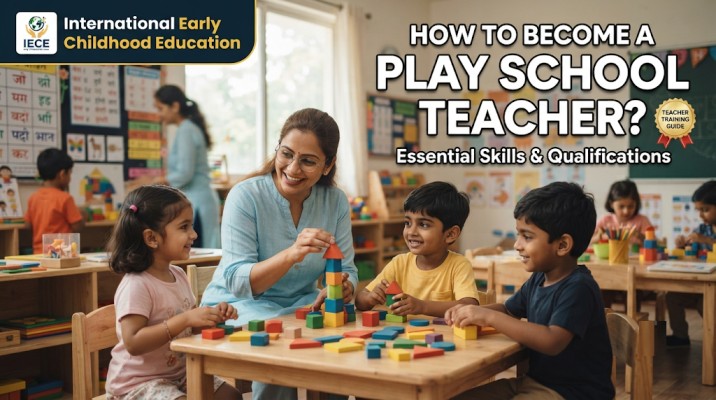
How to Become a Play School Teacher? Essential Skills and Qualifications (2026 Guide)
To become a play school teacher in India, you need three things: a recognised teacher training qualification (NTT, ECCE, or Montessori), a specific set of child-centred skills, and practical classroom experience. The minimum eligibility is 10+2, and a 3–12 month certificate or diploma is enough to start applying for jobs.
India’s preschool sector is growing at 15% annually, with 500+ new preschools opening every year and a rising demand for qualified early childhood educators. NEP 2020 has made structured ECCE certification a national priority. Yet, a large share of pre-primary schools still lack dedicated ECE-trained teachers — which means the opportunity for qualified candidates is real and growing.
One-Line Answer: What Do You Need to Become a Play School Teacher?
Qualification: 10+2 minimum, plus a recognised certificate or diploma in Nursery Teacher Training (NTT), Early Childhood Care and Education (ECCE), or Montessori training. A bachelor’s degree is preferred by premium institutions.
Skills: Patience, communication, creativity, classroom management, and basic child psychology.
Experience: An internship or assistant teacher role in a preschool is not mandatory but significantly improves your chances.
Why this matters to you: You do not need a B.Ed to teach at the preschool level in most private schools. A focused, short-duration certification — combined with the right temperament — is the fastest route into the classroom.
Why Play School Teaching Is a Growing Career in India
15% Annual Sector Growth and 500+ New Preschools Yearly
The preschool sector in cities like Bangalore alone is growing at 15% annually, with over 5,000 preschools and 500+ new ones opening every year. This growth is not limited to metros. Tier-2 cities like Indore, Jaipur, and Patna are seeing a surge in demand for branded preschools, driven by dual-income families and rising awareness of early childhood education.
NEP 2020’s Push for Qualified ECCE Teachers
NEP 2020 explicitly recommends structured certification for ECCE teachers: a 6-month certificate programme for those with 10+2 and above**, and a **1-year diploma** for those with lower qualifications. It also recommends **50 hours of annual Continuous Professional Development (CPD)** for teachers. This policy push is formalising the sector — and creating a premium for certified teachers.
The Gap: Only 9% of Pre-Primary Schools Have Dedicated ECE Teachers
Despite the policy push, only 9% of pre-primary schools have dedicated ECE teachers, according to field reports. This gap is the opportunity. A certified, skilled play school teacher is not competing with hundreds of applicants for every role — they are entering a market where qualified candidates are still scarce.
Why this matters to you: You are entering a profession where demand is growing faster than the supply of trained teachers. The right certification and a genuine love for working with children can open doors quickly.
Essential Qualifications: NTT, ECCE, Montessori, or D.El.Ed?
Minimum Eligibility: 10+2 and a Recognised Teacher Training Certificate
The baseline requirement for most play school teacher roles in India is 10+2 (any stream) plus a recognised teacher training certificate or diploma. A bachelor’s degree in any discipline is preferred by premium institutions, and a degree in Education or Child Development is a further advantage.
Nursery Teacher Training (NTT): Duration, Cost, and Recognition
NTT is the most widely recognised pathway for preschool teaching in India. Course duration ranges from 1 to 2 years**, with fees varying from **₹6,000 to ₹60,000** depending on the institute. A 1-year NTT diploma is sufficient for most private preschools.
ECCE Diploma: NEP 2020’s Recommended Pathway
The ECCE Diploma** is the qualification NEP 2020 explicitly recommends for early childhood educators. Duration is **6 months to 1 year**, with fees ranging from **₹20,000 to ₹80,000**. It covers early literacy, numeracy, and developmentally appropriate practices — aligned with the NCF-FS 2022 framework.
Montessori Training: The International Option
Montessori training is a strong choice for teachers who want to work in premium international preschools or Montessori-affiliated centres. Duration ranges from 3 to 12 months**, with fees from **₹30,000 to ₹1,50,000**. It is more expensive but opens doors to higher-paying institutions.
Comparison Table: Duration, Cost, and Career Fit
| Qualification | Duration | Estimated Cost (₹) | Best For |
|---|---|---|---|
| Play School Teacher Training | 3–6 months | ₹15,000–₹50,000 | Quick entry into preschool teaching |
| NTT (Nursery Teacher Training) | 1–2 years | ₹6,000–₹60,000 | Widely recognised; standard pathway |
| ECCE Diploma | 6 months–1 year | ₹20,000–₹80,000 | NEP 2020 aligned; policy-preferred |
| Montessori Training | 3–12 months | ₹30,000–₹1,50,000 | International schools and premium preschools |
Sources: Gigglezz Academy (2026), ISD (2026), JS Bright Education (2026). Figures are estimates and vary by institute and city.
Why this matters to you: The ECCE Diploma is the most future-proof qualification because it aligns with NEP 2020. If you want the fastest route, a 3–6 month play school teacher training certificate is enough to start. If you want to work in a premium international school, invest in Montessori training.
Essential Skills Every Play School Teacher Needs
Patience and Empathy (The Non-Negotiable)
Every job listing for a play school teacher lists patience, empathy, and a genuine love for working with children as the top requirement. Young children have short attention spans, big emotions, and unpredictable behaviour. A teacher who can stay calm, respond with warmth, and see the child’s perspective is more valuable than one with a dozen certifications.
Communication and Storytelling
Strong verbal communication — in English and the local language — is essential. But it is not just about speaking clearly. It is about expressive storytelling, singing, and using voice and gesture to hold a child’s attention**. Job listings consistently highlight “expressive storytelling ability” and “clear diction” as key skills.
Creativity and Activity Planning
Play school teachers design activities with minimal resources** — chart paper, colours, everyday objects, and imagination. Creativity in planning lessons, making teaching aids, and setting up activity corners is a core skill. You do not need expensive materials. You need ideas.
Classroom Management and Child Psychology
Managing a room of 15–25 three-to-five-year-olds requires calm authority, routine, and positive discipline** — not punishment. Basic knowledge of **child psychology and developmental milestones** helps you understand why a child is acting out and how to respond.
Parent Communication and Teamwork
Parents are anxious about their child’s first school experience. A play school teacher must be able to communicate progress, address concerns, and build trust** with parents. Teamwork with co-teachers, helpers, and centre heads is equally important.
Why this matters to you: Qualifications get you the interview. Skills get you the job — and keep you in it. If you are patient, creative, and genuinely enjoy being around young children, you already have the foundation. The rest can be learned.
Step-by-Step Path to Becoming a Play School Teacher
Step 1: Complete 10+2 (Any Stream)
This is the minimum educational requirement for most teacher training courses and play school jobs. A bachelor’s degree is preferred by premium institutions but not mandatory to start.
Step 2: Enrol in a Recognised Teacher Training Course
Choose between a 3–6 month play school teacher training certificate** (fastest), a **1-year NTT or ECCE diploma** (most recognised), or **Montessori training** (best for international schools). Look for courses with a practical internship component.
Step 3: Gain Practical Experience
Complete an internship or work as an assistant teacher in a preschool. This gives you real classroom exposure, a portfolio of lesson plans, and a reference. Many training institutes offer placement assistance.
Step 4: Build Your Portfolio and Apply
Create a simple portfolio: your lesson plans, activity ideas, teaching philosophy, and any classroom management strategies you have learned. Apply to chain preschools (Kidzee, EuroKids, Little Millennium), international schools with preschool programmes, and independent preschools.
Step 5: Continue Professional Development (CPD)
NEP 2020 recommends 50 hours of annual CPD**. Attend workshops on child psychology, play-based learning, and first aid. The best teachers never stop learning.
Why this matters to you: The path is not complicated, but it requires deliberate steps. Certification + practical experience + a good portfolio is the winning combination.
Play School Teacher Salary in India (2026)
Fresher vs. Experienced vs. Senior Teacher Salary Ranges
| Experience Level | Monthly Salary Range (₹) | Source |
|---|---|---|
| Fresher (0–1 year) | ₹8,000–₹20,000 | SimplyHired (2026); Indeed (2026) |
| Experienced (1–3 years) | ₹15,000–₹35,000 | Indeed (2026); EducoHire (2026) |
| Senior Teacher (3–5 years) | ₹25,000–₹60,000 | Glassdoor (2026); Gigglezz (2026) |
| Lead Teacher / Coordinator (5+ years) | ₹40,000–₹80,000+ | Gigglezz (2026) |
City-Wise Salary Comparison
Mumbai/Bangalore: Premium international preschools pay ₹25,000–₹36,000+ per month for experienced teachers. Indore/Jaipur: ₹12,000–₹25,000 per month. Patna: ₹10,000–₹20,000 per month. Salaries vary widely by institution type, location, and qualifications.
Why this matters to you: Play school teaching is not a high-salary career at entry level, but it offers steady growth, strong work-life balance (typically 9 AM to 1 PM), and clear progression to centre head or preschool owner.
NEP 2020 and the Future of ECCE Teaching in India
6-Month Certificate for 10+2 Holders; 1-Year Diploma for Others
NEP 2020 recommends that Anganwadi workers and ECCE teachers with 10+2 or above** receive a **6-month certificate programme in ECCE**, while those with lower qualifications receive a **1-year diploma** covering early literacy, numeracy, and developmentally appropriate practices. This is formalising the sector and creating a clear qualification pathway for new entrants.
50 Hours of Annual CPD Recommended
The policy also recommends 50 hours of annual Continuous Professional Development (CPD)** for all ECCE teachers. This means qualified teachers will be expected to keep learning — and those who do will be better positioned for promotions and premium roles.
Why this matters to you: A play school teacher qualification is not a one-time investment. The field is professionalising. If you enter now with a recognised certification and a commitment to ongoing learning, you are ahead of the curve.
7-Point Checklist for Aspiring Play School Teachers
- Do I genuinely enjoy spending time with young children?
- Do I have 10+2 or a bachelor’s degree?
- Have I enrolled in (or completed) a recognised NTT, ECCE, or Montessori course?
- Do I have practical classroom experience (internship or assistant teacher)?
- Am I patient, creative, and comfortable communicating with parents?
- Have I built a portfolio of lesson plans and activity ideas?
- Am I committed to ongoing professional development (CPD)?
If the answer to questions 1, 3, or 4 is “no,” start there before applying for jobs.
Final Verdict
If you are a fresh graduate or career switcher: Start with a 3–6 month play school teacher training certificate** or a **1-year NTT/ECCE diploma**. Complete an internship. Apply to chain preschools and independent schools in your city. You can be in a classroom within 6–12 months.
If you want to work in a premium international school: Invest in Montessori training** and build a portfolio that demonstrates child-led, play-based teaching. The higher course fee pays back in better salary and career options.
If you are already working in a preschool without formal certification: Enrol in an ECCE diploma** — it is NEP 2020 aligned, increasingly expected by employers, and can be completed alongside your job.
Ready to start your journey as a play school teacher?
Explore ECCE teacher training programmes and resources on international-ece.com →
Frequently Asked Questions (FAQ)
What qualifications do I need to become a play school teacher in India?
The minimum requirement is 10+2, plus a recognised teacher training certificate or diploma in NTT, ECCE, or Montessori. A bachelor’s degree is preferred by premium institutions. NEP 2020 recommends a 6-month ECCE certificate for 10+2 holders and a 1-year diploma for others.
How long does it take to become a play school teacher?
You can complete a play school teacher training certificate in 3–6 months, an NTT or ECCE diploma in 6 months–1 year, or Montessori training in 3–12 months. Adding an internship or assistant teacher role adds another 3–6 months. Most people can start applying for jobs within 6–12 months.
What skills are most important for a play school teacher?
Patience, empathy, creativity, strong communication, and classroom management are the core skills. Basic knowledge of child psychology and the ability to communicate with parents are also essential. Expressive storytelling and activity planning with minimal resources are consistently listed in job requirements.
What is the salary of a play school teacher in India?
Freshers earn ₹8,000–₹20,000 per month. Experienced teachers (1–3 years) earn ₹15,000–₹35,000. Senior teachers (3–5 years) earn ₹25,000–₹60,000. Lead teachers and coordinators (5+ years) can earn ₹40,000–₹80,000+ per month, with premium international schools paying at the higher end.
Is a B.Ed required to become a play school teacher?
No. A B.Ed is not mandatory for preschool teaching in most private schools. A recognised NTT, ECCE, or Montessori certification is sufficient. A bachelor’s degree in any discipline is preferred, but the teacher training certification is the key requirement.
What is the difference between NTT, ECCE, and Montessori?
NTT (Nursery Teacher Training) is the most widely recognised Indian certification. ECCE (Early Childhood Care and Education) is the NEP 2020-aligned qualification focused on play-based, developmentally appropriate practice. Montessori training is an international method focused on child-led, hands-on learning, best for premium and international schools.