Smart Ways to Teach Preschoolers: How to Educate Children Through Play (2026)
Play is not a break from learning for preschoolers — it is the learning. Research consistently shows that play-based learning improves cognitive, social, emotional, and physical development in young children, and India’s NEP 2020 now mandates play-based, activity-based, and inquiry-based education for the foundational stage (ages 3–8).
The smartest way to teach a preschooler is not through worksheets or rote memorisation. It is through guided play, storytelling, sensory exploration, role-play, and movement — methods that build foundational literacy, numeracy, and social skills while the child is having fun. This guide gives you practical, research-backed ways to do it at home or in a classroom.
One-Line Answer: Why Play Is the Smartest Teaching Tool
Play-based learning works because it matches how young brains develop. Preschoolers learn best through sensory exploration, movement, repetition, and joyful interaction — not through sitting still and copying letters. A child who “plays shop” is learning counting, language, negotiation, and empathy simultaneously. A child who completes a worksheet is learning to follow instructions — and often learning to dislike learning.
Why this matters to you: If you are a parent or teacher pushing academics earlier and earlier, you may be slowing down the very skills — curiosity, problem-solving, language — that make later academics easier.
What the Research Says About Play-Based Learning
Cognitive, Social, and Emotional Benefits
A 2025 review of play-based learning in early childhood settings found that it improves educator-child interactions while fostering creativity, problem-solving, communication, and emotional well-being. Another 2025 study confirmed that play-based activities improve cognitive, social, emotional, and physical development, helping children learn new information, develop critical thinking, and build empathy and self-regulation[reference:0].
Play also supports early literacy and mathematics. A 2025 study across 37 pre-primary classes found that teacher play practices contributed to student learning gains in language and mathematics in early childhood education[reference:1]. The evidence is not anecdotal — it is consistent across countries and contexts.
NEP 2020 and the Push for Play-Based ECCE in India
India’s National Education Policy (NEP) 2020 marks a turning point. It explicitly emphasises play-based, activity-based, and inquiry-based learning for the foundational stage, moving away from rote memorisation and narrow academic focus[reference:2]. The National Curriculum Framework for Foundation Stage (NCFFS) 2022 builds on this, advocating a shift from teacher-centred methods to child-centred, play-based pedagogy[reference:3].
The policy also introduced Universal Early Childhood Care and Education (ECCE) , covering three years of pre-K as an integral part of formal education. This is driving demand for structured preschool programmes, especially in Tier-2 cities and beyond[reference:4].
The Gap Between Policy and Classroom Practice
Despite the policy push, implementation remains uneven. Research suggests that many early childhood educators do not sufficiently value play’s inclusion in preschool programmes, and some “play-based” classrooms still coexist with traditional rote methods rather than replacing them[reference:5]. In some private preschools, formal instruction akin to primary school persists, while public preschools are more likely to engage children in play-based activities like artwork, singing, and puzzles[reference:6].
Why this matters to you: The policy is on your side, but the classroom may not be. Whether you are a parent choosing a preschool or a teacher building a curriculum, you need to know what genuine play-based learning looks like — and what it does not.
The 5 Smart Play-Based Teaching Methods
1. Guided Play (The Sweet Spot Between Free Play and Instruction)
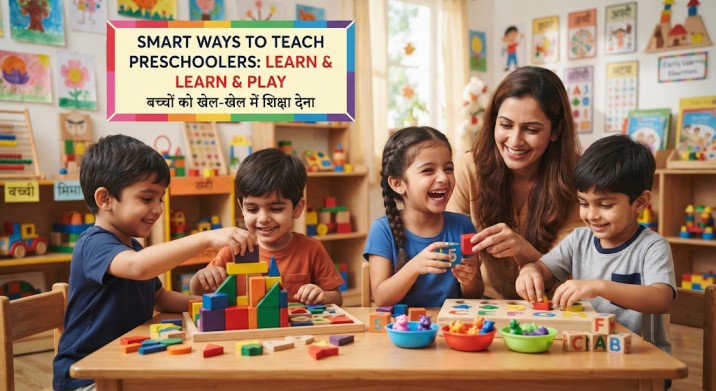
Guided play sits between unstructured free play and direct instruction. The child leads the play, but the adult observes, scaffolds, and extends the learning with gentle questions or props. For example, if a child is stacking blocks, the adult might ask, “What happens if you take one away?” or “Can you build a tower taller than this one?”
Guided play is often the most effective method because it respects the child’s autonomy while ensuring the learning is intentional[reference:7]. It works for language, numeracy, problem-solving, and social skills.
2. Storytelling and Puppetry
Stories are one of the oldest teaching tools — and still one of the most powerful. Telling stories with voice, expression, puppets, or hand gestures builds vocabulary, listening skills, sequencing, and imagination[reference:8]. Puppetry adds a layer of engagement that helps shy children participate and makes abstract ideas concrete.
India’s National Book Trust has explicitly highlighted storytelling, puppetry, and play-based learning as powerful tools for early childhood education, noting that simple tools like puppets and everyday objects can stimulate imagination and enhance communication[reference:9].
3. Sensory and Loose-Parts Play
Young children learn through their senses. Sensory play — with sand, water, rice, pebbles, playdough, or fabric — helps children explore texture, volume, cause and effect, and early measurement concepts. “Loose parts” play uses open-ended materials like bottle caps, buttons, sticks, and paper scraps for sorting, counting, pattern-making, and art.
UNICEF India recommends using local and low-cost materials like seeds, buttons, bottle caps, paper scraps, mud, sand, or twigs for counting, sorting, or making art. These materials make learning fun and root it in everyday life[reference:10].
4. Role-Play and Pretend Play
Pretend play — running a “shop,” cooking in a “kitchen,” or playing “doctor” — is a rich learning opportunity. Children practise language, negotiation, turn-taking, empathy, and early numeracy (counting play money, measuring “ingredients”). Role-play also helps children process real-world experiences and build confidence.
UNICEF recommends role-playing everyday situations like going to the market or helping at home as a simple, effective way to support learning[reference:11].
5. Music, Movement, and Action Rhymes
Songs, rhymes, and movement games build phonological awareness, memory, rhythm, coordination, and social connection. Action rhymes like “Head, Shoulders, Knees, and Toes” teach body awareness and vocabulary. Musical games like “freeze” or “follow the leader” build self-regulation and listening skills.
Movement is not a distraction from learning — it is a pathway to it. Children who move while learning are more likely to retain information and stay engaged.
Play-Based Learning vs. Traditional Rote Teaching
Comparison Table: Engagement, Retention, Skill Development
| Factor | Play-Based Learning | Traditional Rote Teaching |
|---|---|---|
| Engagement | High — child-led, joyful, curiosity-driven | Variable — often passive, compliance-driven |
| Retention | Stronger — learning is embedded in experience and emotion | Weaker — facts are memorised without context |
| Skill development | Whole-child: cognitive, social, emotional, physical, language | Narrow: literacy and numeracy only |
| Creativity and problem-solving | Actively nurtured through open-ended play | Limited — focus on correct answers |
| Social-emotional growth | Built through collaborative play and negotiation | Rarely addressed |
| Love of learning | Preserved and strengthened | Often diminished |
Sources: Synthesis of 2025 play-based learning research, NEP 2020 framework, and UNICEF guidance.
Why Worksheets and Rote Memorisation Fail Preschoolers
Preschoolers’ brains are not wired for sustained sedentary instruction. They learn through movement, touch, repetition, and social interaction. Worksheets may produce short-term performance — a child who can write “A” earlier than peers — but they do not build the foundational understanding that later reading and mathematics require. Worse, they can turn learning into a chore before the child has even started formal school.
Why this matters to you: If you are choosing a preschool, ask what a typical day looks like. If the answer is “lots of worksheets” or “children sit and copy,” that is not a play-based programme, regardless of what the brochure says.
Age-Wise Play Activities for Preschoolers
Ages 2–3: Sensory Exploration and Simple Pretend Play
At this age, children learn through their senses and simple imitation. Try:
- Feel-and-guess bag: Put different objects in a bag and ask the child to feel one and describe it — “Is it soft? Rough? Round?”[reference:12]
- Stacking and knocking down blocks: Builds early number sense and cause-and-effect understanding[reference:13]
- Sound shakers: Fill containers with rice, pebbles, or sand and let the child shake them to discover different sounds[reference:14]
- Pretend play: Simple role-play like “feeding a doll” or “driving a car” builds language and empathy.
Ages 3–4: Guided Play, Sorting, Matching, and Storytelling
At this stage, children are ready for more intentional guided play. Try:
- Sorting and matching games: Sort buttons, bottle caps, or coloured paper by size, colour, or shape.
- Storytelling with props: Use puppets or simple toys to tell a story and ask the child what happens next.
- Pattern-making: Create simple patterns with blocks or beads and ask the child to continue them.
- Action rhymes: Sing rhymes with movements — “Twinkle, Twinkle” with hand actions, or “The Wheels on the Bus” with gestures.
Ages 4–5: Role-Play, Early Numeracy Through Games, Collaborative Play
Older preschoolers can handle more complex play with rules and collaboration. Try:
- Pretend shop: Set up a “shop” with play money and encourage counting, adding, and taking turns[reference:15].
- Obstacle courses: Build a simple indoor or outdoor obstacle course that requires jumping, balancing, and following sequences.
- Collaborative art: Work on a group drawing or craft project that requires sharing materials and negotiating roles.
- Simple board or card games: Games that involve counting, matching, or turn-taking build numeracy and social skills.
Why this matters to you: The activities are simple, low-cost, and do not require special toys. What they require is your presence, a little intentionality, and the willingness to let the child lead.
How Parents Can Teach Through Play at Home
Low-Cost, Everyday Materials
You do not need expensive toys or a dedicated playroom. The best play materials are often everyday objects: vessels, spoons, clothes, boxes, bottles, rice, sand, water, buttons, and paper. UNICEF recommends using local and low-cost materials like seeds, buttons, bottle caps, paper scraps, mud, and twigs for counting, sorting, and art[reference:16].
5-Minute Play Ideas for Busy Parents
- While cooking: Let the child “measure” ingredients with you, count spoons, or sort vegetables by colour.
- While folding laundry: Ask the child to match socks, sort clothes by size, or count items.
- During bath time: Provide containers for pouring and measuring — early volume and cause-and-effect learning.
- On a walk: Count steps, identify colours, or play “I spy” with shapes and sounds.
- Before bedtime: Tell a story with voices and ask the child to add to it.
What to Avoid (Over-Scheduling, Screen Dependence, Forced Academics)
Three common mistakes undermine play-based learning at home:
- Over-scheduling: Too many structured classes leave no time for free, unstructured play.
- Screen dependence: Passive screen time does not replace active, hands-on play.
- Forced academics: Pushing worksheets or formal reading before the child is ready can create anxiety and resistance.
Why this matters to you: Your child does not need a “learning app” or a tuition class at age four. They need you, a few simple materials, and permission to play.
How Preschools Can Build a Play-Based Curriculum
Environment Design and Learning Corners
A play-based classroom is organised into learning corners — a reading corner, a block corner, an art corner, a pretend-play corner, and a sensory corner. Children move between these areas, choosing activities and exploring at their own pace. The environment itself becomes a teacher.
Teacher Training and Intentionality
Play-based learning is not laissez-faire. Teachers need training in observing, scaffolding, and extending play without hijacking it. The most effective play-based teachers know when to step in and when to step back[reference:17]. This intentionality is what separates genuine play-based pedagogy from unstructured free time.
Balancing Structure and Free Play
A good preschool day includes both structured play (games with rules, teacher-led activities) and unstructured play (free choice, child-initiated exploration). Both are valuable. Structured play teaches turn-taking and following rules; unstructured play builds creativity, independence, and problem-solving[reference:18].
7-Point Checklist for Play-Based Learning at Home or School
- Is the child leading the play, with an adult observing and scaffolding?
- Are there open-ended materials (blocks, sand, water, art supplies) available daily?
- Is there a balance of structured and unstructured play?
- Are stories, songs, and movement part of the daily routine?
- Is the environment safe, welcoming, and child-friendly?
- Are worksheets and rote memorisation kept to a minimum (or avoided entirely)?
- Is there time for social play with other children?
If the answer to questions 1, 2, or 6 is “no,” the learning is not genuinely play-based.
Final Verdict
For parents: You do not need a formal curriculum to teach your preschooler. You need daily play — guided, sensory, storytelling, movement — and the willingness to let your child lead. Five minutes of intentional play is worth more than an hour of worksheets.
For teachers and preschools: The policy (NEP 2020) is on your side, but implementation requires training, environment design, and a genuine belief that play is learning — not a reward after learning.
For anyone choosing a preschool: Ask what a typical day looks like. If children spend most of their time sitting, copying, or completing worksheets, it is not play-based. Look for learning corners, open-ended materials, storytelling, outdoor play, and happy, engaged children.
Ready to explore play-based preschool programmes and resources?
Visit international-ece.com for expert early childhood education guidance →
Frequently Asked Questions (FAQ)
What is play-based learning for preschoolers?
Play-based learning is an approach where children learn through play — guided, unstructured, sensory, and social — rather than through rote instruction. The child leads the activity, and the adult scaffolds learning through questions, props, and gentle extension. It builds cognitive, social, emotional, and physical skills simultaneously.
Is play-based learning better than traditional preschool teaching?
Research consistently shows that play-based learning improves engagement, retention, creativity, problem-solving, and social-emotional development compared to rote teaching. NEP 2020 also mandates play-based, activity-based, and inquiry-based education for the foundational stage. Traditional rote methods may produce short-term performance but often undermine long-term love of learning.
How do I teach my child through play at home?
Use everyday materials — vessels, buttons, rice, sand, clothes, boxes — and simple activities like sorting, counting, storytelling, pretend play, and action rhymes. Let the child lead, ask open-ended questions, and keep sessions short and joyful. Five to ten minutes of intentional play daily is enough.
What are the best play activities for 3–5 year olds?
Guided play, storytelling with puppets, sensory play with sand or water, role-play (shop, kitchen, doctor), sorting and matching games, pattern-making, action rhymes, and collaborative art. The key is open-ended materials and adult scaffolding, not structured worksheets.
Does NEP 2020 support play-based learning?
Yes. NEP 2020 explicitly emphasises play-based, activity-based, and inquiry-based learning for the foundational stage (ages 3–8). The National Curriculum Framework for Foundation Stage (NCFFS) 2022 builds on this, advocating a shift from teacher-centred to child-centred, play-based pedagogy.
How do I choose a play-based preschool?
Ask what a typical day looks like. Look for learning corners, open-ended materials, storytelling, outdoor play, and happy, engaged children. Avoid preschools where children spend most of their time sitting, copying, or completing worksheets. Ask about teacher training in play-based methods.