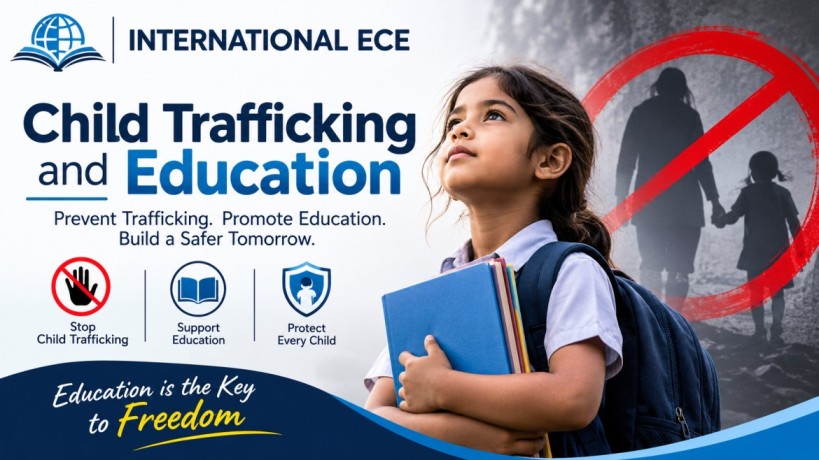
Child Trafficking and Education: How Schools and Teachers Can Prevent Risk
Schools and teachers are India’s most strategic frontline against child trafficking because they see children daily, notice absences, and can intervene before a child disappears. Teachers must know the legal duty to report under BNS 2023 and NCPCR guidelines, recognise warning signs like sudden dropout or online grooming, and immediately alert Childline 1098 or the local Anti-Human Trafficking Unit (AHTU).
NCRB data shows over 53,000 children were rescued from trafficking and exploitation between April 2024 and March 2025 The conviction rate remains 4.8%]. The gap between rescue and conviction is exactly why prevention — not just prosecution — must start in classrooms.
Why Schools Are India’s Most Strategic Anti-Trafficking Frontline
A trafficker’s first move is to remove a child from visibility. School is the one institution that sees the child every day. When a child stops attending, a teacher is often the first adult to notice.
Prajwala, the Hyderabad-based anti-trafficking organisation, puts it plainly: school students spend the majority of their daytime at school, which gives a teacher the opportunity to address vulnerabilities before predators exploit them More than 25% of those sex-trafficked are girls below 16 years of age
Why this matters to you: If you teach in a government school in Patna, a low-fee private school in Indore, or a Tier-3 school in Jaipur, your daily attendance register is a child-protection tool — not just administrative paperwork.
The Scale of the Problem: NCRB Data You Cannot Ignore
NCRB recorded 3,098 children below 18 rescued in 2022 alone The 2024–25 rescue figure of 53,000+ includes children from labour, trafficking, and kidnapping. On average, one child goes missing in India every eight minutes, according to NCRB-linked reporting[.
The Supreme Court in K. P. Kiran Kumar vs State (2025) called trafficking a direct violation of Article 21 and issued binding guidelines to states and police. Schools are named as part of the prevention ecosystem.
The Legal Duty of Schools and Teachers: What the Law Actually Says
India does not yet have a single operative “Trafficking in Persons Act” in force as of 2027— the Bill has been pending in various forms since 2018. But trafficking is already criminalised across multiple statutes, and school staff are covered.
BNS 2023, POCSO, and JJ Act: The Relevant Provisions
| Law | Relevant Provision | What It Means for Schools |
|---|---|---|
| Bharatiya Nyaya Sanhita (BNS) 2023 | Section 143 (trafficking of minors) | Trafficking is punishable irrespective of consent. Reporting suspicion is a civic and legal duty. |
| POCSO Act, 2012 | Section 19 (mandatory reporting) | If trafficking involves sexual exploitation, POCSO reporting duty is triggered immediately. |
| Juvenile Justice Act, 2015 | Care and protection provisions | Children rescued or at risk must be produced before the Child Welfare Committee (CWC). |
| NCPCR Guidelines (2024) | RTE enrollment, vigilance against illegal transportation | Schools must ensure children aged 6–14 are enrolled and flag unexplained cross-border movement. |
NCPCR wrote to all states in May 2024 asking authorities to be vigilant against trafficking “in the garb of transporting children from one state to another” and to ensure every child aged 6–14 is in a neighbourhood school under the RTE Act. The Commission specifically flagged school dropouts and out-of-school children as the highest-risk group.
Why this matters to you: A child missing from your class for seven consecutive days is not just a truancy issue. It is a trafficking-risk signal that NCPCR expects schools to act on.
NCPCR Guidelines: RTE, Enrollment, and Vigilance
NCPCR’s 2024 directive is explicit: state authorities must ensure children in the 6–14 age group are enrolled in formal schools and receive free and compulsory education under RTE. In one case, 95 children were rescued while being illegally transported from Bihar to Uttar Pradesh; they had been confined to an unregistered Madrasa and denied formal schooling.
For schools, this means two duties: keep children enrolled, and flag any pattern of withdrawal or transfer that looks like movement for exploitation.
Warning Signs a Teacher Can Spot Before Trafficking Happens
Traffickers rely on invisibility. Teachers can make a child visible again by noticing changes early.
Behavioural and Attendance Red Flags
A child who suddenly stops attending, or whose parents withdraw them citing “a job in the city” or “marriage,” is a red flag. So is a child who appears with an unrelated adult claiming to be a “relative” or “employer.”
Prajwala’s teacher training manual identifies adolescence — especially for first-generation learners in government schools — as the highest-vulnerability window, because parents may lack the awareness to spot grooming.
Online Grooming and Fake Job Lure Signs
Traffickers now use social media and messaging apps to lure teenagers with fake job offers, modelling contracts, or “scholarships.” A student who suddenly has a new phone, unexplained money, or talks about meeting an “online friend” in another city needs a private, non-judgmental conversation.
| Warning Sign | Teacher’s Immediate Action |
|---|---|
| Absent for 7+ consecutive days without valid reason | Call home; document; escalate to nodal teacher / principal; report to Childline if unreachable. |
| Withdrawal from school citing vague “job” or “relative’s offer” | Do not approve transfer immediately; ask for details; alert school safeguarding lead. |
| New phone, money, or gifts unexplained | Private conversation; document exact words; do not confiscate or investigate. |
| Older “friend” or “recruiter” contacting student online | Report to principal and Childline 1098; preserve screenshots if student shares them. |
Why this matters to you: You do not need proof to raise a concern. Early signal + early report = prevention.
Step-by-Step: What a Teacher Should Do When Trafficking Is Suspected
Step 1: Do Not Confront or Investigate
Your role is to observe and report, not to verify. Confronting a suspected trafficker or pressuring the child for details can endanger the child and compromise a future investigation.
Create a quiet, private space. Use open prompts: “I’ve noticed you’ve been absent. Is everything okay at home?”
Step 2: Document and Report to Childline 1098 / AHTU
Write down exactly what you observed and what the child said, using their words. Note date, time, and context. Then call Childline 1098 or the local Anti-Human Trafficking Unit (AHTU).
Childline 1098 is the national 24×7 helpline for children in distress. It connects to the district child protection system. You do not need permission from the school to call.
Step 3: Escalate Within the School Safeguarding Chain
Inform the principal or the designated safeguarding lead after (or simultaneously with) reporting. If the school has a nodal teacher for child protection, loop them in immediately. The school’s internal process must never delay the external report.
Why this matters to you: A delayed report can be the difference between a rescued child and a missing child.
What Schools Must Build: Prevention Systems That Work
Child Vigilant Clubs and Nodal Teachers
Schools that have stopped trafficking cases share one feature: they track absence aggressively. In one model, schools identify 10 student volunteers and 2–3 teachers to form a Child Vigilant Club. The club watches for missing students and reports absence to teachers, who alert the protection team[
Every school should designate a Nodal Teacher for child protection — a single point of contact for Childline, AHTU, and the District Child Protection Unit.
Teacher Training: The Prajwala Model and Telangana Example
Prajwala’s 2025 training manual for School Assistants and high school teachers is a practical, module-based resource for preventing human trafficking among students aged 12–16. In June 2025, Prajwala signed an MoU with the Telangana School Education Department to sensitise teachers across KGBV, Model Schools, and government schools on trafficking prevention.
Delhi, Maharashtra, and Tamil Nadu have also moved from advisory to mandatory school-safety compliance after trafficking and abuse cases. The pattern is clear: training is shifting from “good to have” to “required.”
POCSO, Trafficking, and Education: How the Laws Interlock
Trafficking and sexual exploitation often overlap. If a trafficked child is also a victim of sexual abuse, POCSO Section 19 mandatory reporting applies in addition to trafficking provisions.
This means a teacher who suspects trafficking must ask one question: Is there any indication of sexual exploitation? If yes, POCSO reporting to the Special Juvenile Police Unit (SJPU) is triggered alongside the Childline/AHTU report.
The JJ Act ensures the child is treated as a victim in need of care, not as an offender. Schools should never hand a trafficked child over to police without involving the CWC and child-protection authorities.
Child Trafficking Prevention Checklist for School Staff
Use this as a personal and institutional readiness checklist:
- ☐ I know the Childline number 1098 by memory.
- ☐ I know the name and contact of the district Anti-Human Trafficking Unit (AHTU).
- ☐ I have read the school’s child protection policy and know the nodal teacher’s name.
- ☐ I check attendance daily and flag 3-day and 7-day absences.
- ☐ I know the warning signs of online grooming and fake job lures.
- ☐ I know that I do not need proof to report a suspicion.
- ☐ I know that I do not need the principal’s permission to call Childline.
- ☐ I have attended a trafficking-awareness or child-protection training in the last 12 months.
- ☐ I know how to document a disclosure in the child’s exact words.
- ☐ I know that trafficked children must be linked to the CWC, not treated as offenders.
Why This Matters to You (and the Child in Front of You)
A trafficker’s greatest advantage is a school that does not notice. Your attendance register, your morning greeting, your question about a bruise or a new phone — these are not small things. They are the moments when a child becomes visible again.
The law gives you the power to report without proof. NCPCR gives you the mandate to keep children enrolled. Prajwala’s manual gives you the skills. What remains is the decision to act.
If you take one sentence from this guide, let it be this: A child who is seen every day is harder to traffic. Be the adult who sees.