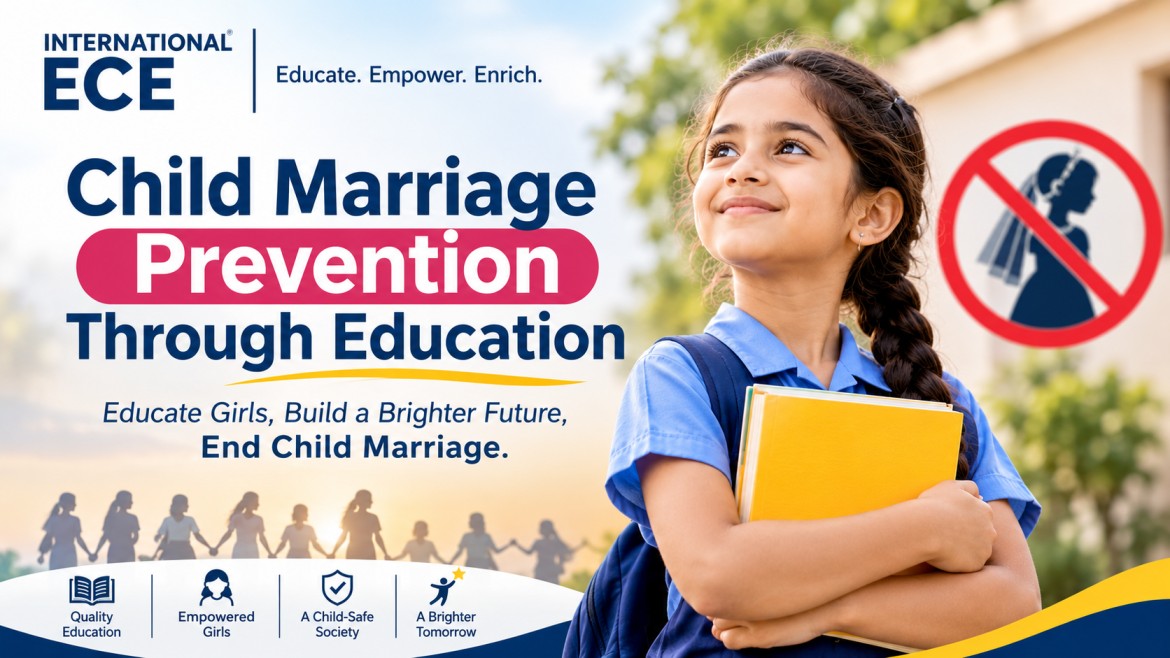
Child Marriage Prevention Through Education 2027: School-Level Awareness Strategies That Work
Direct answer: Child marriage prevention through education works when schools track dropout and irregular attendance, train peer educators, run gender-transformative classroom activities, engage parents, and refer at-risk children directly to Child Marriage Prohibition Officers (CMPOs) and Childline. In 2027, India’s NFHS-6 data shows child marriage has fallen to 20.1%, but the decline is uneven — and schools are the most scalable prevention institution the country has.
If you are a principal, a teacher, an ECE centre owner, or a parent who wants a school to do more than teach, this guide gives you the strategies that have evidence behind them and the legal duties that are already binding.
Why Education Is the Strongest Vaccine Against Child Marriage
The NFHS-6 Data: 20.1% and Falling — But Not Fast Enough
India’s child marriage rate has declined from 23.3% in NFHS-5 to 20.1% in NFHS-6, according to data released in 2026. That means one in five women aged 20–24 was still married before 18[reference:0].
The decline is real. It is also uneven. Rural-urban disparities persist, and the burden remains higher among poorer households. NFHS analysis shows secondary education is one of the strongest protective factors[reference:1].
What Secondary Education Actually Changes
A girl who completes secondary school marries later, has fewer children, and earns more. The mechanism is not mysterious: school keeps her in a structured environment, connects her to peers and trusted adults, and delays the transition that families interpret as “ready for marriage.”
The Global Programme to End Child Marriage modelling shows that combining child marriage interventions with education interventions could reduce the marriage rate among girls aged 15–17 from an estimated 16.4% in 2020 to 8.9% by 2050[reference:2].
Why this matters to you: If you work in a school, you are not a bystander to child marriage. You are the institution with the most daily contact with the child at risk.
The Legal and Policy Framework Schools Must Know in 2027
Prohibition of Child Marriage Act 2006: The School’s Duty
The Prohibition of Child Marriage Act, 2006 (PCMA) makes child marriage voidable and creates Child Marriage Prohibition Officers (CMPOs) at the district level. A pending amendment bill seeks to raise the minimum age of marriage for women from 18 to 21, but the current legal age remains 18[reference:3].
Schools are not passive observers under PCMA. When a school identifies a child at risk, it has a duty to refer the case to the CMPO, the Child Welfare Committee, or Childline 1098. The BVMB portal (stopchildmarriage.wcd.gov.in) now serves as a centralised repository of over 60,700 CMPOs across states and UTs[reference:4].
Bal Vivah Mukt Bharat: The National Campaign and Its School Spell
The Government of India launched the Bal Vivah Mukt Bharat campaign on 27 November 2024. A 100-day special campaign followed, structured in spells — and Spell-I (27 November to 31 December 2025) focused specifically on sensitisation activities in schools, colleges, and universities through debates, essay competitions, and pledge ceremonies[reference:5].
Awareness programmes under the campaign have reached over 6 crore citizens, and more than 28 lakh pledges against child marriage have been registered on the portals[reference:6].
The campaign explicitly directs education officials to track dropouts and identify adolescent girls who are school dropouts or at risk of child marriage[reference:7].
NCPCR’s School-Wise Dropout Tracking Mandate
NCPCR has instructed District Magistrates to prepare school-wise lists of children who are dropouts, out of school, or not attending regularly, and to identify from those lists children at risk of child marriage. Family counselling and proper inquiry of identified children must be ensured[reference:8].
A national drive identified 11.5 lakh children as “vulnerable” to child marriage, with school-wise dropout lists as the primary identification tool.
Why this matters to you: The school register is not administrative paperwork. It is the earliest warning system India has for child marriage.
7 School-Level Awareness Strategies That Work
1. The School-Wise Dropout and Irregular Attendance Register
Maintain a register of every child who is absent without intimation for more than three consecutive days. NCPCR specifically asks schools to draw up separate lists of children absent without informing the principal.
The register should record the child’s name, class, guardian contact, reason for absence (if known), and the date of the home visit. A teacher or SMC member should conduct the home visit within a week.
2. Peer Educators and Adolescent Youth Groups
ChildFund India trains selected youth group members as Peer Educators on the PCMA, 2006. These peer educators lead interactive sessions and campaigns within youth groups, helping adolescents understand the risks of child marriage, their rights, and the role they can play in prevention[reference:11].
Peer education works because adolescents disclose risk to peers before they disclose to adults. A trained 15-year-old is often a faster warning channel than a teacher.
3. Gender-Transformative Classroom Activities (The SAKSHUM Model)
UNICEF’s SAKSHUM programme in Maharashtra’s Parbhani district uses an activity-based school initiative for Grades 6–10. Female teachers are trained as “SAKSHUM Guides,” and peer advocates from Grades 7 and 8 — called “SAKSHUM Doots” — use gender role-reversal games to spark reflection on child marriage and discriminatory norms[reference:12].
Between December 2023 and November 2024, SAKSHUM prevented 145 child marriages in Parbhani and reached 21,495 adolescent girls, 20,503 boys, and 12,124 parents through its school initiative[reference:13].
4. Weekly Pledges and School-Wide Commitment
All elementary and secondary schools in the SAKSHUM model participate in a weekly pledge emphasising the harms of child marriage, the legal marriage age, and the helpline number. The pledge strengthens school-wide commitment and keeps the message visible[reference:14].
The Bal Vivah Mukt Bharat portal allows schools to register pledges digitally, which creates a record of institutional commitment[reference:15].
5. Parent Counselling and Family Engagement
NCPCR’s guidance is explicit: family counselling and proper inquiry of identified children must be ensured to prevent child marriage[reference:16]. SAKSHUM reached 12,124 parents with messages promoting gender equality[reference:17].
Parent counselling should not be a one-time meeting. It should be a structured conversation that covers the legal age of marriage, the health risks of early pregnancy, the economic returns of completing school, and the specific schemes available to keep the girl in school.
6. School Management Committee (SMC) as a Prevention Body
Under the RTE Act, the SMC must have 75% parent membership. That parent majority is a prevention asset. SMC members can visit homes, track absentees, and raise child marriage risk in monthly meetings.
NCERT’s manual on gender-based violence suggests SMCs can plan activities for transmitting messages on gender discrimination and child marriage[reference:18].
7. Direct Referral to CMPO, Childline, and the BVMB Portal
Every school should have the district CMPO’s contact number, Childline 1098, and the BVMB portal URL displayed in the staff room and the principal’s office. When a case is identified, the referral should happen the same day — not after an internal committee meeting.
Why this matters to you: These seven strategies are not parallel programmes. They reinforce each other: the register identifies the child, the peer educator hears the rumour, the teacher counsels the family, and the SMC follows up.
Comparison Table: School-Level Strategies, Effort, and Evidence
| Strategy | Effort Level | Evidence / Model | Best For |
|---|---|---|---|
| Dropout and irregular attendance register | Low (existing staff, existing register) | NCPCR mandate; 11.5 lakh vulnerable children identified through school lists | All schools; mandatory baseline |
| Peer educators / youth groups | Medium (training, facilitation) | ChildFund India Peer Educators trained on PCMA[reference:20] | Secondary schools, Grades 8–12 |
| Gender-transformative classroom activities | Medium (teacher training, activity design) | SAKSHUM: 145 marriages prevented; 41,000+ adolescents reached[reference:21] | Grades 6–10; adaptable to ECE teacher training |
| Weekly pledge / school-wide commitment | Low (10 minutes per week) | SAKSHUM weekly pledge; BVMB pledge portal[reference:22][reference:23] | All schools; culture-building |
| Parent counselling | Medium–High (time-intensive) | NCPCR family counselling directive; SAKSHUM parent reach[reference:24][reference:25] | Families of identified at-risk children |
| SMC as prevention body | Low (uses existing committee) | RTE 75% parent rule; NCERT SMC guidance[reference:26] | All government and private schools |
| Direct referral to CMPO / Childline / BVMB | Low (display numbers, one call) | 60,700+ CMPOs on BVMB portal[reference:27] | All schools; crisis response |
Why this matters to you: You do not need a large budget to start. The two highest-evidence strategies — the dropout register and the SMC — cost almost nothing and already exist in your school system.
Cost and Impact: What School-Level Prevention Actually Delivers
| Intervention | Estimated Cost (₹) | Expected Output | What Happens Without It |
|---|---|---|---|
| Teacher training on PCMA and early warning signs (one batch) | ₹8,000–₹20,000 | Teachers who can identify and refer at-risk children | Risk goes unnoticed until a marriage is fixed |
| Peer educator programme (materials + facilitation, per school year) | ₹15,000–₹35,000 | Adolescent-to-adolescent disclosure channel | Children have no trusted channel to report |
| Parent counselling sessions (per at-risk family) | ₹500–₹1,500 (staff time + travel) | Family-level behaviour change; delay or cancellation of marriage | Legal intervention becomes necessary; family resistance hardens |
| Dropout register and home visits (per school year) | ₹3,000–₹8,000 (stationery + staff time) | Early identification of 100% of irregular attendance | Dropout becomes permanent; child disappears from school data |
| Weekly pledge and school-wide campaign | ₹1,000–₹3,000 | Visible school norm against child marriage | Child marriage remains a “family matter” that no one discusses |
For comparison, the cost of a single rescue operation — police, CMPO, Child Welfare Committee, counselling, and rehabilitation — is many times higher than the cost of prevention at the school level.
Why this matters to you: School-level prevention is one of the cheapest child-protection interventions available. The barrier is not money. It is whether the school decides to use the systems it already has.
10-Point Child Marriage Prevention Checklist for Schools (2027)
- ☐ A dropout and irregular attendance register is maintained, with home visits recorded within 7 days of unexplained absence.
- ☐ The school has a trained peer educator group or youth group that discusses child marriage and legal rights.
- ☐ At least one teacher has been trained on PCMA, early warning signs, and referral pathways.
- ☐ Gender-transformative classroom activities are part of the Grades 6–10 calendar, not a one-off event.
- ☐ A weekly pledge or school-wide campaign keeps the legal marriage age and Childline 1098 visible.
- ☐ Parent counselling is offered to families of identified at-risk children, with a written record.
- ☐ The School Management Committee reviews dropout and child marriage risk at every monthly meeting.
- ☐ The district CMPO’s contact number, Childline 1098, and BVMB portal URL are displayed in the staff room.
- ☐ The school has made at least one referral to the CMPO, CWC, or Childline in the past year (or can explain why none was needed).
- ☐ The school participates in Bal Vivah Mukt Bharat campaign activities and has registered a pledge on the portal.
What ECE Centres Can Do Before a Child Reaches Marriageable Age
- Track attendance from the earliest grade: A child who drops out in Grade 3 is more likely to be married before 18. Early-childhood attendance data is the first data point in the prevention chain.
- Engage parents on girls’ education from day one: The conversation about completing school should start in nursery, not in Grade 8. ECE centres are often the first formal institution a family trusts.
- Train anganwadi and ECE staff on PCMA: Frontline workers who see the child every day are the most likely to notice a family preparing for an early marriage.
- Connect to the SMC and panchayat committee: An ECE centre can feed attendance and dropout data into the local child protection committee, even before the child reaches secondary school.
- Display Childline 1098 and CMPO contact: Parents who trust an ECE centre will use its notice board. Make the reporting channel visible where parents already look.
Why this matters to you: Child marriage prevention is not a secondary-school problem. By the time a girl reaches Grade 9, the decision may already be in motion. ECE centres are the earliest intervention point in the system.
Frequently Asked Questions
What is the legal age of marriage in India in 2027?
The legal age of marriage remains 18 for women and 21 for men under the Prohibition of Child Marriage Act, 2006. A pending amendment bill seeks to raise the minimum age for women to 21, but it has not yet been enacted. Schools should teach the current legal age and the PCMA provisions.
What is Bal Vivah Mukt Bharat, and how can schools participate?
Bal Vivah Mukt Bharat is the Government of India’s national campaign to end child marriage, launched on 27 November 2024. Schools can participate through debates, essay competitions, pledge ceremonies, and awareness activities. Pledges can be registered on the BVMB portal (stopchildmarriage.wcd.gov.in) and the MyGov portal.
What should a teacher do if she suspects a student is at risk of child marriage?
The teacher should immediately inform the principal and conduct a home visit with an SMC member. If the risk is credible, the school should refer the case to the district Child Marriage Prohibition Officer (CMPO) and Childline 1098. NCPCR requires family counselling and proper inquiry of identified children.
What is the SAKSHUM model, and can other schools copy it?
SAKSHUM is a UNICEF-supported school initiative in Maharashtra’s Parbhani district for Grades 6–10. It trains female teachers as guides and students as peer advocates, uses gender role-reversal games, and holds a weekly pledge. Between December 2023 and November 2024, it prevented 145 child marriages. The model is designed to be adapted by other districts.
Are schools legally required to track dropout and report child marriage risk?
NCPCR has instructed District Magistrates to prepare school-wise lists of dropouts and irregular attendees and identify children at risk of child marriage. While PCMA does not explicitly name schools as reporting authorities, schools are bound by NCPCR directives and child protection guidelines to refer at-risk cases to CMPOs and Childline.
How can parents support school-level child marriage prevention?
Parents can join the School Management Committee, attend parent counselling sessions, monitor their child’s attendance, and learn the legal age of marriage and the reporting channels. Parents who complete secondary education are more likely to delay their own children’s marriage, so parent engagement is itself a prevention strategy.