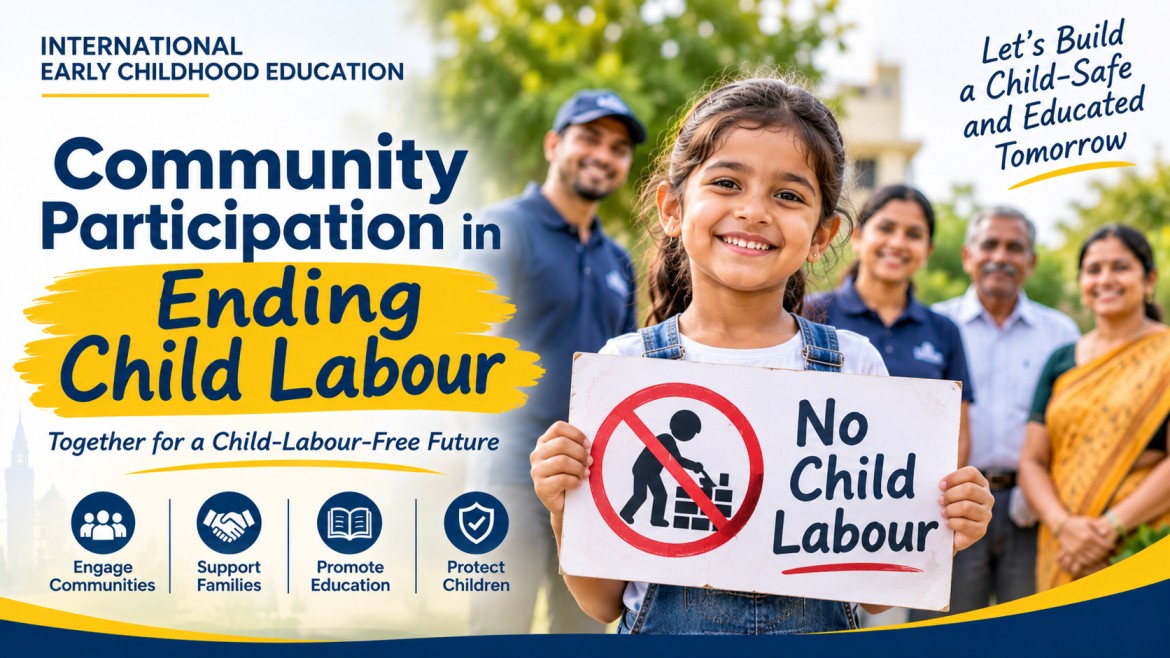
Community Participation in Ending Child Labour 2027: Involving Parents and Local Leaders
Direct answer: Community participation in ending child labour means parents, Gram Panchayats, Bal Panchayats, Village Child Protection Committees, schools, and local leaders working together to identify at-risk children, keep them in school, and report violations — rather than relying only on police raids and rescue operations. In 2027, India’s child labour strategy is shifting from rescue to prevention, and communities are at the centre of that shift.
If you are a parent, a teacher, a panchayat member, or an ECE centre owner, you are not a bystander in this fight. You are the system. This guide explains what the law expects, what successful community models look like, and what you can do starting this month.
Why Community Participation Is the Missing Piece in India’s Child Labour Fight
Enforcement Alone Has Not Worked
India has strong laws. The Child Labour (Prohibition and Regulation) Amendment Act, 2016 bans employment of children below 14 in all occupations and prohibits adolescents (14–18) from hazardous work. Penalties range from six months to two years of imprisonment and fines of ₹20,000 to ₹50,000[reference:0].
Yet child labour persists. The 2011 Census identified approximately 43.53 lakh working children in the 5–14 age group[reference:1]. Between April 2024 and March 2025, 44,902 children were rescued from exploitation, and 90% were from child labour[reference:2].
Enforcement rescues children after harm has occurred. Prevention stops harm before it starts. That is where communities come in.
The 2027 Opportunity: From Rescue to Prevention
Between 12 June and 31 August 2026, NCPCR conducted a Pan-India Rescue and Rehabilitation Campaign that freed more than 3,800 children and led to 575+ FIRs[reference:3]. The campaign explicitly focused on rehabilitation, restoration to families, educational mainstreaming, and follow-up monitoring — a recognition that rescue alone is insufficient[reference:4].
That follow-up work is community work. It requires parents to keep children in school, panchayats to monitor dropout patterns, and local leaders to challenge the social norms that normalise child labour.
Why this matters to you: The state can rescue a child, but only a community can keep that child out of work for good.
What “Community Participation” Actually Means in Child Labour Prevention
Community participation is not a slogan. It is a set of specific, repeatable actions by people who live in the same village or neighbourhood as the child at risk.
The Four Actors Who Matter Most
- Parents and guardians: They decide whether a child goes to school or to work. They are also the first to notice warning signs in other families.
- Gram Panchayats: They control local resources, can pass resolutions declaring villages child-labour-free, and can leverage schemes like MGNREGA to reduce household distress[reference:5].
- Bal Panchayats (children’s councils): Elected child leaders who advocate against child labour and child marriage, and who can reach households that adults cannot.
- Village Child Protection Committees (VCPCs): Formal bodies with representation from panchayats, teachers, and frontline workers, mandated to monitor and prevent child labour, trafficking, and abuse[reference:7].
Why Parents Are the First Line of Defence
ChildFund India’s Zero Child Labour initiative identifies at-risk children through household visits and community outreach, with a focus on marginalised families. It engages parents and children through awareness sessions on the harmful impact of child labour and available protection services[reference:8].
The law also recognises the parental role — and its limits. Under the 2016 Amendment, parents are not punished for a first offence, but repeat offences can attract a fine of up to ₹10,000[reference:9][reference:10]. The intent is corrective, not punitive — but it assumes parents will act once informed.
Why this matters to you: If you are a parent, your decision to keep a child in school is the single strongest intervention in the entire system.
The Legal and Policy Framework That Empowers Communities (2027 Update)
Child Labour Amendment Act 2016: Penalties and Parental Exemptions
The Act prohibits employment of children below 14 in all occupations, with limited exceptions for family enterprises after school hours and the entertainment industry. Adolescents (14–18) are barred from hazardous occupations. Violations are cognizable offences, meaning police can arrest without a warrant[reference:11].
Parents are exempt from punishment for a first offence, but a repeat offence can attract a fine up to ₹10,000[reference:12]. The law treats parents as partners in correction, not as primary offenders.
PENCIL Portal and NCLP: Tools for Community Reporting
The PENCIL Portal (Platform for Effective Enforcement for No Child Labour), launched in 2017, connects the Central Government, state governments, district project societies, and a Child Tracking System with a public Complaint Corner[reference:13]. Any community member — a parent, a teacher, a neighbour — can file a complaint at pencil.gov.in[reference:14].
The National Child Labour Project (NCLP) provides rescued children aged 9–14 with bridging education, vocational training, a midday meal, a stipend, and health care through Special Training Centres, with the goal of mainstreaming them into formal schools[reference:15][reference:16].
RTE Act and School Management Committees
The Right to Education Act, 2009 mandates the formation of School Management Committees (SMCs) with 75% parent membership. These committees give parents a formal channel to monitor attendance, flag dropouts, and demand quality education — all of which are direct child labour prevention functions[reference:17].
Community-based programmes have found that when an SMC member is also part of the Village Child Protection Committee, the two systems reinforce each other[reference:18].
Mission Vatsalya and Village Child Protection Committees
Mission Vatsalya assigns child welfare and protection functions to existing Panchayati Raj Institution committees at the gram panchayat and urban local body level[reference:19]. Karnataka has developed a manual for gram panchayat officials with systematic guidelines to build child-friendly villages, explicitly stating that “no child should be left out of school or become a child labourer”[reference:20].
Odisha launched a 44-day campaign in October 2026 to make gram panchayats child-labour-free.
Why this matters to you: The structures already exist. Your job is not to create a new system — it is to use the ones the law has already given you.
The Data: Why Community Action Cannot Wait
3,800+ Children Rescued in a Single 2026 Campaign
NCPCR’s 2026 campaign rescued more than 3,800 children and registered 575+ FIRs in just 80 days[reference:22]. Telangana alone rescued over 11,000 children in 2024–25, leading the country[reference:23].
These numbers show enforcement capacity. They also show the scale of the problem that remains undetected.
The Reporting Gap: Why Most Cases Never Reach Authorities
NCPCR’s complaint data shows that child labour and children in distress together accounted for nearly 20,000 cases in 2024, with 19,645 pending by year-end[reference:24]. The volume is not the problem. The backlog is.
Community participation reduces the backlog at source. A parent who knows the PENCIL Portal, a panchayat member who tracks school dropout data, or a Bal Panchayat that reports a child missing from class can intervene before a case enters the formal system.
Why this matters to you: Every child who never enters the rescue system is a child your community protected before the state had to.
How Parents Can Prevent Child Labour: A Practical Role
Recognising the Signs of Child Labour in Your Own Community
Child labour is often hidden in households, small workshops, and agricultural fields. Signs include: a child consistently absent from school, visible fatigue, carrying loads, working in a family enterprise during school hours, or a family that has recently migrated for work.
In Bundi, Rajasthan, migrant families working in sandstone quarries were cut off from public entitlements. Children like Golu were denied school admission for lack of address proof and began helping at the quarry. The turning point came when a community-based intervention helped families secure temporary documentation and liaised with school authorities[reference:25].
What Parents Can Do (and What the Law Says About Parental Liability)
Parents can:
- Enrol every child in school and monitor attendance;
- Refuse to send children to work, even during economic distress — and seek government schemes instead;
- Report violations they see in other households to the panchayat or PENCIL Portal;
- Participate in School Management Committees and parent-teacher meetings.
The law exempts parents from punishment for a first offence, but repeated offences can attract a fine[reference:26]. The stronger incentive is not legal — it is the long-term income loss from a child who never completes school.
Why this matters to you: As a parent, you are not just protecting your own child. You are setting the norm for your street, your village, and your child’s peer group.
How Local Leaders Can Build Child-Labour-Free Villages
The Gram Panchayat’s Role: From Awareness to Enforcement
Gram Panchayats are constitutionally mandated local bodies and are best positioned to tackle child labour because they know every household[reference:27]. Specific actions include:
- Passing a gram sabha resolution declaring the village child-labour-free, as Veilpur did with a stone inscription in 2001[reference:28];
- Raising child labour issues in gram sabha meetings to create awareness among members[reference:29];
- Leveraging MGNREGA and other schemes to reduce household distress that pushes children into work;
- Coordinating with the District Level Task Force on rescue and rehabilitation.
Bal Panchayats: When Children Lead the Change
In Bal Mitra Gram (child-friendly villages), every village where child labour is rooted out has a Bal Panchayat — an elected children’s council that interacts with adults and advocates withdrawing children from work.
In 2020–21, Bal Panchayat elections were held in 291 Bal Mitra Grams, electing 3,201 child leaders, including 1,600 girls. These children submitted 34 applications to Gram Panchayats on issues including school infrastructure and transportation[reference:31].
The Darwaza Khatkhatao campaign in Jharkhand reached 113 villages and 9,040 households, identifying 410 child labourers and withdrawing 271 from work[reference:32].
Village Child Protection Committees: The Frontline Structure
Village and Ward-Level Child Protection Committees are formed with representation from panchayats, teachers, and frontline workers. They monitor prevention of child marriage, sexual abuse, and child labour, and ensure children’s safety and education[reference:33].
In Chittoor district, the District Women and Child Welfare Officer directed village-level committees to intensify efforts to eliminate child labour and safeguard children’s rights[reference:34].
Why this matters to you: A panchayat resolution costs nothing. A Bal Panchayat election costs nothing. A VCPC meeting costs nothing. The barrier is not money — it is whether someone decides to start.
Community Models That Work: Lessons from the Field
ChildFund India’s Zero Child Labour Initiative
ChildFund India works to eliminate child labour by strengthening community vigilance and government systems. Children at risk are identified through household visits, community outreach, and coordination with local leaders. Parents, children, and adolescents are engaged through awareness sessions on child rights and protection services. Government officials, local self-governments, and community stakeholders are trained on child protection laws and rehabilitation measures[reference:35].
ActionAid’s Bundi Intervention: From Quarries to Classrooms
In Bundi, Rajasthan, ActionAid Association with ILO support helped migrant families secure temporary documentation and liaise with local schools. Labour collectives were formed, peer-learning was encouraged, and local leaders were trained in occupational safety and legal rights, enabling them to become agents of change[reference:36]. A father’s words capture the outcome: “Earlier, my son used to go to work. Now he goes to school… and we are happy”[reference:37].
The Bal Mitra Gram Model: 545 Children Withdrawn
Kailash Satyarthi Children’s Foundation’s Bal Mitra Gram programme uses Bal Panchayats as a core component. In one reporting period, collective action by Bal Panchayat members and stakeholders led to the withdrawal of 545 children from child labour, with 387 enrolled in schools[reference:38].
Why this matters to you: These are not pilot projects in remote laboratories. They are replicable models running in Rajasthan, Jharkhand, Madhya Pradesh, and beyond.
10-Point Community Action Checklist for 2027
- ☐ Your Gram Panchayat has passed a resolution declaring the village child-labour-free.
- ☐ A Village Child Protection Committee is constituted and meets monthly.
- ☐ A Bal Panchayat has been elected and is recognised by the Gram Panchayat.
- ☐ Every child in the village is enrolled in school, and dropout data is reviewed each quarter.
- ☐ Parents know about the PENCIL Portal and Childline 1098.
- ☐ The School Management Committee has 75% parent membership and meets regularly.
- ☐ Local employers and contractors have been sensitised on the 2016 Amendment penalties.
- ☐ Migrant families know how to obtain temporary documentation for school admission.
- ☐ At least one community member has been trained on child protection laws and reporting channels.
- ☐ The panchayat has linked at-risk households to MGNREGA or other livelihood schemes.
What Schools and ECE Centres Can Do to Mobilise Communities
- Use the SMC as a prevention platform: The School Management Committee is not a compliance formality. Use its parent majority to track attendance, flag absentees, and visit homes of dropouts.
- Train teachers to identify at-risk children: NCPCR recommends sensitising teachers on the Child Labour Act, RTE Act, and POCSO. A teacher who knows the signs can intervene before a child disappears.
- Connect with the Village Child Protection Committee: Invite VCPC members to school events. Share dropout data. Make the school a node in the protection network, not an island.
- Host a Bal Panchayat meeting at your school: Give children a physical space and institutional legitimacy. Schools that host Bal Panchayats report stronger child participation and better attendance.
- Display PENCIL Portal and Childline 1098 information: Make reporting channels visible to every parent who walks through the gate.
Why this matters to you: A school that only teaches is doing half its job. A school that mobilises its community is doing the job the RTE Act actually intended.
Frequently Asked Questions
What is community participation in ending child labour?
Community participation means parents, Gram Panchayats, Bal Panchayats, Village Child Protection Committees, schools, and local leaders actively working to identify at-risk children, keep them in school, and report violations. It shifts the focus from rescue after harm to prevention before harm occurs.
What is a Bal Panchayat, and how does it prevent child labour?
A Bal Panchayat is an elected children’s council in a village. It advocates against child labour and child marriage, interacts with adult Gram Panchayats, and reaches households that adults may not. In Bal Mitra Grams, Bal Panchayats have helped withdraw hundreds of children from work and enrol them in school.
What is the PENCIL Portal, and can parents use it?
The PENCIL Portal (pencil.gov.in) is the government’s online platform for child labour enforcement, with a public Complaint Corner. Any parent, teacher, or community member can file a complaint. It connects to the National Child Labour Project and the Child Tracking System.
Are parents punished for sending children to work under Indian law?
Under the Child Labour Amendment Act 2016, parents are not punished for a first offence. A repeat offence can attract a fine up to ₹10,000. The law treats parents as partners in correction, not primary offenders. Employers face much stricter penalties.
What is the role of the Gram Panchayat in preventing child labour?
Gram Panchayats can pass resolutions declaring villages child-labour-free, raise the issue in gram sabha meetings, link at-risk households to MGNREGA and other schemes, and coordinate with District Task Forces on rescue and rehabilitation. Mission Vatsalya assigns child protection functions to panchayat committees.
How can schools involve parents in child labour prevention?
Schools can use the School Management Committee — which must have 75% parent membership under the RTE Act — to track attendance and flag dropouts. They can train teachers to identify at-risk children, connect with Village Child Protection Committees, and display PENCIL Portal and Childline 1098 information prominently.