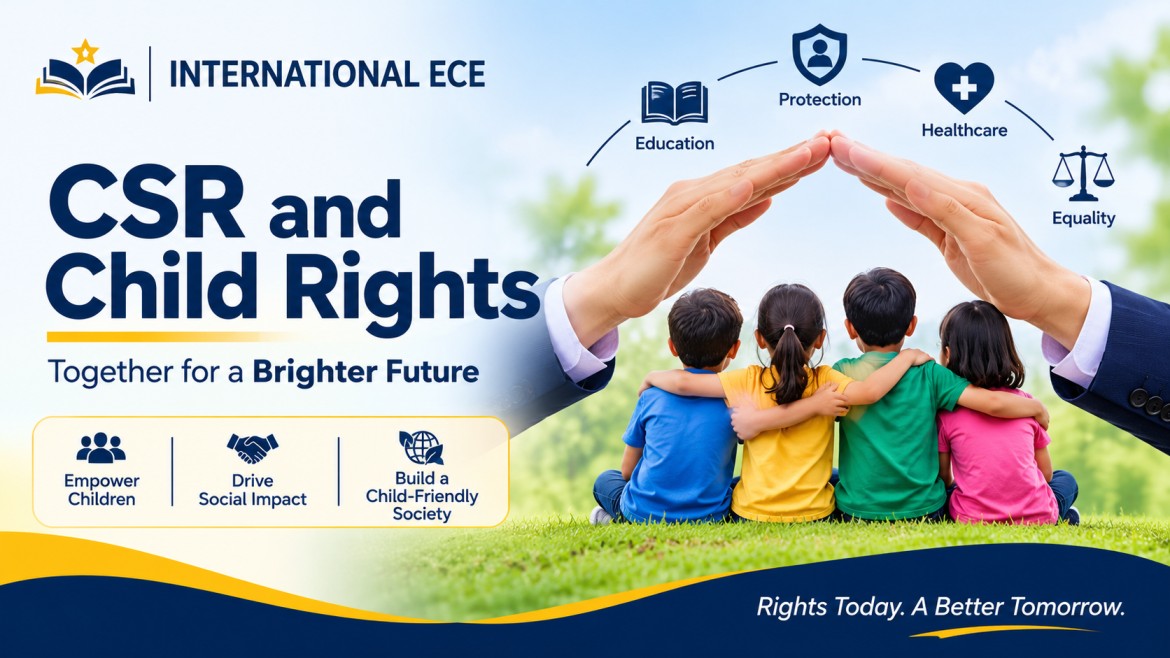
CSR and Child Rights: How Companies Can Include Child Protection in CSR Policy
Direct answer: Companies can include child protection in CSR policy by treating it as a distinct, funded commitment—not a by-product of education spending. This means writing child safeguarding into the CSR policy document, funding school-based prevention programmes, screening supply chains for child labour risks using the Child Rights and Business Principles (CRBP), and measuring protection outcomes alongside education outputs. Schedule VII of the Companies Act already permits this; most companies simply have not structured their CSR that way.
India mandates 2% of average net profit for eligible companies under Section 135 Education consistently ranks among the highest-funded CSR sectors But funding a classroom is not the same as protecting the child inside it. This guide explains the gap and gives a practical framework to close it.
Why Child Protection Is a Strategic CSR Priority, Not a Charity Add-On
Child protection is often treated as the responsibility of government or NGOs. That framing leaves a structural hole: companies fund schools, digital labs, and scholarships, but do not fund the systems that keep children safe inside those schools.
CRY’s 2027 analysis of CSR and child rights makes the case directly: CSR-backed protection programmes are already supporting child helplines, training communities to identify abuse, and funding legal aid. The infrastructure exists. What is missing is deliberate policy inclusion.
Why this matters to you: If your CSR policy funds education but not protection, you are investing in a building without a lock on the door.
The Business Case for Child Rights in CSR
Child rights are not a peripheral “social good” category. They are a material risk and opportunity area:
- Supply chain risk: Child labour in sourcing regions creates reputational and legal exposure. Bal Raksha Bharat has implemented CRBP programmes across tea, cotton, readymade garments, spices, and stone supply chains, reducing children’s engagement in those chains and improving school enrolment.
- Social licence to operate: Companies operating in communities where children drop out, marry early, or work face long-term instability. CSR that addresses these root causes protects the operating environment.
- Reporting credibility: CSR reporting that shows protection outcomes—not just expenditure—signals maturity to investors and regulators.
What Schedule VII Already Allows (and What Companies Miss)
Schedule VII explicitly includes “promoting education, including special education and employment enhancing vocational skills especially among children”. It also covers eradicating hunger, reducing child mortality, and improving maternal health
Child protection activities—awareness of POCSO, school safety training, child protection committees, anti-trafficking vigilance—fit within these heads. They are education-adjacent and child-welfare-adjacent. The legal permission is there. The policy language is what most companies have not written.
The Legal Foundation: UNCRC, POCSO, and Section 135
UNCRC’s Four Pillars as a CSR Design Framework
India ratified the UN Convention on the Rights of the Child in 1992. The UNCRC rests on four pillars: survival, protection, development, and participation.
CRY’s framework maps CSR directly onto these pillars: survival (nutrition, healthcare), protection (anti-labour, anti-abuse, anti-trafficking), development (education, skills), and participation (children’s voices in decisions affecting them
For a company designing a CSR policy, this is the cleanest structure available. It is internationally recognised, legally aligned with Indian statutes, and auditable.
POCSO and RTE: The Compliance Backbone
POCSO provides the legal framework for protection. RTE provides the legal backbone for education A CSR programme that funds school infrastructure without funding POCSO awareness or staff training is funding half the mandate.
Sai Life Sciences’ 2025 CSR programme in Hyderabad illustrates the integrated model: a Child Sexual Abuse Prevention Program across ten government schools, reaching 3,400 children, training over 100 teachers, and orienting staff on the POCSO Act.
Why this matters to you: A child protection CSR line item is not “extra.” It is the delivery mechanism for rights your education CSR already claims to support.
Where Child Protection Fits Inside Your CSR Policy
Policy Language: Moving from “Education” to “Protection”
Most CSR policies say “promoting education.” Few say “ensuring children are safe in the schools we fund.”
Add explicit language: “The company will support child protection systems in partner schools, including POCSO awareness for staff, child protection committees, and reporting mechanism training.” This costs nothing and changes everything downstream.
Project Design: School-Based Protection Programmes
Protection programmes do not need to be large. They need to be specific:
- POCSO staff training: Fund training for teachers and support staff on mandatory reporting, disclosure handling, and child-friendly conversation.
- Child protection committees: Fund the formation and functioning of school-level committees with parent, teacher, and counsellor representation.
- Awareness for children: Age-appropriate body safety education, using tools like the “PANTS” rule that Sai Life Sciences’ programme employed.
- Reporting infrastructure: Fund Childline 1098 awareness, notice boards, and a nodal teacher stipend or training.
Supply Chain: The CRBP Model That Already Works
The Child Rights and Business Principles (CRBP), developed by UNICEF, the UN Global Compact, and Save the Children, provide a ready framework for supply chain child protection. Bal Raksha Bharat’s CRBP programmes across five supply chains have reduced children’s engagement in work and improved school enrolment.
For a company with agricultural or manufacturing supply chains, CRBP is not a new invention. It is a plug-in module for CSR policy.
A Five-Step Framework to Embed Child Protection in CSR
- Map your current CSR portfolio against the UNCRC pillars. Identify which of your existing education or health projects already touch protection, and which children they reach.
- Write a child safeguarding clause into the CSR policy document. One paragraph. It commits the company to funding protection systems in partner institutions.
- Choose one school-based protection intervention and fund it for three years. Teacher training on POCSO, or child protection committees, or body safety curriculum. Pick one and go deep, not wide.
- Screen your supply chain using CRBP. If you source from high-risk regions, commission a child labour risk assessment and fund remediation through education support.
- Report protection outcomes, not just expenditure. Number of teachers trained, committees formed, helpline awareness reached—alongside your education metrics.
Two Tables: Where CSR Money Goes vs. Where Protection Gaps Remain
| CSR Focus Area (Common) | Protection Gap It Leaves Open |
|---|---|
| School infrastructure (classrooms, toilets, libraries) | No staff training on POCSO reporting; children unsafe inside the improved building. |
| Digital classrooms and tablets | No online grooming awareness; children exposed to digital risks without protection skills. |
| Scholarships and fee support | No attendance monitoring; scholarship children drop out and become invisible to the system. |
| Teacher salary support | No child protection training; teachers cannot recognise or report abuse. |
| Nutrition and mid-day meals | No trafficking or child labour vigilance; children remain at risk outside the meal window. |
| Company | Child Protection CSR Action (2024–2025) |
|---|---|
| Sai Life Sciences | POCSO-oriented Child Sexual Abuse Prevention Program across 10 government schools in Hyderabad; 3,400 children reached, 100+ teachers trained. |
| Bal Raksha Bharat partners (CRBP) | Child Rights and Business Principles across tea, cotton, garments, spices, stone supply chains; school enrolment improved, child engagement in work reduced. |
| Fortrea (with CRY) | Integrated education, STEM, digital access, health, and nutrition interventions for 37,000+ children across Karnataka and Maharashtra (2023–26). |
Why this matters to you: The companies already doing this are not waiting for a new law. They are using existing CSR heads and existing NGO capacity.
CSR Child Protection Checklist for Companies
- ☐ Our CSR policy document includes an explicit child protection commitment.
- ☐ We have mapped our CSR portfolio against the four UNCRC pillars.
- ☐ At least one funded programme includes POCSO awareness or staff training.
- ☐ Partner schools or institutions have functioning child protection committees.
- ☐ Our supply chain has been screened for child labour risk using CRBP or equivalent.
- ☐ Our CSR reports include protection outcomes (trained staff, committees, helpline reach).
- ☐ We know the Childline 1098 and local AHTU contacts in our programme districts.
- ☐ Our NGO partners have child safeguarding policies that meet our standards.
- ☐ We have a multi-year commitment to protection, not a one-year pilot.
- ☐ We review protection metrics annually alongside education metrics.
Why This Matters to You (and the Children Your CSR Reaches)
CSR in India has moved beyond token donations. It is a structured, legally mandated force for social good. Education receives a large share of that funding. But a child who is unsafe in school cannot learn, regardless of how many digital classrooms you fund.
Child protection is the condition that makes every other CSR investment work. It is also one of the few areas where Schedule VII permission, NGO capacity, and legal obligation already align. The missing piece is policy language.
If you take one sentence from this guide: Write child protection into your CSR policy before you write the next cheque for education.
Frequently Asked Questions
1. Can CSR funds be used for child protection in India?
Yes. Schedule VII permits CSR spending on education and child welfare, and child protection activities—POCSO awareness, school safety training, child protection committees—fit within those heads. Companies can fund protection directly or through NGO partners without seeking a separate Schedule VII amendment.
2. What is the difference between CSR for education and CSR for child protection?
Education CSR funds infrastructure, materials, and learning outcomes. Child protection CSR funds systems that keep children safe: staff training on abuse reporting, school-level committees, helpline awareness, and supply chain child labour screening. Protection is the safety layer around education, not a replacement for it.
3. How does Section 135 of the Companies Act apply to child rights?
Section 135 mandates 2% CSR spending for companies meeting net worth, turnover, or profit thresholds. Schedule VII lists education and child welfare as eligible activities. Child protection qualifies under both. The law does not force companies to fund protection specifically, but it permits and supports it.
4. What are the Child Rights and Business Principles (CRBP)?
CRBP is a framework developed by UNICEF, the UN Global Compact, and Save the Children to help businesses respect and support children’s rights. In India, Bal Raksha Bharat has used CRBP across tea, cotton, garments, spices, and stone supply chains to reduce child labour and improve school enrolment.
5. Which Indian companies are already funding child protection through CSR?
Sai Life Sciences funds a POCSO-oriented abuse prevention programme across 10 government schools in Hyderabad. Bal Raksha Bharat partners with multiple companies on CRBP supply chain programmes. Fortrea, with CRY, supports integrated education and child welfare for 37,000+ children across Karnataka and Maharashtra.
6. How can a company measure child protection outcomes in CSR?
Measure what you fund: number of teachers trained on POCSO reporting, number of school child protection committees formed, child helpline awareness reach, supply chain assessments completed, and children transitioned from work back to school. Use third-party impact assessment where possible, as leading CSR programmes already do.