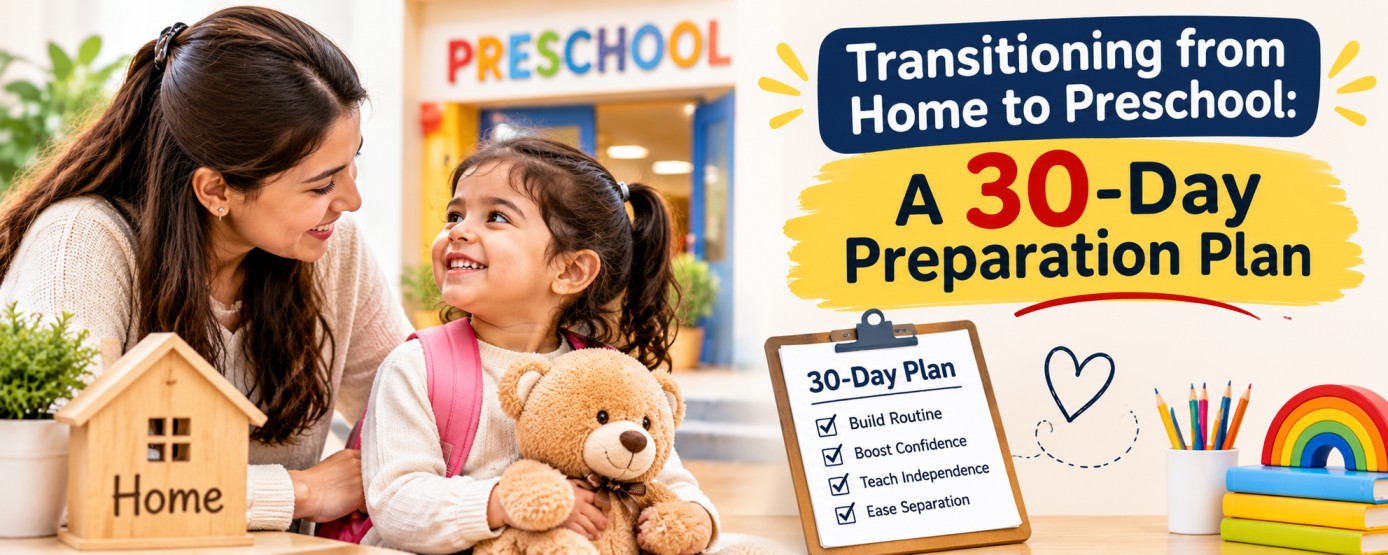
Transitioning from Home to Preschool: A 30-Day Preparation Plan (2027)
Direct answer: A 30-day home-to-preschool transition plan works by gradually shifting sleep routines, practising short separations, building self-help skills, and visiting the school before day one. Most Indian children settle within 1–4 weeks of starting preschool
The first day of preschool is not just a big day for your child. It is a big day for you.
Most Indian children start some form of playschool between two and three years of age, with nursery typically beginning around age three. Under NEP 2020, the foundational stage now covers ages 3 to 8, with three years of preschool before Classes 1 and 2. That means the transition from home to preschool is no longer a casual first step — it is the formal beginning of your child’s educational journey.
This guide gives you a practical, week-by-week plan. No fluff. No jargon. Just what to do, when to do it, and why it matters.
Why the Home-to-Preschool Transition Matters in 2027
The transition from home to preschool is the first time a child steps out of their home environment and spends hours in an unfamiliar setting. Adjusting to being away from parents, following routines, and interacting with other children can be challenging.
Schools know this. Across India — from Kendriya Vidyalayas to private preschools — schools are introducing readiness programmes, home visits, and play-based settling-in initiatives to help children feel secure before formal learning begins.
One principal estimates that approximately 10–15% of children initially experience difficulties adjusting to school, though most eventually become comfortable with the routine.
What NEP 2020 Changed for Early Childhood Education
The National Education Policy 2020 recommends that learning should be in continuum, starting from preschool through the early primary grades. The National Curriculum Framework for the Foundational Stage (2022) states that learning at this age should be play-based, not rote.
In practice, this means preschool in 2027 is not about worksheets or alphabet drilling. It is about play, social skills, and emotional security.
Why this matters to you: You do not need to “prepare” your child academically. You need to prepare them emotionally and practically. That is exactly what this 30-day plan does.
Estimated Preschool Age Criteria for 2027 Admissions
Age cut-offs vary by state and school, but here is the general pattern across Indian schools for the 2027–28 session. Always confirm with your specific school.
| Programme | Typical Age (as on 31 March 2027) | Born Between (Example) |
|---|---|---|
| Pre-Nursery / Playgroup | 3–4 years | 01.04.2023 – 31.03.2024 |
| Nursery (Balvatika 1) | 4–5 years | 01.04.2022 – 31.03.2023 |
| LKG (Balvatika 2) | 5–6 years | 01.04.2021 – 31.03.2022 |
Sources: DPS Gaya published admission criteria for 2027–28, DPS Noida registration notice for 2027–28, and general Indian preschool age guides.
Why this matters to you: The 30-day plan should begin roughly four to five weeks before your school’s confirmed start date. Work backwards from day one.
What “Preschool Readiness” Actually Means (It’s Not Academics)
Preschool readiness is the set of everyday skills that let a young child take part in a group learning day without constant one-to-one help. It is not knowing the alphabet, writing their name, or sitting still for forty minutes.
The Five Skill Areas That Matter
A useful readiness checklist sorts skills into five groups:
- Self-help and independence: Can your child drink from a cup, eat a snack, wash hands, and indicate toilet needs?
- Social: Can they play beside other children and share space?
- Emotional: Can they separate from you without prolonged distress?
- Communication: Can they express basic needs in short sentences?
- Fine motor: Can they hold a crayon, stack blocks, or turn pages?
A child is ready when they can manage most of these — not all of them. Missing a few skills is normal, and most can be built at home in eight to twelve weeks of everyday practice.
Why this matters to you: Your 30-day plan should focus on independence and emotional security, not flashcards.
Your 30-Day Preparation Plan: Week-by-Week
Week 1 (Days 1–7): Talk, Visit, and Shift the Routine
What to do:
- Talk about school warmly and matter-of-factly. Avoid overhyping it (“You’ll love it!”) or warning tones (“Be brave”).
- Walk past the school or visit it if allowed. Preschools increasingly organise pre-session visits and meetings.
- Read books about starting school. Play “going to school” at home.
- Begin shifting bedtime and wake-up time gradually toward the school-day schedule. Experts recommend starting this about two weeks before school begins.
Why this matters to you: Familiarity reduces fear. A child who has seen the school gate before day one is already less anxious.
Week 2 (Days 8–14): Build Independence and Practise Goodbyes
What to do:
- Practise self-help skills: drinking from a cup unaided, eating a snack alone, taking shoes off, washing hands.
- Practise short separations at home — an hour with a grandparent, then two
- Continue shifting the sleep schedule. A fixed sleep schedule of 10–11 hours of uninterrupted night sleep is a readiness marker.
- Teach the words for toilet and water. Tell the teacher your child’s home word for toilet once school begins.
Why this matters to you: Independence builds confidence. A child who can manage small tasks alone feels safer in a group setting.
Week 3 (Days 15–21): Practise the Morning Routine and Play School at Home
What to do:
- Run the full morning routine as a dress rehearsal: wake up, breakfast, dress, bag, shoes, “goodbye”.
- Play school at home, taking turns to be the teacher and the child.
- Create a goodbye ritual. A hug, a special handshake, and the same phrase every time: “I’ll see you after snack time”.
- Visit the school again if possible. Meet the teacher if the school allows it.
Why this matters to you: Predictability is calming for young children. The brain finds comfort in knowing what comes next.
Week 4 (Days 22–30): Final Countdown — Label Everything and Prepare Yourself
What to do:
- Label everything with your child’s name: bag, bottle, tiffin, shoes, spare clothes.
- Pack spare clothes daily. Tell the teacher any food, medical, or comfort details in writing.
- Choose a special first-day outfit together.
- Prepare yourself. Your child will read your emotional cues. Stay calm at drop-off
- Build in 10–15 extra minutes on the first morning so goodbyes are calm, not rushed.
Why this matters to you: Children take emotional cues from trusted adults. A calm parent is the strongest signal that school is safe.
The 30-Day Preparation Checklist (Copy This)
Print this. Tick it off. Do not aim for perfect — aim for consistent.
- ☐ Day 1–3: Talk about school warmly. Visit or walk past the school.
- ☐ Day 4–7: Start shifting sleep schedule by 15 minutes earlier each night.
- ☐ Day 8–10: Practise drinking from a cup, eating a snack, taking shoes off.
- ☐ Day 11–14: Arrange a short separation (1–2 hours) with a trusted adult.
- ☐ Day 15–17: Run the full morning routine as a rehearsal.
- ☐ Day 18–21: Create a goodbye ritual. Say the same phrase every time.
- ☐ Day 22–24: Label bag, bottle, tiffin, shoes, spare clothes.
- ☐ Day 25–27: Visit the school again if allowed. Meet the teacher.
- ☐ Day 28–30: Pack the bag together. Choose the first-day outfit. Prepare yourself.
Why this matters to you: One month of small, consistent actions is more powerful than one panicked week of preparation.
Investment and ROI: What Preschool Transition “Costs” (and Returns)
You do not need to spend money to prepare your child for preschool. The real investment is time and emotional energy.
| Investment Area | Estimated Time/Cost (2027) | What It Returns |
|---|---|---|
| Daily routine practice (weeks 1–4) | 15–20 minutes per day | Reduced morning chaos, calmer drop-offs |
| School visits | 1–2 visits, 30–60 minutes each | Familiarity, reduced fear |
| Goodbye ritual practice | 2–3 minutes per separation | Trust, emotional security |
| Labelling and packing supplies | ₹200–₹500 (labels, spare clothes) | Practical readiness, fewer lost items |
| Preschool registration fee (example) | ₹2,500 (DPS Noida, 2027–28) | Admission processing |
| Professional consultation (if anxiety persists beyond 4–6 weeks) | ₹800–₹2,500 per session (estimated 2027) | Clinical support for persistent separation anxiety |
Why this matters to you: The highest-return investment is your consistent presence and calm during the transition — not money spent on “school readiness” kits.
Separation Anxiety: Normal vs. Concerning — A Comparison
Separation anxiety is a normal part of early childhood development. It typically peaks between ages 18 months and 3 years and can resurface when preschool begins. Here is how to tell the difference between normal adjustment and something that needs attention.
| Signs of Normal Adjustment | Signs That Need Attention |
|---|---|
| Crying at drop-off but settling within 15–20 minutes | Crying that continues most of the school day, repeatedly |
| Morning clinginess only | Refusing to attend school regularly |
| Mild stomach aches on school days | Persistent physical complaints (headaches, vomiting) |
| Asking about parents during the day | Extreme withdrawal or regression at home |
| Settles in after a few weeks | Distress continuing beyond 4–6 weeks with no improvement |
Source: OWIS India separation anxiety guide (2026).
Why this matters to you: If your child’s experience looks more like the right-hand column consistently, speak to the teacher and, if needed, a paediatric counsellor. Asking for support early is always the right call .
What to Expect in the First Four Weeks After School Starts
Expect crying at the gate for one to three weeks. Expect it to stop within minutes of your leaving — ask the teacher to message you after fifteen minutes rather than standing outside imagining.
Expect also: tiredness, clinginess at home, sleep disruption, an appetite dip, and a cold or three, since preschool is where the immune system meets a hundred new viruses
Persistent misery beyond about a month, or a child who was settled and suddenly refuses, deserves a proper conversation with the school and a look at what has changed.
Why this matters to you: Knowing what is normal reduces your own anxiety. Your calm is your child’s safest anchor.Internal Link Suggestions
Frequently Asked Questions
What is the right age to start preschool in India?
Most Indian children start playgroup around 2 to 2.5 years and nursery around 3 years. Under NEP 2020, the foundational stage covers ages 3 to 8. Age cut-offs vary by state and school — for the 2027–28 session, nursery typically requires the child to be 3–4 years as on 31 March 2027.
How long does it take for a child to settle in preschool?
Most children settle within 1 to 4 weeks of starting preschool. Crying at drop-off that stops within 15–20 minutes is normal. If distress continues beyond 4–6 weeks without improvement, speak to the teacher and consider professional guidance.
Should I sneak out when my child is distracted at drop-off?
Never sneak out. Sneaking away breaks trust and makes the next day worse. Instead, create a short, warm goodbye ritual — a hug, a special phrase — and leave confidently. A steady exit sends a clear message that school is safe and you will return.
My child cries every morning at drop-off. What should I do?
Build in 10–15 extra minutes so mornings are calm, not rushed Keep the goodbye short and consistent. Stay calm — children take emotional cues from trusted adults. Ask the teacher to message you after 15 minutes so you know your child settled.
What if my child is not toilet trained before preschool?
Toilet training helps but rarely has to be complete before starting preschool — ask the school. Teach the words for toilet and water. Send spare clothes daily. Tell the teacher your child’s home word for toilet so they can communicate clearly.
How can I prepare my child for preschool in 30 days?
Use a week-by-week plan: talk about school and shift sleep routines (week 1), build self-help skills and practise short separations (week 2), rehearse the morning routine and create a goodbye ritual (week 3), label everything and prepare yourself (week 4). Consistency matters more than perfection.