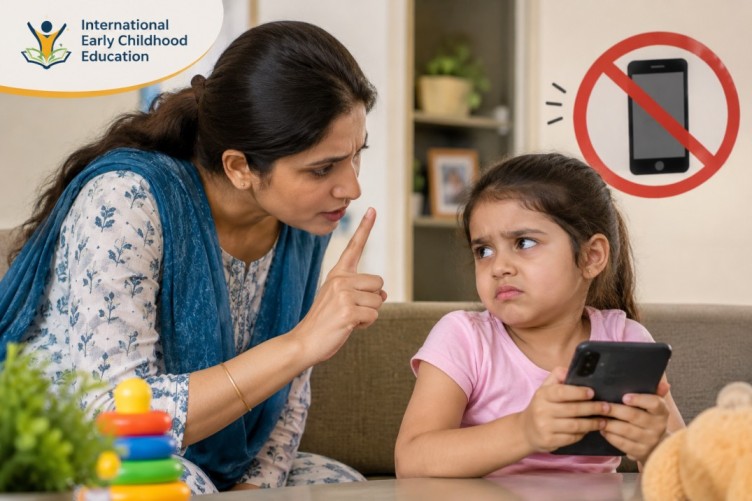
How to Keep Kids Away from Mobile Phones: Tips to Reduce Screen Time in Early Years (2027 Guide)
Indian children under five spend an average of 2.2 hours per day on screens — more than double the World Health Organization’s recommended limit. Nearly 50% of rural children aged 2–4 have excessive screen time, and 49% of urban children aged 9–17 spend three or more hours daily on social media, OTT, and gaming platforms.
The Economic Survey 2025–26 has flagged digital addiction among children and adolescents as an “alarming” public health concern, linked to poor sleep, anxiety, and declining learning outcomes. The good news: the strategies that actually work are not about banning screens. They are about replacing them with something better — play, connection, and routine. This guide gives parents and educators practical, research-backed ways to reduce screen time in the early years.
One-Line Answer: The Screen Time Reality for Indian Kids
The average Indian child under five spends 2.2 hours per day on screens. The WHO recommends zero screen time for children under 2 and no more than 1 hour per day for ages 2–5. Indian children are consuming more than double the recommended limit — and the consequences show up in sleep, behaviour, and language development.
Why this matters to you: If your child is spending 2+ hours on a screen, they are not “just playing.” Their brain is being trained to expect fast, passive stimulation — and that makes the real world (books, play, conversation) feel slow and boring by comparison.
What the Data Says About Screen Time in India
50.5% of Rural Children Aged 2–4 Have Excessive Screen Time
A 2026 cross-sectional study from rural Haryana found that 50.5% of children aged 2–4 had excessive screen time. Screen use was primarily for entertainment (71.1%) or as a parenting tool (50%) — meaning parents were using screens to manage behaviour, not to educate. This is not a metro problem. It is a national one.
49% of Urban Kids Aged 9–17 Spend 3+ Hours Daily
A LocalCircles survey across 302 urban districts found that 49% of parents with children aged 9–17 report their children spend three hours or more daily on social media, OTT platforms, and online gaming. 22% of parents report screen time exceeding six hours daily. The Economic Survey 2025–26 estimates that nearly 60% of children may already display behaviour patterns linked to digital dependency, including poor sleep.
Economic Survey 2025–26 Flags Digital Addiction as Alarming
The Economic Survey 2025–26 has explicitly warned that excessive screen use harms learning, sleep, well-being, and social development. Compulsive digital use is closely linked to anxiety, stress, and emotional dysregulation. This is not a parenting opinion — it is a national policy concern.
Why this matters to you: You are not overreacting. The data confirms what you already feel: screens are changing your child’s behaviour, and it is not just in your home.
What the Guidelines Actually Say (WHO and Indian Pediatrics)
Under 2 Years: Zero Screen Time
The World Health Organization recommends no screen time for children under 2 years. The Indian Academy of Pediatrics (IAP) and Indian Pediatrics align with this: children below 2 should not be exposed to any type of screen. For children aged 12–24 months, if screens are introduced, they should be co-viewed with a caregiver and limited to educational content only.
Ages 2–5: Maximum 1 Hour Per Day
For children aged 2–5, the WHO recommends no more than 1 hour of sedentary screen time per day** — and **less is better. IAP guidelines specify that for children 24–59 months, screen time should be limited to a maximum of 1 hour per day, with each session not exceeding 20–30 minutes. Only one screen should be used at a time.
The Comparison Table
| Age Group | WHO Recommendation | Indian Pediatrics / IAP |
|---|---|---|
| Under 2 years | Zero screen time | Zero screen time |
| 2–5 years | Maximum 1 hour/day; less is better | Maximum 1 hour/day; each session 20–30 min |
| 6+ years | Consistent limits; prioritize sleep, activity, and offline play | Balanced online and offline activities |
Sources: World Health Organization guidelines; Indian Academy of Pediatrics (IAP) screen time recommendations; Indian Pediatrics (2021).
Why this matters to you: The guidelines are not arbitrary. They are based on what young brains need for healthy development — and Indian children are exceeding them by a wide margin.
Why Screen Time Harms Early Development
Sleep Disruption and Emotional Problems
Excessive screen time is linked to myopia, obesity, and insufficient sleep in children. A 2025 study found that excessive screen time is associated with emotional and behavioural problems, mediated by sleep disturbance. Screens before bed delay sleep onset and reduce sleep quality — and poor sleep makes every other developmental challenge worse.
Language and Attention Delays
A study of children aged 1–3 found that screen exposure affects psychosocial status. Another study linked screen time of more than 60 minutes to poor performance on developmental assessments. The mechanism is simple: time spent on a screen is time not spent talking, playing, and interacting with caregivers — and those interactions are how language and attention are built.
The “Technoference” Effect on Parent-Child Bonding
Research on “technoference” — parental screen use interrupting parent-child interactions — shows that children’s perceptions of maternal technoference are associated with depression and anxiety symptoms. It is not just the child’s screen time that matters. It is also the parent’s. When you are on your phone during playtime, your child notices.
Why this matters to you: The harm from screens is not just about “too much time.” It is about what screens replace: sleep, conversation, play, and connection.
7 Practical Strategies to Reduce Screen Time (That Actually Work)
1. Model the Behaviour You Want
Children copy what they see. If you are scrolling at the dinner table, they will want to do the same. Put down your own devices during family time and talk with your kids. The NIH recommends modelling healthy habits as the first step in managing screen use.
2. Create Screen-Free Zones and Times
Designate phone-free zones** — the dining table, bedrooms, and the car — and **screen-free times — mealtimes, the hour before bed, and during homework. The American Academy of Pediatrics (AAP) recommends establishing phone-free zones during mealtimes, in bedrooms, an hour before bed, and during homework.
3. Replace Screens with Active Play
The best way to reduce screen time is not to say “no” to screens — it is to say “yes” to something better. Fill the gap with outdoor play, sports, reading, board games, art, cooking, or building with blocks. The NIH recommends getting involved in activities like sports, playing outdoors, reading, and board games.
4. Use the “I’m Bored” Jar
Create a jar filled with screen-free activity ideas** — “build with Legos,” “draw with your non-dominant hand,” “make a cardboard creation,” “cook something new,” “rearrange your room.” When your child says “I’m bored,” they pick from the jar instead of reaching for a screen. This simple tool removes the decision fatigue from both of you.
5. Turn Off Screens One Hour Before Bed
Screens before bed delay sleep and reduce sleep quality. Turn off screens at least an hour before bedtime**. Charge devices **outside the bedroom and replace screen time with calming activities like reading or journaling. This single change improves both sleep and behaviour.
6. Use Tech Tools Wisely
Use do-not-disturb times** and **app time limits on devices. Turn off notifications on unimportant apps and uninstall apps that do not have a strong connective or educational purpose. Focus on improving quality over quantity — not all screen time is equal, and educational, co-viewed content is better than passive scrolling.
7. Make a Family Media Plan Together
Do not impose rules from above. Build a family media plan together** — with your children, not for them. The AAP recommends creating screen-free time for the entire family and ensuring opportunities for sleep, movement, reading, play, homework, and family time. When children help make the rules, they are more likely to follow them.
Why this matters to you: These seven strategies are not about deprivation. They are about creating a home where screens have a place — but not the first place.
What NOT to Do (Strategies That Backfire)
The Comparison Table: Effective vs. Counterproductive Responses
| Effective Response | Counterproductive Response | Why It Backfires |
|---|---|---|
| Offer a choice of offline activities | Snatching the phone away | Triggers tantrums and resentment |
| Set clear, consistent limits | Giving in when the child cries | Teaches that crying works |
| Co-view and discuss content | Using screens as a babysitter | Loses the educational value |
| Model screen-free behaviour | Scrolling while telling the child to stop | Children copy what they see, not what they hear |
| Create routines and predictability | Random rules that change daily | Creates anxiety and testing behaviour |
Why this matters to you: The way you reduce screen time matters as much as the reduction itself. A punitive approach creates conflict; a collaborative approach creates habits.
Age-Wise Approach: What Works at 1, 3, and 5
The Age-Wise Strategy Table
| Age | Screen Time Limit | What Works |
|---|---|---|
| Under 2 | Zero | Distraction with toys, physical comfort, outdoor walks, face-to-face interaction |
| 2–3 | Max 1 hour/day (20–30 min sessions) | Co-viewing educational content, “I’m bored” jar, active play, predictable routines |
| 4–5 | Max 1 hour/day | Family media plan, screen-free zones, collaborative rule-making, outdoor play, creative projects |
Sources: WHO guidelines; Indian Academy of Pediatrics; NIH and AAP screen time recommendations.
Why this matters to you: A 2-year-old cannot negotiate a media plan. A 5-year-old can. Match your strategy to the child’s developmental stage, not to their age in months.
NEP 2020 and the Push for Play-Based Learning
Why the Policy Favours Play Over Screens in Early Years
NEP 2020 explicitly emphasises play-based, activity-based, and inquiry-based learning for the foundational stage (ages 3–8). The policy recognises that technology in the Foundational Stage is not meant to increase screen time, but to expand opportunities for exploration, creativity, and communication through carefully guided, age-appropriate experiences. The National Curriculum Framework (NCF-FS 2022) recommends a balanced approach to online and offline activities**, keeping screen time as an essential parameter in accordance with the child’s level.
For pre-primary children, the recommended screen time is 20–30 minutes per day, supervised — far below what most Indian children are actually getting. For primary children, it is 40 minutes per day, supervised.
Why this matters to you: The policy direction is clear: early childhood is for play, not screens. If your child’s preschool or Anganwadi is using screens as a teaching tool, ask how much and for what purpose.
7-Point Checklist for Parents and Educators
- Am I modelling screen-free behaviour during family time?
- Have I created at least two screen-free zones (meals, bedrooms) and one screen-free time (the hour before bed)?
- Do I have a list of screen-free activities ready when my child says “I’m bored”?
- Is my child’s screen time under the WHO/IAP limit for their age?
- Am I co-viewing and discussing content, or using screens as a babysitter?
- Have I involved my child in making the family media plan?
- Am I consistent, or do the rules change depending on my mood?
If the answer to questions 1, 4, or 7 is unclear, start there.
Final Verdict
If your child is under 2: The target is zero screen time. Use physical comfort, toys, outdoor walks, and face-to-face interaction. Do not introduce screens as a calming tool.
If your child is 2–3: Limit to 1 hour per day, in 20–30 minute sessions, with co-viewing. Build the “I’m bored” jar and establish predictable routines. Expect resistance — hold the boundary with warmth.
If your child is 4–5: Involve them in making a family media plan. Create screen-free zones and times. Replace screen time with active play, creative projects, and outdoor time. The goal is not to eliminate screens — it is to make them one small part of a rich, active childhood.
If you are an educator: Align with NEP 2020’s play-based approach. Keep screen time to 20–30 minutes per day for pre-primary, supervised, and educational. Communicate with parents about a unified approach.
Ready to build healthier screen habits in your home or classroom?
Explore early childhood resources and parenting guides on international-ece.com →
Or fill this 2-minute form and get practical, age-specific guidance for your child.
Frequently Asked Questions (FAQ)
How much screen time is safe for a 2-year-old?
The WHO and Indian Academy of Pediatrics recommend no more than 1 hour per day for children aged 2–5, with each session not exceeding 20–30 minutes. For children under 2, the recommendation is zero screen time. Indian children under 5 average 2.2 hours per day — more than double the limit.
What are the signs my child is addicted to screens?
Signs include tantrums when screens are removed, losing interest in offline play, poor sleep, irritability, and difficulty focusing on non-screen activities. The Economic Survey 2025–26 estimates nearly 60% of children may display behaviour patterns linked to digital dependency, including poor sleep.
Should I completely ban screens for my child?
A complete ban is not realistic for most families. The goal is to reduce screen time to age-appropriate limits, prioritise educational and co-viewed content, and replace passive screen time with active play, reading, and family interaction. A family media plan built together works better than a top-down ban.
How do I stop my child from crying for the phone?
Do not give in to crying — it teaches the child that crying works. Stay calm, name the feeling (“You’re upset because you want the phone”), hold the boundary with warmth (“We’re not using the phone now”), and offer a choice of offline activities. Consistency is more important than intensity.
Does screen time affect my child’s sleep?
Yes. Screens before bed delay sleep onset and reduce sleep quality. Excessive screen time is linked to insufficient sleep, which in turn is associated with emotional and behavioural problems. Turn off screens at least an hour before bedtime and charge devices outside the bedroom.
What does NEP 2020 say about screen time in early childhood?
NEP 2020 emphasises play-based, activity-based learning for the foundational stage and recommends a balanced approach to online and offline activities. For pre-primary children, the recommended screen time is 20–30 minutes per day, supervised — far below what most Indian children are getting.