Positive Discipline vs Punishment: What Works for Preschoolers (2027 Guide)
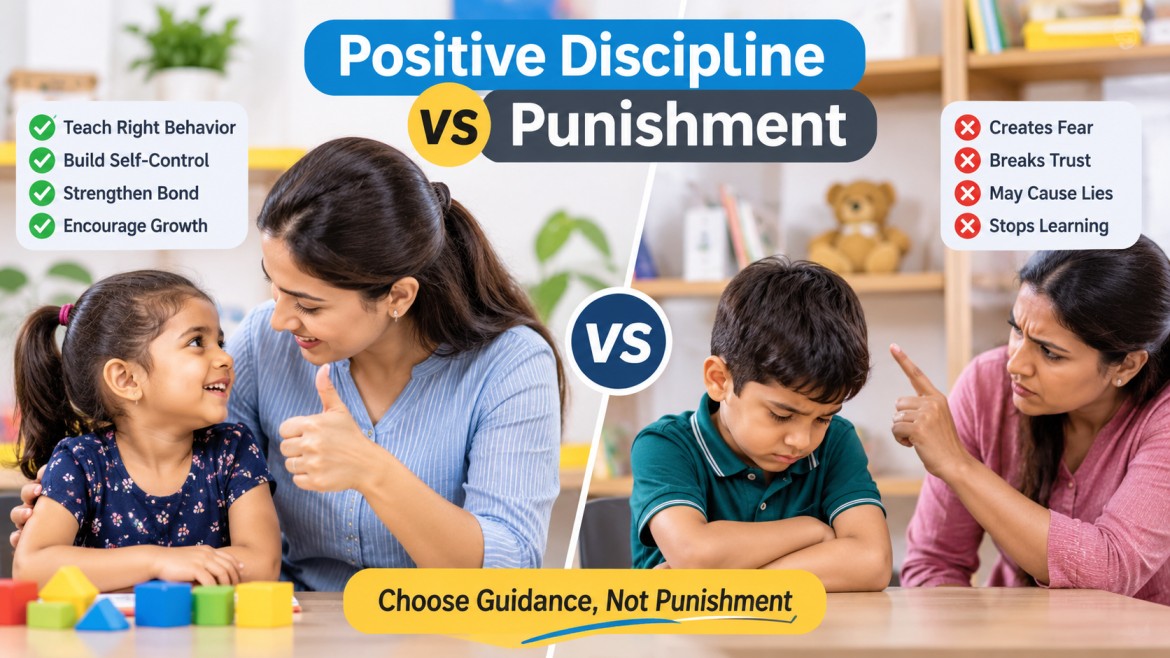
Direct answer: Positive discipline teaches children what to do; punishment makes them feel bad for what they did wrong. For preschoolers, positive discipline works better — it builds self-regulation, protects the parent–child relationship and aligns with Indian law and NCF-FS 2022. Punishment may stop behaviour in the moment, but it does not teach the skill the child is missing.
If you have ever wondered whether a stern punishment “works better” than gentle guidance, you are not alone. Indian parents in 2027 are caught between traditional discipline scripts and modern research. This guide settles the debate with evidence, not opinion.
The Core Difference: Discipline Teaches, Punishment Controls
The word “discipline” comes from the Latin disciplina, meaning “to teach” or “to learn”. Punishment, by contrast, is about inflicting discomfort for a past mistake. One looks forward; the other looks backward.
What Positive Discipline Actually Means
Positive discipline is a research-backed approach developed by Dr. Jane Nelsen, built on the Adlerian idea that children should be treated with respect. It is not permissive. It combines warmth with clear boundaries, holds expectations, and uses consequences that teach rather than shame.
In practice, it sounds like: “I can see you’re frustrated. Toys are not for throwing because someone could get hurt. Let’s find another way to show how you’re feeling.” The boundary stays. The dignity stays. The learning happens.
What Punishment Does (And Doesn’t Do)
Punishment — whether physical (hitting, slapping) or emotional (yelling, shaming, isolating) — activates fear. A frightened preschooler may stop the behaviour temporarily, but the thinking brain needed for learning shuts down What remains is resentment, confusion or a damaged sense of self.
Why this matters to you: Every time you choose teaching over punishing, you are building the neural pathways for self-control — not just compliance.
Why Punishment Fails Preschoolers — The 2027 Evidence
The research is now unambiguous. A 2025 meta-analysis of 189 studies across 92 countries found that physical punishment is linked to mental health problems, worse parent–child relationships, impaired social-emotional development and higher externalising behaviour. The harms were specific to physical and psychological aggression — not to non-violent discipline
For Indian parents, a 2026 urban study of children aged 3–6 found that positive techniques like supervision, reasoning and explanation foster cooperation and emotional security, while harsh practices like yelling or physical punishment lead to fear, sadness, aggression and parental guilt
What the Research Says About Physical and Emotional Punishment
The Positive Discipline in Everyday Parenting (PDEP) programme, evaluated with parents of children aged 2–6, showed that parents who shifted away from punishment reported greater self-reflection, improved child well-being and stronger connection, communication and trust. The change is learnable — and it happens within weeks, not years.
The Indian Context: Law, NEP 2020 and NCF-FS 2022
Indian law is clear. Corporal punishment is prohibited in schools under the Right to Education Act, 2009 (Section 17). The Juvenile Justice Act, 2015 and the Bhartiya Nyaya Sanhita also protect children from cruel or degrading punishment, even at home Positive discipline — reasoning, setting limits, role-modelling and reinforcing good behaviour — is legally supported
NEP 2020 and NCF-FS 2022 go further. The NCF explicitly states: “Enforcing norms should be done in a positive manner. When rules are broken, gently point children to the ‘norms’ poster and talk about it”. It also directs teachers to examine how they themselves were disciplined, warning against replicating harsh methods.
Why this matters to you: Choosing positive discipline is not just good parenting — it is alignment with Indian law and national curriculum frameworks.
What Positive Discipline Looks Like in Real Indian Homes and Classrooms
Positive discipline is not a foreign import. It fits naturally into Indian family structures, joint families and preschool routines. What changes is the how, not the what.
Positive Discipline vs Punishment: Side-by-Side Comparison
| Moment | Punishment Response | Positive Discipline Response | What the Child Learns |
|---|---|---|---|
| Child throws a toy | “You’re naughty. No TV tonight.” | “Toys are not for throwing. Let’s practise rolling the ball instead.” | Alternative behaviour; safety |
| Child hits a sibling | Slap or shout; forced apology | “Hitting hurts. Look at her face. What could you do instead?” | Empathy; repair |
| Child refuses to share | “You must share. Give it now.” | “When you’re finished, Riya can have a turn. Let’s use the timer.” | Turn-taking; ownership security |
| Child spills water | “See what you did! I told you.” | “Let’s get a cloth and clean it together.” | Responsibility; problem-solving |
The Four Pillars of Positive Guidance
NCF-FS 2022 and global research converge on four pillars:
- Clear, positively worded expectations — tell children what to do, not just what not to do.
- Warm connection — the relationship is the vehicle for discipline.
- Logical consequences — consequences must be related, respectful and reasonable.
- Teaching replacement skills — show the child what to do instead of the challenging behaviour
Why this matters to you: These four pillars work in a Mumbai apartment, an Indore preschool and a Patna joint family — because they are about human connection, not culture-specific rules.
7 Positive Discipline Strategies That Work for Preschoolers
1. State Expectations Positively
Instead of “Don’t run,” say “Walk inside.” Instead of “Stop shouting,” say “Use your inside voice.” NCF-FS 2022 gives this exact example: “Walk around the edge of the grass so you won’t get hit by the swing” rather than “Don’t go near the swing”. Preschoolers hear the action word, not the “don’t.”
2. Use Logical Consequences, Not Arbitrary Punishment
A logical consequence is directly connected to the behaviour. If a child throws blocks, they help pick them up. If they refuse to wear a jacket, they feel cold (natural consequence). Arbitrary punishment — “No screen time for a week” — teaches nothing about the behaviour itself[.
3. Validate the Feeling, Limit the Behaviour
All feelings are acceptable; not all behaviours are. “You’re angry that he took your car. It’s okay to feel angry. It’s not okay to hit. Let’s use words.” This is emotional coaching — the single strongest predictor of self-regulation in preschoolers.
4. Offer Two Acceptable Choices
Choice restores a preschooler’s sense of control without giving up your boundary. “Do you want to wear the red shirt or the blue shirt?” instead of “Wear this now”. Both options are acceptable to you. The child feels empowered.
5. Redirect Instead of Correct
Preschoolers have short attention spans. When behaviour is unsafe or disruptive, redirect to an acceptable alternative. “Let’s get a basket for you to toss those balls into, so others can play safely nearby”. Redirection is not permissiveness — it is guidance in action.
6. Use “Time-In,” Not “Time-Out”
Traditional time-out isolates a dysregulated child, which escalates the nervous system. Time-in means sitting with the child, co-regulating until the thinking brain comes back online. Only then can teaching happen. A calm-down corner with soft toys, books or breathing cards works far better than a punitive chair.
7. Repair After Conflict
No parent is perfect. What matters is repair. “I shouted. That wasn’t fair. I’m sorry. Let’s try again.” Repair teaches accountability, humility and the exact skill you want your child to learn: that relationships can survive conflict.
Why this matters to you: These seven strategies take seconds, not hours. They fit into real Indian mornings, school runs and bedtime routines.
Common Myths About Positive Discipline (And Why They’re Wrong)
Myth 1: Positive discipline means no rules
Fact: Positive discipline has more boundaries, not fewer. The difference is that boundaries are delivered with respect and followed through consistently. Permissiveness is not positive discipline — it is neglect of guidance.
Myth 2: Children need punishment to learn respect
Fact: Fear produces compliance, not respect. Respect is learned through being respected. The 2025 meta-analysis found that punishment damages the parent–child relationship — the very foundation of respect.
Myth 3: Praising good behaviour is bribery
Fact: Bribery is given before behaviour to stop a problem (“I’ll give you chocolate if you stop crying”). Praise and acknowledgment are given after the desired behaviour to reinforce it (“You waited for your turn. That was patient”) One teaches manipulation; the other teaches internal motivation.
How international-ece.com Applies Positive Discipline
At international-ece.com, positive discipline is not a policy on paper — it is the daily practice of our educators. We do not use time-out as punishment. We do not shout. We do not shame. Instead, we state expectations positively, coach through conflict and teach replacement skills in real time.
Our approach aligns directly with NCF-FS 2022’s directive that behaviour guidance must focus on “understanding, teaching and supporting children — not punishment”. We use stories, puppets and role-play to build emotional vocabulary. We narrate positive behaviour out loud so children hear what they did right. And we partner with parents so the language of positive discipline is consistent at home and at school.
Aligning with NCF-FS 2022 Positive Guidance
NCF-FS 2022 identifies five domains of development, including “Socio-Emotional and Ethical Development”. It explicitly warns that children behave inappropriately because they are still learning, not because they are “bad” or trying to “trouble us”. Our educators are trained to see behaviour as communication — and to respond with guidance, not punishment.
If you are looking for an early childhood partner that treats positive discipline as a core competency, explore our programmes or speak to our team.
A Quick Checklist: Are You Disciplining or Punishing?
- ☐ My response teaches a skill the child is missing.
- ☐ My words protect the child’s dignity (no shaming, no labelling).
- ☐ The consequence is related, respectful and reasonable.
- ☐ I validated the feeling before correcting the behaviour.
- ☐ I offered an acceptable alternative or choice.
- ☐ I stayed calm (or regulated myself first).
- ☐ I followed through consistently.
- ☐ I repaired if I lost my temper.
Final Thoughts: The Goal Is Self-Regulation, Not Obedience
Punishment asks, “How do I stop this behaviour right now?” Positive discipline asks, “What does my child need to learn, and how can I teach it?” The first question produces children who behave when watched. The second produces children who behave because they have learned to manage themselves.
In 2027, with Indian families navigating more stress, more screens and more comparison than ever, self-regulation is the real competitive advantage — and it is built through daily, respectful guidance.
Frequently Asked Questions
1. What is the main difference between discipline and punishment?
Discipline means to teach. It focuses on guiding a child toward self-control and responsibility. Punishment inflicts discomfort for a past mistake and relies on fear. Discipline looks forward; punishment looks backward.
2. Does positive discipline mean letting children do whatever they want?
No. Positive discipline is warm but firm. It holds clear boundaries, uses logical consequences and follows through consistently. Permissiveness is the absence of guidance; positive discipline is guidance delivered with respect.
3. Is physical punishment illegal in India?
Corporal punishment is prohibited in schools under the Right to Education Act, 2009 (Section 17). Other laws, including the Juvenile Justice Act, 2015, protect children from cruel or degrading punishment even at home
4. What does NCF-FS 2022 say about discipline?
NCF-FS 2022 directs that norms be enforced positively. When rules are broken, adults should gently point children to agreed norms and discuss them — not punish. It also warns adults against replicating harsh methods from their own childhood.
5. How do I handle a preschooler who hits?
Block the hit, stay calm and validate the feeling: “You’re angry. It’s okay to feel angry. It’s not okay to hit. Let’s use words.” Teach a replacement skill — stomping, squeezing a cushion or asking for help. Repair afterwards if needed.
6. Does positive discipline take more time than punishment?
In the moment, yes — teaching takes longer than yelling. But over weeks, positive discipline saves time because children learn to self-regulate. The PDEP evaluation showed parents shifted habits within weeks, with lasting improvements in cooperation and connection.