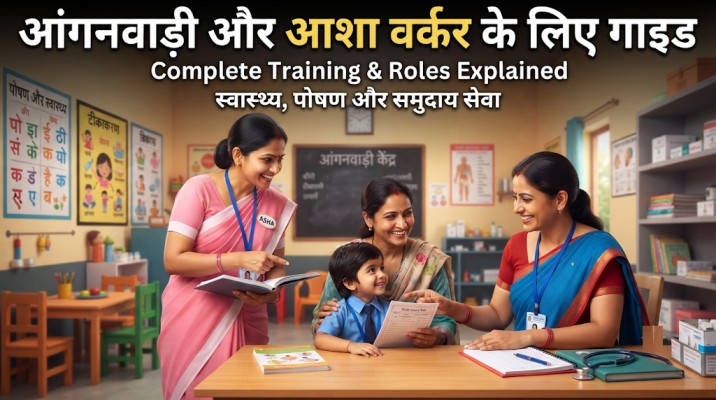
A Guide for Anganwadi and ASHA Workers: How to Improve Foundational Education for Children (2026)
Foundational education for children aged 3–8 is the single most important investment India can make, and Anganwadi and ASHA workers are the frontline deliverers. The good news: you do not need new infrastructure or a formal teaching degree to improve early learning. You need five to ten minutes of intentional, play-based interaction woven into the work you already do.
NEP 2020, the National Curriculum Framework for Foundational Stage (NCF-FS 2022), and the Jadui Pitara play-based learning kit have given you the policy and the tools. This guide gives you the practical routines, activities, and habits that actually work in a real Anganwadi centre — with limited time, limited materials, and limited support.
One-Line Answer: What Is Foundational Education and Why It Matters
Foundational education refers to the learning that happens in the first five years of a child’s life — ages 3–8 — covering three years of pre-school (Anganwadi or Balvatika) and Grades 1 and 2. It is called “foundational” because everything that comes later in school is built on it.
Why this matters to you: 85% of a child’s brain develops in the first six years. What happens in your Anganwadi centre in those years shapes the child’s language, numeracy, thinking, and confidence for the rest of their life. You are not just “looking after” children. You are building the foundation of their future.
The Policy Context: NEP 2020, NCF-FS, and the Tools You Already Have
Jadui Pitara: 53 Play-Based Learning Materials in 23 Languages
The Jadui Pitara (Magic Box) is a set of 53 play-based learning-teaching materials for children aged 3–8, launched on 20 February 2023 by the Ministry of Education. It includes toys, puzzles, story cards, flashcards, and teacher handbooks centred on the NCF-FS, and is available in 23 languages including English.
The digital extension, e-Jaadui Pitara, launched in February 2024, offers multilingual stories, activities, songs, and AI-based bots — Katha Sakhi, Teacher Tara, and Parent Tara — to support children, teachers, and parents. If your centre has received the Jadui Pitara kit, you already have the core materials. If not, most of the activities in this guide can be done with local, low-cost materials.
Poshan Bhi Padhai Bhi (PBPB): Training for Anganwadi Workers
Poshan Bhi Padhai Bhi (“Education along with nutrition”) was launched on 10 May 2023 by the Ministry of Women and Child Development under the Saksham Anganwadi and Mission Poshan 2.0 umbrella. It aims to enhance early learning for children from birth to six years through the Anganwadi system.
As of the latest government data, 41,645 State Level Master Trainers (SLMTs) and 8,95,814 Anganwadi Workers (AWWs) have been trained under PBPB across the country. The training covers curriculum, pedagogy, and assessment tools, with a strong emphasis on play-based, activity-based learning. If you have not yet received this training, ask your supervisor — it is your right, and it makes your daily work easier.
Aadharshila and Navchetana: The 2024 Curriculum and Stimulation Frameworks
In 2024, the Ministry of Women and Child Development launched two important frameworks:
- Navchetana: A National Framework for Early Childhood Stimulation for Children from Birth to Three Years (2024), based on the principles of “serve and return,” and the caregiver’s three acts: love, talk, play, and positive guidance.
- Aadharshila: A National Curriculum for Early Childhood Care and Education for Children from Three to Six Years (2024). It is a 48-week, play-based curriculum designed for India’s 14 lakh Anganwadis, with competency-based lesson plans and almost 150 activities covering all learning domains. It includes special focus on screening, inclusion, and referral of Divyang (disabled) children.
Why this matters to you: You do not have to invent a curriculum. The government has already created it. Your job is to use it — and the activities below show you how.
The Reality on the Ground: Challenges Anganwadi and ASHA Workers Face
38 Minutes of Instruction vs. the Recommended 2 Hours
Government data shows that Anganwadi workers spend only about 38 minutes per day on preschool instruction, against a recommended two hours. The reasons are well known: too many registers (11 or more), BLO duties, health surveys, and the sheer burden of running a centre with limited help.
Over 60% of Workers Without Playful Teaching Training
Despite the PBPB rollout, more than 60% of Anganwadi workers have received no training in playful teaching, according to field reports. Only 9% of pre-primary schools have dedicated ECE teachers. And many workers still rely on rote methods — repeating numbers, reciting rhymes — because that is what they know.
The Overburden of Registers, BLO Duties, and Health Work
Anganwadi workers are overworked and underpaid. Many are engaged in BLO (Booth Level Officer) duties, which means centres are sometimes shut for weeks or run only by helpers. The result: only 15% of children can match basic objects, and 30% can compare numbers — essential pre-Class 1 skills.
Why this matters to you: You are not failing. The system is stretched. But even within these constraints, five minutes of intentional play can change a child’s trajectory. This guide is designed for that reality — not an ideal one.
7 Practical Ways to Improve Foundational Education (No Extra Budget Needed)
1. Create a “Learning Corner” with Local Materials
You do not need a classroom. You need one corner of the Anganwadi with open-ended materials: bottle caps, sticks, stones, fabric scraps, cardboard boxes, and paper. UNICEF recommends using local, low-cost materials like seeds, buttons, bottle caps, paper scraps, mud, and twigs for counting, sorting, and art.
What to do: Set up a low shelf or a mat. Place 5–7 different materials. Let children choose what to play with. Your role is to ask questions, not to direct.
2. Use the 5-Minute Guided Play Routine
You do not need two uninterrupted hours. You need five minutes of focused guided play — twice a day. Guided play means the child leads, and you extend the learning with one good question.
What to do: Pick one activity — blocks, sorting, or pretend play. Sit with the child. Ask: “What are you making?” or “What happens if you put this here?” Wait for the answer. Do not correct. Just extend.
3. Turn Daily Routines into Language and Numeracy Moments
Every routine is a learning opportunity. Handwashing, snack time, and lining up can all teach counting, sequencing, and vocabulary.
What to do: Count plates as you set them out. Ask children to sort spoons by size. Describe what you are doing: “I am pouring water. The cup is full. Now it is empty.”
4. Use Storytelling and Local Songs
Stories and songs build vocabulary, listening, memory, and phonological awareness. You do not need books. You can tell stories from memory, use puppets made from socks or paper, or sing local rhymes.
What to do: Tell one story every day. Use different voices. Ask: “What happens next?” Let children act out the story with their hands or bodies.
5. Involve Parents with Simple Take-Home Activities
Parents are the child’s first teacher. A simple take-home task — “Count the stairs with your child” or “Ask your child to tell you one thing they played today” — extends learning beyond the centre.
What to do: At pick-up time, give one parent one specific, simple activity for the week. Keep it to one sentence. Do not overload.
6. Screen Early for Developmental Delays and Refer
Aadharshila includes special focus on screening, inclusion, and referral of Divyang children. Early identification is one of the most powerful things an Anganwadi or ASHA worker can do.
What to do: Watch for signs — no eye contact, no response to name, no pointing by 18 months, no words by 2 years. If you see these, refer to the nearest health facility or district early intervention centre. You are not diagnosing. You are connecting.
7. Track Progress with a Simple Checklist, Not a Register
You already have too many registers. Do not create another one. Use a simple, one-page checklist for each child — three or four skills you are watching for (e.g., “can count to 5,” “can name 5 colours,” “can tell a simple story”).
What to do: Once a month, mark the checklist. Use it to plan the next month’s activities. Do not submit it anywhere unless asked.
Why this matters to you: None of these seven strategies require extra budget, extra staff, or extra hours. They require a shift in how you use the minutes you already have.
How ASHA Workers Can Support Foundational Education (Without Adding to Their Load)
The Natural Overlap: Home Visits, Maternal Health, and Early Stimulation
ASHA workers already visit homes for maternal and child health. Those visits are the perfect opportunity to support early stimulation — the “serve and return” interactions that build a baby’s brain. Navchetana (the 2024 framework for birth to three years) is built on this principle.
3 Things ASHA Workers Can Say During Every Home Visit
- “Talk to your baby.” Describe what you are doing. Respond to their sounds. This builds language.
- “Play with your baby.” Peek-a-boo, stacking cups, and simple songs are not just fun — they are brain-building.
- “Look at your baby.” Eye contact and smiling build emotional security, which is the foundation of all learning.
Why this matters to you: You are not being asked to become a teacher. You are being asked to add one sentence to a conversation you are already having. That sentence — repeated across hundreds of homes — changes outcomes.
A Sample Daily Routine for a Play-Based Anganwadi Day
The 2-Hour Block: Welcome, Play, Story, and Reflection
| Time | Activity | What It Builds |
|---|---|---|
| 15 minutes | Welcome song and circle time | Social skills, listening, routine |
| 30 minutes | Guided play (blocks, sorting, sensory bin) | Numeracy, problem-solving, fine motor |
| 20 minutes | Storytelling with props or puppets | Language, imagination, sequencing |
| 20 minutes | Outdoor or movement play | Gross motor, self-regulation, risk assessment |
| 15 minutes | Snack time with language (naming, counting, sharing) | Vocabulary, social skills, nutrition |
| 20 minutes | Free choice play in learning corners | Independence, creativity, peer interaction |
Source: Adapted from NCF-FS 2022 and Aadharshila curriculum guidance. This routine can be shortened to 1 hour if time is limited — the sequence matters more than the minutes.
Why this matters to you: You do not need a perfect day. You need a predictable rhythm. Children thrive on routine. Even 15 minutes of guided play, done every day, compounds into significant learning over a year.
7-Point Checklist for Anganwadi and ASHA Workers
- Do I have a learning corner with open-ended, local materials?
- Am I doing at least 5–10 minutes of guided play every day?
- Am I telling a story or singing a song every day?
- Am I asking open-ended questions (“What would happen if…?”) instead of giving answers?
- Have I given at least one parent a simple take-home activity this week?
- Am I screening for developmental delays and referring when needed?
- Am I tracking 3–4 simple skills per child, once a month?
If the answer to questions 1, 2, or 4 is “no,” start there tomorrow.
Final Verdict
For Anganwadi workers: You do not need to be a trained teacher to improve foundational education. You need a learning corner, five minutes of guided play, one story a day, and one good question. The policy and tools (Jadui Pitara, Aadharshila, Navchetana) are already there. Use what you have.
For ASHA workers: Your home visits are a learning opportunity. Three sentences — “talk,” “play,” “look” — repeated across homes, can change the trajectory of a generation.
For supervisors and trainers: Your job is to protect the Anganwadi worker’s time for play. Reduce registers. Defend the 2-hour learning block. And make sure every worker gets the PBPB training they are entitled to.
Ready to strengthen foundational education in your Anganwadi or community?
Visit international-ece.com for practical ECE resources and training support →
Frequently Asked Questions (FAQ)
What is foundational education for children?
Foundational education covers the learning that happens from ages 3–8 — three years of pre-school (Anganwadi or Balvatika) plus Grades 1 and 2. It focuses on early literacy, numeracy, and cognitive skills through play-based, activity-based methods. NEP 2020 makes it the first stage of the 5+3+3+4 structure.
How can Anganwadi workers improve early learning with limited time?
Focus on five minutes of guided play, one story a day, and open-ended questions. Use local, low-cost materials like bottle caps, sticks, and fabric. Turn daily routines — handwashing, snack time — into counting and vocabulary moments. You do not need extra hours; you need intentional use of the minutes you have.
What is Jadui Pitara and how can I use it?
Jadui Pitara is a set of 53 play-based learning materials for ages 3–8, launched in 2023. It includes toys, puzzles, story cards, and teacher handbooks, available in 23 languages. Use it to set up learning corners, guide play, and tell stories. The e-Jaadui Pitara app offers multilingual stories and activities.
How can ASHA workers support foundational education?
ASHA workers can add three simple messages to every home visit: talk to your baby, play with your baby, and look at your baby. These “serve and return” interactions build language, emotional security, and brain development. Navchetana, the 2024 framework for birth to three years, is built on this principle.
What is the Poshan Bhi Padhai Bhi training?
Poshan Bhi Padhai Bhi (PBPB) is a Ministry of Women and Child Development initiative launched in May 2023 to train Anganwadi workers in play-based early learning. Over 8.95 lakh AWWs and 41,645 master trainers have been trained. It covers curriculum, pedagogy, and assessment tools aligned with NCF-FS and Aadharshila.
How do I screen for developmental delays in young children?
Watch for: no eye contact, no response to name, no pointing by 18 months, no words by 2 years, and no interest in other children. If you see these signs, refer to the nearest health facility or district early intervention centre. Early identification and referral are among the most powerful things a frontline worker can do.