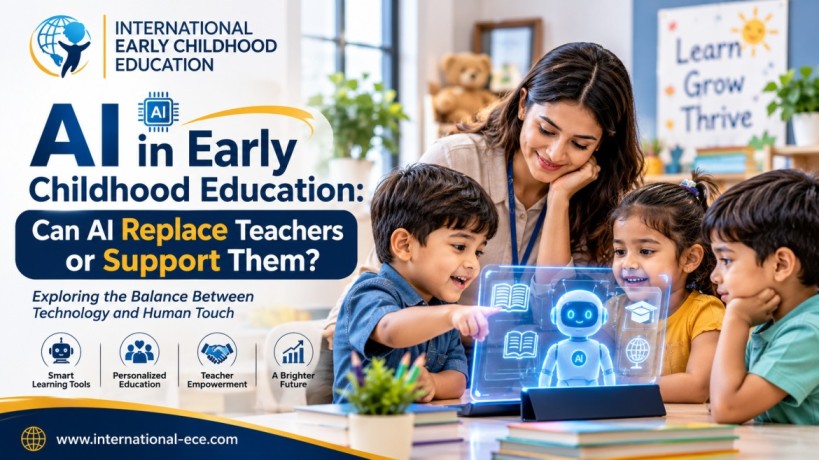
AI in Early Childhood Education: Can AI Replace Teachers or Support Them?
Direct answer: In 2027, AI will not replace early childhood teachers — it will support them. AI handles attendance, parent updates, assessments and lesson planning, while teachers handle what only humans can: nurturing, play, comfort and trust. In India, AI works best as a management layer, not as a classroom replacement.
If you are a preschool owner, franchisee, or planning to start one with a ₹2–25 lakh budget, the real question is not “AI or teacher”. It is “which AI tools save me money without compromising child safety”.
What Does AI Actually Do in an Early Childhood Classroom in 2027?
Forget the sci-fi version. In a real Indian preschool in 2027, “AI” mostly means software that observes patterns, automates routine work and sends alerts.
Common examples running today:
- Face-recognition attendance for children and staff
- Parent communication apps that auto-send daily reports
- AI-assisted lesson planners that generate weekly activity sheets
- Voice-to-text observation logs for teachers
- CCTV analytics that flag unsafe behaviour or long idle time
Why this matters to you: None of these replace a teacher. They replace paperwork. In most Indian preschools, teachers lose 30–40% of their day to admin work (industry estimate). That is the actual target for AI.
Can AI Replace Early Childhood Teachers? The Honest Answer
No — and the reason is developmental, not technical. Children aged 3–6 learn through touch, eye contact, tone of voice and emotional co-regulation. AI cannot provide any of these.
What AI Already Does Better Than Teachers
- Data capture: Attendance, meal logs, nap times, incident reports — faster and more accurate than paper.
- Parent reporting: Automated daily updates in English + regional languages.
- Pattern detection: Flags a child with repeated low engagement before a teacher might notice.
- Lesson planning: Generates age-appropriate weekly activity sheets in minutes.
- Record keeping: Instant access to health records, allergies, and emergency contacts.
What AI Cannot Do (And Never Will)
- Comfort a crying 4-year-old who misses home.
- Read a child’s fear when they go quiet.
- Physically guide a child’s hand to hold a crayon.
- Model kindness, patience and empathy in real time.
- Replace a teacher’s eye contact when a child seeks reassurance.
Table 1: AI vs Teacher — Task-by-Task Comparison
| Task | AI in 2027 | Teacher in 2027 |
|---|---|---|
| Attendance & record keeping | Fully automated | Reviewed only |
| Parent daily updates | Auto-generated | Adds personal notes |
| Lesson planning | Draft plans | Adapts to child needs |
| Emotional support | Not capable | Core strength |
| Physical play & motor skills | Assisted only | Core strength |
| Assessment & reporting | Auto-tracked | Interprets & advises |
| Safety supervision | Alerts only | Physically present |
Why this matters to you: Teachers are not being replaced — they are being upgraded. AI gives them back 1–2 hours per day for real teaching.
AI in Indian Preschools 2027: Where It Actually Fits Today
India’s ECE sector runs on tight margins. Every AI tool you add must justify its cost within months, not years. In 2027, only five use cases actually pay back for a small preschool.
5 Real Use Cases Running in Indian ECE Centres
- Smart attendance + safety alerts — face-recognition for entry/exit, SMS to parents on pickup. Reduces parental anxiety and staff paperwork.
- Parent engagement app — daily photos, progress notes, fee reminders in English + Hindi/regional language. Drives retention and word-of-mouth referrals in Tier-2 cities like Indore and Jaipur.
- AI lesson planner — aligns weekly plans with NCF-FS 2022. Saves 4–6 hours of teacher planning per week.
- Assessment & progress dashboards — tracks each child against developmental milestones, flags early concerns for parent conversations.
- CCTV analytics + safety compliance — auto-detects unsupervised zones or prolonged idle time. Useful when applying for franchise certification or government audits.
Table 2: AI Tool Costs for a Small Indian Preschool (2027)
| Tool | Monthly cost (₹) | Setup (₹) | Payback |
|---|---|---|---|
| Attendance + parent app (combo) | 1,200–2,500 | 5,000–15,000 | 3–5 months |
| AI lesson planner | 800–1,800 | 2,000–5,000 | 2–4 months |
| Assessment dashboard | 1,000–2,000 | 5,000–12,000 | 4–6 months |
| CCTV AI analytics | 2,000–4,000 | 15,000–40,000 | 6–10 months |
| Full stack (all above) | 5,000–9,000 | 30,000–65,000 | 6–12 months |
Source: industry estimates from Indian EdTech vendors and franchise support teams (2025–2026). Prices vary by city and vendor.
Why this matters to you: A full AI stack costs less than one extra teacher’s salary per month. That is why it makes business sense — as support, not as replacement.
The Teacher Shortage Problem AI Cannot Solve Alone
India’s ECE sector runs on a chronic teacher shortage. UDISE+ 2023–24 estimates show that pre-primary teacher availability remains uneven across states, especially in Tier-3 districts.
AI cannot fix this shortage. It cannot show up in a classroom, comfort a child, or model good behaviour. But it can reduce how many teachers you need to burn out.
- Admin automation frees teachers for teaching.
- Training modules built into tools upskill new hires faster.
- Retention improves when teachers spend less time on paperwork.
- Data dashboards help principals identify training gaps.
Why this matters to you: Teacher attrition in India’s ECE sector is high. Reducing admin load is the cheapest retention strategy available in 2027.
WHO Screen Time Rules and AI: What Every Preschool Must Follow
WHO guidelines (2019, still current in 2027) recommend zero screen time for children under 2 and no more than 1 hour per day of high-quality screen time for ages 2–4.
This directly limits how AI can be used in preschools:
- AI must stay behind the scenes (admin, planning, safety) — not on a child’s screen.
- Any “AI learning app” for a 3-year-old is a red flag, no matter the marketing.
- Teacher training must include screen-time discipline as a core competency.
Why this matters to you: Parents will check this. A preschool known for responsible tech use wins trust faster than one pushing screens on toddlers.
How AI Supports Teachers: 7 Practical Workflows
- Morning attendance — face ID + SMS to parent in under 10 seconds.
- Daily observations — voice notes auto-converted into report-ready text.
- Weekly lesson plans — AI drafts, teacher edits in 10 minutes.
- Parent communication — auto-translated into English, Hindi, or regional language.
- Progress tracking — real-time dashboards replace paper file reviews.
- Safety monitoring — alerts if child is out of view beyond a set threshold.
- Fee follow-ups — automated reminders reduce awkward parent conversations.
10-Point AI Readiness Checklist for Your Preschool in 2027
- ☐ Staff trained on any tool before rollout (not after)
- ☐ Parent data stored per Indian DPDP Act 2023 requirements
- ☐ AI tool vendor is Indian or has Indian data centres
- ☐ Screen-time policy for children under 5 written down
- ☐ CCTV + AI analytics approved by parents in admission form
- ☐ Backup and manual process exists if AI tool fails
- ☐ All parent reports reviewed by a teacher before sending
- ☐ Tools align with NCF-FS 2022 curriculum goals
- ☐ Monthly cost under 5% of total operating expenses
- ☐ 3-month trial period with clear exit clause signed
Risks and Safeguards: What Every Franchise Must Enforce
- Data privacy: Children’s biometric data must comply with India’s DPDP Act 2023 — insist on encrypted storage and no third-party sharing.
- Over-dependence: Teachers must retain manual skills. AI should never be the only safety layer.
- Vendor lock-in: Choose tools with exportable data and clean exit clauses.
- Bias in assessment: AI dashboards should support, not replace, teacher judgement on a child’s development.
- Parent trust: Any AI usage must be disclosed at admission — with clear opt-out options.
Why this matters to you: A single data leak or AI misfire can shut a preschool down in a small city. Safeguards are not optional.
What This Means for Your Franchise Investment in 2027
If you are opening a preschool franchise with a ₹2–25 lakh budget, AI adoption changes your cost model in three ways:
- Lower staffing overhead: 1 coordinator can manage admin for 2–3 centres.
- Faster break-even: Retention improves when parents get daily transparency — reducing churn by an estimated 10–15%.
- Higher valuation: Brands with documented tech systems sell for higher multiples than paper-run centres.
But AI is not a substitute for curriculum, teacher quality, or location. Franchises that treat AI as a shortcut fail within 12–18 months. Franchises that use it as a support layer scale cleanly.
Why this matters to you: AI affects your operating cost, not your brand value. Brand value still comes from teachers and parent trust.