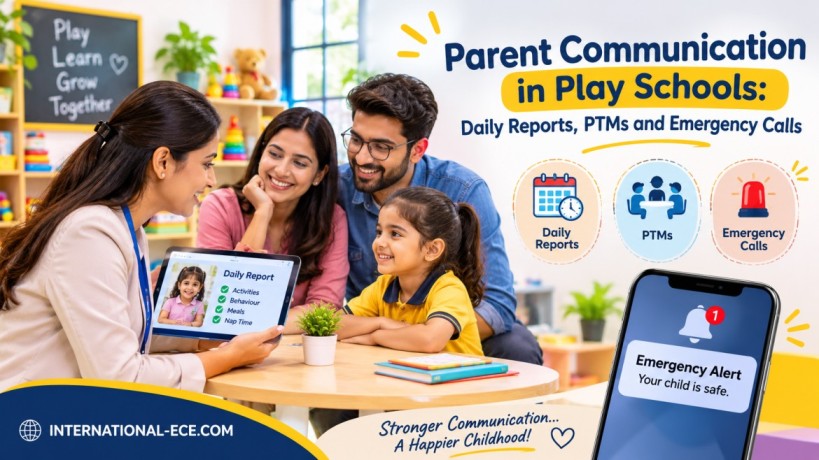
Parent Communication in Play Schools: Daily Reports, PTMs and Emergency Calls
Direct answer: Effective parent communication in play schools rests on three pillars—daily reports that cover meals, naps and mood; regular Parent-Teacher Meetings (PTMs) with a clear agenda; and a written emergency protocol that includes authorised pickup contacts and the 108 ambulance service. Indian play schools that build these systems see stronger trust and fewer complaints. Source: GoKidsy transparency guide, 2025; Petals Kids safety protocols, 2026.
Why Parent Communication Matters in Indian Play Schools
Indian parents today are more involved in early education than any previous generation. In cities like Mumbai, Bengaluru, Delhi and Pune, both parents often work full-time. They need constant reassurance that their child is safe, happy and learning[reference:0].
The trust gap between home and school
When communication is poor, trust erodes quickly. Parents start calling repeatedly, complaining on WhatsApp groups, and eventually looking for another play school. Transparency is the cheapest and most effective retention tool a play school has.
Why this matters to you: If you run a play school, every unanswered question is a parent who may not re-enrol next year.
What Indian parents expect in 2026
According to industry observations from GoKidsy (2025), Indian parents now expect real-time updates, instant responses to questions, visual proof (photos and videos), honest reporting of both achievements and challenges, and easy access to information despite busy work schedules[reference:1]. The National Education Policy (NEP) 2020 also explicitly prioritises a “communication strategy to orient parents” on quality early childhood care and education[reference:2].
Daily Reports: What to Include and How to Share Them
A daily report tells a parent what their child actually experienced between drop-off and pick-up. It is not a tick-box formality. A report with only checked boxes and no observations tells a parent almost nothing about their child’s day[reference:3].
Core elements of a useful daily report
| Element | What to record | Example |
|---|---|---|
| Meals and snacks | What was offered, how much was eaten, any feeding notes | “Ate most of her dal-rice, tried cucumber for the first time.”[reference:4] |
| Nap and rest | Start time, wake time, quality of sleep | “Slept 12:30–2:00 pm; woke up cheerful.”[reference:5] |
| Mood and behaviour | Overall mood, social interactions, any emotional notes | “Happy and playful; shared toys during free play.”[reference:6] |
| Activities and learning | Art, music, outdoor play, story time, milestones | “Painted with fingers; counted 1–5 during circle time.” |
| Care notes | Toileting, medication (if any), injuries or incidents | “Minor scratch on knee during outdoor play; cleaned and bandaged.”[reference:7] |
Why this matters to you: A parent who reads a specific, honest report every evening does not need to interrogate their child at home or call the teacher at 8 pm.
Digital vs. paper: choosing the right format
Handwritten diaries get lost, damaged, or never read. Digital tools solve this. Platforms like EdPayU allow teachers to fill a complete daily report in under 2 minutes per child, attach photos, and send it automatically via WhatsApp every evening[reference:8]. Parents do not even need to download an app to receive the update[reference:9]. For Tier-2 and Tier-3 cities like Indore, Jaipur or Patna, WhatsApp-based reports are often the most practical first step because they work on any smartphone.
WhatsApp and app-based updates
A well-formatted WhatsApp message with sections for meals, nap, mood and activities—plus one or two photos—is enough to build daily trust[reference:10]. Apps like Hello Parent and Unicare add features such as attendance alerts, direct teacher chat, cab tracking and event calendars[reference:11]. Start simple. A consistent WhatsApp report beats an unused fancy app.
Parent-Teacher Meetings (PTMs): Making Them Count
PTMs are not formalities. They are the structured moments where home and school align on a child’s development. For preschool and kindergarten parents in India, PTMs are essential bridges between home and school[reference:12].
How often should PTMs happen?
| Frequency | Best for | Format |
|---|---|---|
| Monthly (short) | Quick check-ins, settling-in concerns, behaviour updates | 10-minute call or brief in-person slot |
| Quarterly (structured) | Progress review, developmental milestones, goal-setting | 15–20 minute scheduled PTM[reference:13] |
| Need-based | Specific concerns, transitions, incidents | Immediate conversation or same-day call |
A simple PTM agenda that works
- Start with the child’s strengths. Mention one specific thing the child did well since the last meeting.
- Share observations, not labels. Say “He needed extra time to settle after outdoor play” instead of “He is difficult.”
- Show evidence. Use photos, work samples or milestone notes.
- Ask the parent for their observations. PTMs should be two-way conversations, not report readings[reference:14].
- Agree on one or two next steps. Both sides leave with a clear, small action.
Why this matters to you: A focused 15-minute PTM prevents months of misunderstanding. Parents remember how you made them feel, not how many worksheets you showed.
Handling difficult conversations
If a child is biting, not eating, or struggling to share, tell the parent directly—but pair every challenge with an action plan and an invitation to collaborate. Honest reporting of challenges builds professionalism and confidence, not panic[reference:15]. Avoid discussing another child by name. Keep the focus on the parent’s child and the support you will provide together.
Emergency Calls and Contact Protocols
Emergencies expose weak communication systems. A play school without a written, practised emergency protocol is a liability—legally and reputationally. NCERT guidelines state that every pre-primary school must keep emergency contact numbers easily available, including parents, the clinic or hospital, ambulance and police[reference:16].
Building an emergency contact list
At admission, collect at least two authorised pickup contacts and two emergency contacts beyond the parents. These must be adults above 18 with verified phone numbers. The school should also record the child’s doctor, allergies, medical conditions and blood group[reference:17]. Universal Beginnings Day Care in Mumbai, for example, requires authorised adults’ photos and phone numbers on the admission form itself[reference:18].
When to call parents vs. emergency services
| Situation | First action | Second action |
|---|---|---|
| Minor scratch or bump | First aid; call parent immediately (not at pickup) | Log the incident; share a photo if appropriate[reference:19] |
| Fever or visible illness | Isolate child comfortably; call parent for pickup | Follow illness protocol; inform coordinator[reference:20] |
| Fall with head injury, breathing difficulty, seizure | Call 108 ambulance immediately | Call parent while ambulance is on the way[reference:21] |
| Child not picked up by closing time | Call parents and authorised contacts | Follow late-pickup policy; stay with child until collected |
The 108 ambulance protocol
India’s 108 Emergency Response Service is a 24×7 medical, police and fire emergency helpline[reference:22]. Play school staff should know three things: when to call 108, what to say (location, child’s condition, age), and who accompanies the child if the parent has not arrived. Staff should not transport an injured child in a private vehicle; only ambulance services should move a child in a critical emergency[reference:23]. Conduct a fire drill and emergency drill at least once per term so that children and staff practise calm assembly procedures[reference:24].
Why this matters to you: In a real emergency, panic is natural. A written protocol turns panic into practised action.
A Practical Checklist for Play School Owners
Use this checklist to audit your current parent communication system.
- ☐ Every child has at least two verified emergency contacts beyond parents.
- ☐ Authorised pickup contacts have photo ID on file.
- ☐ Daily report template includes meals, nap, mood, activities and care notes.
- ☐ Reports are sent to parents the same evening (WhatsApp, app, or paper diary).
- ☐ PTMs are scheduled at least quarterly, with a written agenda.
- ☐ Minor incidents are communicated to parents on the same day, not at pickup.
- ☐ 108 and local hospital numbers are displayed at the front desk and in every classroom.
- ☐ At least one staff member on every shift is first-aid certified[reference:25].
- ☐ Fire and emergency drills are conducted every term.
- ☐ Parents receive a written copy of the emergency and pickup policy at admission.
The Role of Technology in Parent Communication
Technology is a tool, not a substitute for human warmth. A preschool management app can automate attendance, fee reminders and daily reports, freeing teachers to spend more time with children[reference:26]. But the message itself must still sound human. “Aarav tried broccoli today and made a funny face—but he finished his rice” is worth more than a generic “Lunch: 75% consumed.”
For play schools in Tier-2 and Tier-3 cities, WhatsApp is often the most accessible channel. For larger preschool chains in metros, an app with photo sharing, direct messaging and progress tracking adds value—provided teachers actually use it consistently.
Common Mistakes to Avoid
- Only sharing good news. Parents see through it. Report challenges with an action plan[reference:27].
- Waiting until pickup to report a minor injury. Call immediately. The delay feels like concealment.
- Using PTMs to read out a report card. Ask questions. Listen.
- Relying on paper diaries alone. They get lost and never reach working parents[reference:28].
- No written emergency protocol. Verbal plans collapse under stress.