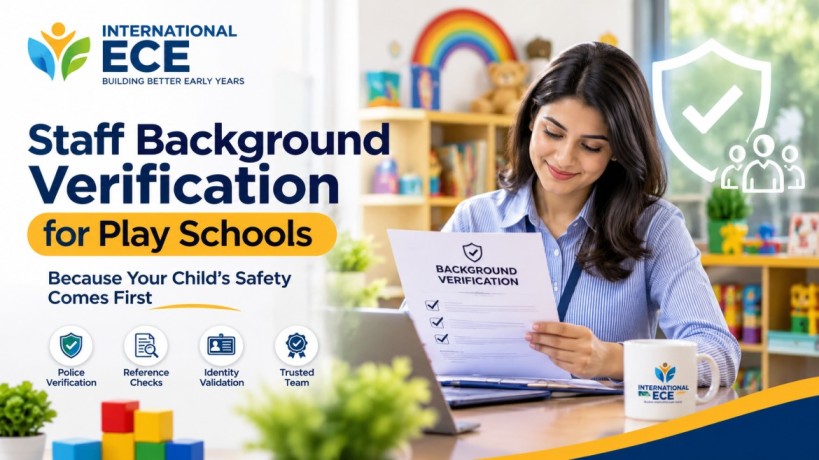
Staff Background Verification for Play Schools: Police Verification and Reference Checks
Direct answer: Every play school in India that comes into regular contact with children is legally required under POCSO Rules, 2020, Rule 3(4), to conduct police verification and background checks of all staff—teaching and non-teaching, regular and contractual—on a periodic basis. A complete verification process combines a police-issued character certificate, directly obtained reference checks from previous employers, and role-based screening that extends to drivers, helpers, and outsourced workers. (Sources: POCSO Rules, 2020, Rule 3(4); NCPCR directive on staff verification; Maharashtra Government Resolution, May 2025.)
Why Staff Background Verification Is a Legal Duty, Not a Good Practice
A play school’s most basic responsibility is knowing who is allowed into a child’s daily environment. That responsibility begins before a teacher enters a classroom—during hiring, when the institution must establish whether a person is who they claim to be and whether their history is safe for children.[reference:0]
POCSO Rules, 2020: the mandatory screening obligation
Rule 3(4) of the POCSO Rules, 2020, is explicit. Any institution “housing children or coming in regular contact with children including schools, creches, sports academies or any other facility for children” must ensure police verification and background checks on a periodic basis of “every staff, teaching or non-teaching, regular or contractual, or any other person being an employee of such Institution coming in contact with the child.” The same rule mandates periodic training on child safety and protection.[reference:1]
This is not advisory. The POCSO Act, 2012 treats institutions as duty-bearers, not bystanders. Management must screen staff and faces its own criminal liability when obligations are ignored. Failure to report or record an offence is punishable with imprisonment up to six months, or fine, or both; a person in charge of an institution who fails to report an offence by a subordinate faces imprisonment up to one year and fine.[reference:2][reference:3]
NCPCR and state-level directives
The NCPCR has repeatedly directed schools to verify all staff before appointment. Its Chairperson has emphasised that verification should be completed by each school before staff are appointed, and the Commission has written to education boards recommending that newly selected candidates provide affidavits.[reference:4]
State governments are translating this into enforceable rules. Maharashtra’s May 2025 Government Resolution mandates “pre-employment character verification of all staff members, preferably with police-issued character certificates,” with non-compliance risking withholding of government grants or cancellation of school registration.[reference:5]Delhi’s Directorate of Education (June 2026) directed schools to carry out background verification of all personnel who interact with students—teaching and non-teaching, contractual and support—and to remove any employee with a criminal record involving offences against children, sexual crimes, or violent offences pending proceedings.Jamshedpur’s district administration has similarly required private school staff and transport personnel to submit police verification reports.[reference:7]
What happens when verification is skipped
Incidents expose the gap between policy and practice. In September 2025, a teacher at a playgroup in Ulhasnagar, Maharashtra, was accused of slapping a three-year-old; the incident sparked demands for mandatory police verification of all play school staff.[reference:8]The Badlapur sexual assault case in Maharashtra led directly to the state’s 2025 staff-vetting mandate.[reference:9]In Sirsa, a play school death case prompted the Child Welfare Committee to flag the absence of trained staff and basic safety systems.[reference:10]
Why this matters to you: A missing verification file is not an administrative oversight. It is a legal exposure and a reputational risk that no amount of curriculum quality can offset.
Police Verification: The Process and the Document
Police verification is the backbone of the screening process. It produces a document—usually a character certificate or police clearance certificate—that confirms whether the candidate has a criminal record.[reference:11]
Character certificate vs. police clearance certificate
| Document | Issuing authority | Typical use for play school hiring | Processing time (indicative) |
|---|---|---|---|
| State-level Character Certificate / Police Verification Certificate | State police (CCTNS portal or local police station) | Domestic employment screening; accepted by most Indian schools and state directives | 10–21 days via CCTNS; faster through gazetted officer routes in some states[reference:12] |
| Police Clearance Certificate (PCC) through Passport Seva | Ministry of External Affairs (Passport Seva) | Required for international purposes, visas, or foreign employment; accepted domestically as a higher-assurance document | 5–7 working days after PSK appointment, subject to police field verification[reference:13] |
How to apply and what to expect
For a state-level character certificate, the candidate typically registers on the state police citizen portal (such as Delhi Police Citizen Portal, UP Cop, or MahaPolice), submits ID proof, address proof, photographs, and a purpose letter from the requesting organisation, and pays the prescribed fee.[reference:14]A beat constable then conducts a field inquiry, and the Superintendent of Police or a designated officer approves the certificate.[reference:15]For a PCC through Passport Seva, the candidate books a PSK appointment, submits passport, Aadhaar or voter ID, address proof, and photographs, pays approximately ₹500, and attends the appointment; police verification at the residential address follows.[reference:16]
The play school’s role is to request the certificate before appointment, not after. Maharashtra’s directive specifies “pre-employment” verification, and Delhi’s directive requires verification of all personnel who interact with students.[reference:17]
What a police verification does not catch
A police verification confirms the absence of a criminal record in the jurisdictions checked. It does not confirm teaching ability, temperament, employment history, or suitability for young children. A candidate with no criminal record can still be unsuitable for a preschool. That is why police verification is the floor, not the ceiling, of screening.
Why this matters to you: If you treat the police certificate as the entire verification, you will hire people who are legally clear but professionally and temperamentally wrong for a room full of three-year-olds.
Reference Checks: The Step Most Play Schools Skip
Reference checks reveal patterns that no criminal record search will show: how a candidate behaves under stress, why they left previous roles, and whether their claims about experience are accurate. Structured reference checks are a core component of safer recruitment for anyone working with children.[reference:19]
Who to contact and what to ask
Best practice requires at least two professional references obtained directly from referees—ideally one from a role in which the candidate worked with children. References should be requested from a senior person with appropriate authority, not a colleague, and should be obtained before the interview so concerns can be explored further.[reference:20]
Ask objective, verifiable questions: dates of employment, role and responsibilities, whether the candidate worked directly with children, reason for leaving, and whether the referee would re-employ the candidate in a similar role. Seek factual confirmation, not subjective opinion.[reference:21]
Why candidate-provided references are not enough
Open testimonials (“to whom it may concern”) and unverified information provided by the candidate should not be relied upon. Electronic references must be checked to confirm they originate from a legitimate source. The school should contact the referee directly using contact details it has independently verified—not details supplied by the candidate alone.[reference:22]
Red flags in employment history
Unexplained gaps, inconsistencies between the application form and the referee’s account, vague or evasive answers about reasons for leaving, and reluctance by a referee to confirm basic facts all warrant follow-up. A certificate may appear genuine while the issuing institution has no record of it; previous employment may be overstated; a candidate may omit a significant stint or conceal a dismissal.[reference:23]None of these automatically proves wrongdoing, but each deserves scrutiny before a person is given access to children.
Why this matters to you: A five-minute phone call to a previous employer can reveal more about a candidate’s suitability than a stack of certificates.
Building a Role-Based Screening Framework
A single checklist applied identically to every hire is not enough. The depth of screening should match the nature of the role and the level of contact with children.[reference:24]
Not every role needs the same depth of check
| Role category | Minimum screening for play schools | Additional checks to consider |
|---|---|---|
| Teachers and academic staff | Police verification + two direct reference checks + qualification verification | Employment history verification; online search as due diligence[reference:25] |
| Helpers, caretakers, kitchen staff | Police verification + at least one direct reference from a role involving children or vulnerable persons | Address verification; affidavit declaring no history of offences against children |
| Drivers and transport staff | Police verification + valid commercial licence + work-history verification + criminal-record screening[reference:27] | Random alcohol testing where mandated; female attendant on board until last child is dropped[reference:28] |
| Outsourced / contractual workers | Police verification through the contractor + written confirmation that verification has been completed | The school retains responsibility even for contractor staff; a vendor contract is not a substitute for due diligence[reference:30] |
Continuous screening, not one-time verification
POCSO Rule 3(4) requires verification “on a periodic basis,” not once at hiring. Background verification cannot be a one-time event; it requires periodic and event-based checks when employees change roles, rejoin after a break, or transition from contractor to direct employment.[reference:31][reference:32]Set a calendar reminder for re-verification every two to three years, and re-verify immediately when a staff member’s role changes to one with greater child contact.
Why this matters to you: A driver verified five years ago is not a verified driver today. Periodic re-checks are the legal requirement and the practical safeguard.
Communicating Verification to Parents (Without Oversharing)
Parents increasingly ask whether staff are background-verified. A 2026 News18 Hindi guide for parents advises that if support staff are changing every two to three months, it signals a serious problem in the working environment and background verification process.[reference:33]The Week’s July 2026 opinion piece argues that educational institutions must adopt structured, role-based, and continuous screening because “each [staff member] becomes part of the environment that parents are expected to trust.”[reference:34]
The right communication is confident and general, not detailed and individual. Tell parents: “All staff who interact with your child have completed police verification and reference checks before joining, and we re-verify periodically.” Do not share individual staff members’ documents, criminal record status, or personal details. The assurance is what matters—not the paperwork. Display your child protection policy at admission and mention the verification process in your parent handbook.
Why this matters to you: Parents who know the process exists are less likely to ask intrusive questions about individual teachers, and more likely to trust the school’s systems.
A Staff Verification Checklist for Play School Administrators
- ☐ Written child protection and safer recruitment policy adopted and displayed.
- ☐ Police verification (state character certificate or PCC) obtained before appointment for every staff member, teaching and non-teaching.
- ☐ Two professional references obtained directly from independently verified referees—one relating to work with children where possible.
- ☐ Qualifications and employment history checked against original documents.
- ☐ Signed affidavit from every new hire declaring no history of offences against children or violent crimes.
- ☐ Role-based screening applied to drivers, helpers, kitchen staff, and outsourced workers.
- ☐ Contractor staff verified and confirmed in writing by the vendor.
- ☐ Re-verification scheduled every two to three years and on role change.
- ☐ Verification file maintained for every employee with dates, documents, and reviewer signature.
- ☐ POCSO and child safety training completed by all staff and documented.
- ☐ At least one senior staff member trained in safer recruitment and reference-check conduct.
- ☐ Child protection committee or designated safeguarding lead in place.
Common Verification Failures in Indian Play Schools
- Verification after appointment. The police certificate arrives two months after the teacher has already started. The legal and safeguarding requirement is pre-employment verification.
- Accepting a candidate-supplied reference letter. A signed letter is not a reference check. Someone must speak to the referee directly and independently verify the referee’s identity.
- Verifying teachers but not helpers or drivers. Children interact daily with support staff. POCSO Rule 3(4) covers every staff member, regular or contractual, who comes in contact with the child.
- Treating contractor staff as “not our responsibility.” The institution bears responsibility for who is present on its campus, regardless of who recruited them.[reference:35]
- No re-verification cycle. A one-time check at hiring does not satisfy the “periodic basis” requirement of POCSO Rule 3(4).
- No written record. If the verification file cannot be produced during an inspection or after an incident, the school cannot demonstrate due diligence.
Frequently Asked Questions (FAQ)
Q1: Is police verification mandatory for play school staff in India?
Yes. POCSO Rules, 2020, Rule 3(4), requires every institution in regular contact with children—including play schools—to conduct police verification and background checks of all staff, teaching and non-teaching, regular and contractual, on a periodic basis. State directives, such as Maharashtra’s 2025 Government Resolution, reinforce this with penalties including cancellation of registration.
Q2: What is the difference between a character certificate and a police clearance certificate for preschool hiring?
A state-level character certificate is issued by state police through CCTNS or the local police station and is typically sufficient for domestic employment screening. A Police Clearance Certificate (PCC) through Passport Seva is issued by the Ministry of External Affairs and is required for international purposes, though it is also accepted domestically as a higher-assurance document.
Q3: How many reference checks should a play school conduct before hiring?
Best practice is at least two professional references obtained directly from independently verified referees. Ideally, one reference should relate to a role in which the candidate worked with children. References should be taken from a senior person with authority, not a colleague, and candidate-supplied open testimonials should not be relied upon.
Q4: Does POCSO verification apply to helpers, drivers, and outsourced staff in a play school?
Yes. POCSO Rule 3(4) covers “every staff, teaching or non-teaching, regular or contractual, or any other person being an employee of such Institution coming in contact with the child.” A vendor contract does not transfer the school’s responsibility for who is present on campus.
Q5: How often should play schools re-verify staff background?
POCSO Rule 3(4) requires verification “on a periodic basis,” not once at hiring. A practical cycle is re-verification every two to three years, plus immediate re-verification whenever a staff member changes roles to one with greater child contact, rejoins after a break, or moves from contractor to direct employment.
Q6: Should a play school tell parents that staff are background-verified?
Yes, at a general level. Tell parents that all staff who interact with their child have completed police verification and reference checks before joining, and that the school re-verifies periodically. Do not share individual staff members’ documents or personal details. The assurance builds trust; the paperwork does not belong in a parent conversation