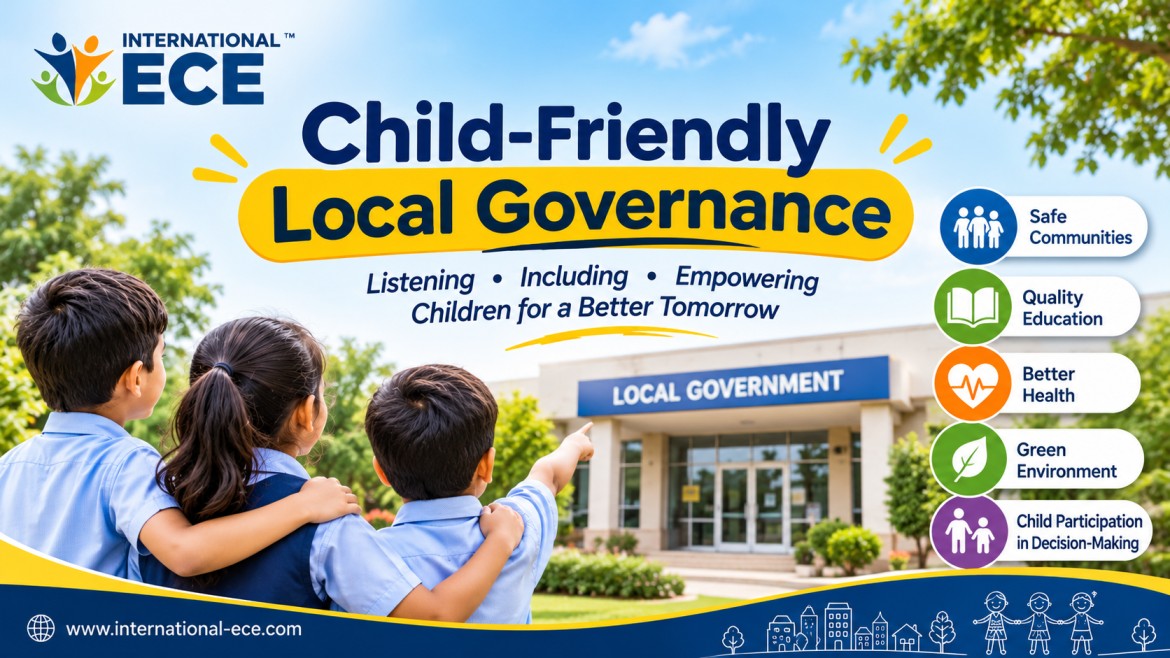
Child-Friendly Local Governance 2027: Ensuring Child Rights at Panchayat and Municipal Level
Direct answer: Child-friendly local governance means Gram Panchayats and Urban Local Bodies actively plan, budget, and monitor for children’s survival, development, protection, and participation — not just implement schemes that mention children. In 2027, India’s policy architecture already assigns child welfare functions to Panchayati Raj Institutions and ULBs under Mission Vatsalya, but implementation remains uneven: 40% of Karnataka’s Gram Panchayats lack functional child protection committees, and only 55% held children’s gram sabhas in a recent 13-month period.
If you are a panchayat member, a municipal ward councillor, an ECE centre owner, or a parent who wants local government to work for children, this guide explains what the law already requires, where the gaps are, and what you can do this year.
What Is Child-Friendly Local Governance?
Child-friendly local governance is the integration of child rights into the day-to-day functioning of local self-government institutions. It means every Gram Panchayat and every Urban Local Body has a functioning committee for child welfare, a budget line for children, a platform for children to be heard, and a monitoring system that tracks outcomes for children.
It is not a separate scheme. It is a way of doing existing governance work — planning, budgeting, implementation, and audit — with children as a named priority.
The Constitutional and Policy Basis for Child Rights at the Local Level
The 73rd and 74th Constitutional Amendments made Panchayats and Municipalities constitutional bodies with responsibilities for local planning and service delivery. Mission Vatsalya, the Centre’s flagship child protection scheme, explicitly assigns child welfare and protection functions to the existing committees of Panchayati Raj Institutions and Urban Local Bodies that deal with social justice and welfare.
The Ministry of Panchayati Raj has also adopted a thematic approach to localising the Sustainable Development Goals, with “child-friendly village” as Theme 3. MoPR and UNICEF released guidelines for institutionalising Bal-Balika Sabhas and Bal-Balika Panchayats under this theme.
Why Panchayats and Municipalities Are the Right Units for Child Protection
Child protection failures are local failures. A child who drops out of school, is pushed into labour, or faces early marriage is known first to the panchayat, the school, and the anganwadi — not to a state capital. Panchayats know every household. Municipal wards know every settlement. That proximity is the governance advantage that no state department can replicate.
Why this matters to you: If you serve in local government, you are already the first responder for child rights. The question is whether your institution has the structure, budget, and skills to act like it.
The 2027 Policy Landscape: Mission Vatsalya, NCPCR, and State Mandates
Mission Vatsalya: Assigning Child Welfare to PRI and ULB Committees
Mission Vatsalya guidelines envisage a robust ecosystem through state and local governments to ensure children’s safety. The scheme explicitly states that child welfare and protection functions are to be assigned to the existing committees of Panchayati Raj Institutions, Gram Panchayats, and Urban Local Bodies that deal with social justice and women and child welfare.
The functions expected of these committees include ensuring safe public spaces, promoting a child-friendly atmosphere, tracking at-risk children, and coordinating preventive programmes at the local level.
Kerala’s 2025 Child Safety Committee Guidelines: A Model for 2027
Kerala issued guidelines on 23 October 2025 for forming Child Safety Committees at Grama Panchayat, Block Panchayat, Municipality, and Corporation levels. The committees are to function under the Integrated Child Protection Scheme and Mission Vatsalya framework, with representation from elected representatives, officials, child welfare officers, teachers, and NGO representatives.
Their mandate includes tracking at-risk children, facilitating preventive programmes, conducting annual planning for child protection, and coordinating with district-level welfare authorities. Local bodies are required to allocate budgetary support from development funds for committee activities, including awareness programmes, school safety initiatives, and rehabilitation support.
Kerala’s model matters for 2027 because it converts a general Mission Vatsalya mandate into a structured, budgeted, locally accountable committee — exactly what most states lack.
NCPCR’s Safe Childhood Programme and Child-Friendly Panchayat Framework
NCPCR developed the Safe Childhood Programme to integrate child rights into panchayat functioning. It released a Handbook, Module, and Guidelines on protection of child rights at the Gram Panchayat level, covering child-friendly panchayats or Bal Panchayats, recreational activities, and vocational training for children.
NCPCR’s framework treats child-friendliness across four pillars: survival, development, protection, and participation. A panchayat is not child-friendly merely because it has a playground. It is child-friendly when its planning and budgeting reflect all four pillars.
Why this matters to you: The policy exists. The gap is operationalisation. Your panchayat or municipality does not need a new scheme — it needs to activate the committee and budget line that Mission Vatsalya already expects.
The Data: Where Local Governance Is Failing Children
40% of Karnataka Gram Panchayats Lack Functional Child Protection Committees
At least 40% of Gram Panchayats in Karnataka do not have full-fledged Women and Child Protection Committees or Education Task Forces, according to the Karnataka State Commission for Child Rights. In many panchayats where committees were formed, they are not functional and members are not aware of their responsibilities.
These committees are tasked with tracking child marriages, teen pregnancies, school dropouts, child labour, and child abuse. When they do not function, these cases go unnoticed.
Only 55% of Gram Panchayats Held Children’s Gram Sabhas
Between April 2024 and May 2025, only 55% of Gram Panchayats in Karnataka held children’s gram sabhas. In the state’s 5,958 Gram Panchayats, only 3,309 children’s gram sabhas were held.
A children’s gram sabha is the most basic participation mechanism available to local government. A 55% compliance rate means nearly half of Karnataka’s Gram Panchayats did not formally hear from children in over a year.
The Cost of Non-Functional Committees
Non-functional committees do not produce no cost. They produce delayed detection. A child marriage that a functional committee would have flagged becomes a rescue operation. A dropout that a School Management Committee would have tracked becomes a child labour case. The fiscal cost of late intervention is always higher than the cost of prevention.
Why this matters to you: If your panchayat or ward has a committee only on paper, the children most at risk are the ones your institution will reach last.
Rural Local Governance: How Gram Panchayats Can Protect Child Rights
The Child Welfare and Protection Committee (CWPC) at Panchayat Level
The CWPC is the frontline structure for child protection at the Gram Panchayat level. A guidebook for Panchayat Child Welfare and Protection Committees describes its function as planning, implementing, and monitoring child protection initiatives — identifying vulnerable children, mapping risks, coordinating services, and developing action plans aligned with Mission Vatsalya.
In Karnataka, the Women and Child Protection Committee typically has 13 members, headed by the Panchayat President, with two women panchayat members, a woman schoolteacher, a beat police officer, a village accountant, an NGO member, an anganwadi worker, a self-help group member, two students, and a panchayat development member.
The composition matters. A committee of officials alone will not reach children. The presence of a teacher, an anganwadi worker, and students is what connects the committee to the households where risk actually lives.
Bal-Balika Sabhas and Bal Panchayats: Institutionalising Child Participation
MoPR and UNICEF have released guidelines for institutionalising Bal-Balika Sabhas (Children’s Assemblies) and Bal-Balika Panchayats (Children’s Parliament). These guidelines support local action under Theme 3: Child-friendly village, and are expected to be adapted by states so that marginalised and underrepresented groups, including children and adolescents, are included in decision-making.
A Bal Panchayat is an elected children’s council, typically with four children — two girls and two boys — aged 10–18 selected from each ward across different socio-economic backgrounds. In Bal Mitra Gram models, every village where child labour is rooted out has its own Bal Panchayat that interacts with adults.
The Bal Mitra Gram model is a three-to-five-year preventive and curative strategy. In one reporting period, collective action by Bal Panchayat members led to the withdrawal of 545 children from child labour, with 387 enrolled in schools.
Child-Friendly Gram Panchayat Award: What Winning Panchayats Do Differently
The Child-Friendly Gram Panchayat Award is instituted for Gram Panchayats and Village Councils, with one award per State/UT. State Panchayat Performance Assessment Committees shortlist up to three Gram Panchayats and forward nominations to MoPR.
Winning panchayats typically demonstrate functioning CWPCs, children’s gram sabhas, child-focused budget lines in the Gram Panchayat Development Plan, and measurable improvements in child health, education, and protection indicators. The award is not a beauty contest. It is an audit of whether the panchayat has built systems, not just events.
Why this matters to you: If you are a panchayat member, the award criteria are your roadmap. If you are a parent or teacher, they are your checklist for holding your panchayat accountable.
Urban Local Governance: How Municipalities and Corporations Can Protect Child Rights
Ward-Level Child Protection Committees in ULBs
Mission Vatsalya explicitly extends child welfare and protection functions to Urban Local Bodies, including town panchayats, municipalities, and corporations. Ward-level Child Protection Committees are the urban equivalent of village-level committees.
Kerala’s 2025 guidelines require Child Safety Committees at Municipality and Corporation levels, with the same structured composition and mandate as rural committees. ChildFund India’s community-based child protection programme forms Village- and Ward-Level Child Protection Committees with representation from panchayats, teachers, and child representatives to monitor risks and take preventive action.
Urban child protection faces distinct risks: migrant families without address proof, children in street situations, informal settlements outside ward-level data, and private schools that operate with limited public oversight. A ward committee that only maps registered residents will miss the children who need it most.
Child-Friendly Urban Governance: Beyond Parks and Playgrounds
Child-friendly urban governance is often reduced to infrastructure — parks, playgrounds, safe footpaths. These matter. But child-friendly governance also requires that municipal budgets name children, that ward committees track dropout and child labour, and that children have a formal channel to influence ward planning.
UNICEF’s child-friendly local governance work treats child-responsive planning as a governance discipline: adequate resource allocation for child priorities, platforms for children and adolescents to build leadership skills, and inclusion of children in local governance processes.
Why this matters to you: If you serve in a municipal body, the test is not whether your city has a children’s park. The test is whether a child in your ward can name the committee that is supposed to protect them.
Rural vs. Urban Child-Friendly Governance: A Comparison Table
| Dimension | Gram Panchayat (Rural) | Urban Local Body (Municipal) |
|---|---|---|
| Primary committee | Child Welfare and Protection Committee (CWPC) | Ward-Level Child Protection Committee |
| Typical composition | Panchayat President (head), ward members, teacher, anganwadi worker, police, NGO, students | Ward councillor, child welfare officer, teacher, NGO representative, child representatives |
| Child participation platform | Bal-Balika Sabha, Bal Panchayat | Children’s ward sabha, child advisory boards (where notified) |
| Planning instrument | Gram Panchayat Development Plan (GPDP), Theme 3: Child-Friendly Village | Municipal annual budget and ward-level plans |
| Key risk | Committee formed but non-functional; children’s gram sabha skipped | Migrant and informal-settlement children outside ward data |
| Budget mechanism | Untied funds, child-focused allocations in GPDP | Municipal development funds, ward-level allocations |
| Accountability route | Gram Sabha, social audit, Child-Friendly GP Award | Ward committee, municipal council, RTI |
Why this matters to you: Rural and urban bodies face the same legal mandate but different operational risks. Copying a rural committee structure into an urban ward without adapting to migration and informal settlements will produce a committee that misses the children it was created for.
Budgeting for Child Rights at the Local Level: What It Costs and What It Delivers
| Intervention | Estimated Local Cost (₹) | What It Delivers | Cost of Not Doing It |
|---|---|---|---|
| Constituting and meeting a CWPC / Ward Committee | ₹25,000–₹60,000 per year (meeting logistics, documentation, basic training) | Monthly risk tracking, early identification of dropout and child marriage | Late rescue operations, higher rehabilitation costs |
| Holding Bal-Balika Sabhas / Bal Panchayat elections | ₹15,000–₹40,000 per cycle | Child participation, better-targeted local plans, early warning from children | Plans that miss children’s actual priorities |
| Child-focused budget line in GPDP (5% of untied funds) | Varies by GPDP size; often ₹2–₹10 lakh in a mid-sized panchayat | Ring-fenced spending on child health, education, and protection | Child schemes absorbed into general expenditure |
| Training committee members on Mission Vatsalya, POCSO, and RTE | ₹10,000–₹25,000 per batch | Functional committees instead of paper committees | Committees that exist but cannot act (the Karnataka 40% problem) |
| Ward-level child risk mapping (including migrant settlements) | ₹20,000–₹50,000 per ward per year | Visibility of children outside official records | Invisible children, undetected exploitation |
Why this matters to you: Child-friendly governance is not a high-cost intervention. It is a low-cost intervention with high returns — but only if the committee meets, the budget line exists, and the mapping includes the children who are easiest to miss.
10-Point Child-Friendly Local Governance Checklist for 2027
- ☐ A Child Welfare and Protection Committee (rural) or Ward-Level Child Protection Committee (urban) is constituted and notified.
- ☐ The committee meets at least once a month and maintains minutes.
- ☐ Committee membership includes a teacher, an anganwadi/frontline worker, a police representative, and child representatives.
- ☐ A Bal-Balika Sabha or children’s gram sabha has been held at least once in the current year.
- ☐ A Bal Panchayat has been elected and is recognised by the Gram Panchayat or ward committee.
- ☐ The Gram Panchayat Development Plan or municipal ward plan includes a named child-focused budget line.
- ☐ The committee tracks child marriage, child labour, school dropout, and child abuse cases with a written register.
- ☐ Migrant and informal-settlement children are included in ward/village risk mapping.
- ☐ Committee members have received orientation on Mission Vatsalya, POCSO, RTE, and the JJ Act.
- ☐ The local body has reviewed its performance against at least five child-friendly indicators (immunisation, enrolment, dropout, child marriage, child labour) in the last year.
How ECE Centres and Schools Can Partner with Local Governance
- Send a representative to the CWPC or ward committee: The committee composition already includes a teacher. Make sure your ECE centre or school fills that seat with someone who attends and reports back.
- Use the School Management Committee as a feeder to the panchayat committee: SMC dropout data should flow directly into the CWPC’s risk register. Two committees working separately waste the same information.
- Host Bal-Balika Sabhas on your campus: A school that provides space and legitimacy to children’s assemblies strengthens both the school and the panchayat.
- Share early-childhood data with the ward committee: Immunisation gaps, developmental delays, and anganwadi-to-primary transitions are early warning signs that local governance should see.
- Display the committee’s contact and Childline 1098: Parents who trust a school will use the school’s notice board. Make the governance system visible where parents already look.
Why this matters to you: An ECE centre that partners with local governance is not doing extra work. It is plugging into the protection system that the law already built.
Frequently Asked Questions
What is child-friendly local governance?
Child-friendly local governance is the integration of child rights into the planning, budgeting, and monitoring functions of Gram Panchayats and Urban Local Bodies. It requires functioning child protection committees, child participation platforms, child-focused budget lines, and measurable tracking of child outcomes at the local level.
What is the role of Mission Vatsalya in panchayat and municipal child protection?
Mission Vatsalya assigns child welfare and protection functions to existing committees of Panchayati Raj Institutions and Urban Local Bodies that deal with social justice and women and child welfare. It expects these committees to ensure safe public spaces, track at-risk children, and coordinate preventive programmes at the local level.
What is a Child Welfare and Protection Committee (CWPC)?
A CWPC is the frontline committee at Gram Panchayat or ward level responsible for planning, implementing, and monitoring child protection initiatives. It identifies vulnerable children, maps risks, coordinates services, and develops action plans aligned with Mission Vatsalya. In Karnataka, it typically has 13 members, headed by the Panchayat President.
What is a Bal Panchayat, and how does it work?
A Bal Panchayat is an elected children’s council, usually with two girls and two boys aged 10–18 from each ward. It represents children’s voices to the Gram Panchayat, advocates on child labour and child marriage, and participates in local planning. MoPR and UNICEF have issued guidelines for institutionalising Bal-Balika Sabhas and Bal-Balika Panchayats under the child-friendly village theme.
Are child protection committees mandatory in all Gram Panchayats?
Mission Vatsalya assigns child welfare functions to existing PRI and ULB committees, and state guidelines operationalise this. Kerala’s 2025 guidelines mandate Child Safety Committees across Grama Panchayats, Block Panchayats, Municipalities, and Corporations. However, implementation is uneven: 40% of Karnataka Gram Panchayats lack functional committees.
How can local bodies budget for child rights?
Local bodies can allocate a named child-focused line in the Gram Panchayat Development Plan or municipal ward plan, use untied funds for committee meetings and child participation activities, and ring-fence a share of development funds for child protection. Kerala’s guidelines require local bodies to allocate budgetary support from development funds for committee activities.