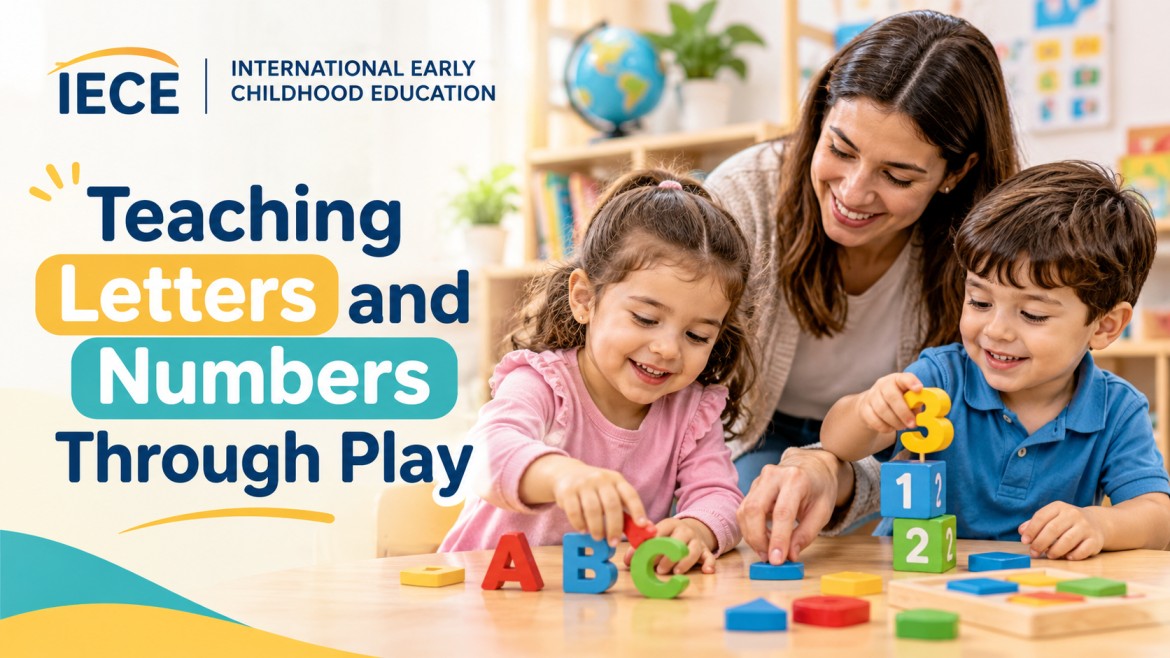
Teaching Letters and Numbers Through Play: Low-Cost Indian Classroom Ideas (2027)
You do not need expensive kits to teach letters and numbers. Locally available materials—sand, dal, bottle caps, chalk, and old egg trays—can build strong foundational literacy and numeracy through play, exactly as NEP 2020 recommends.
This guide gives you practical, classroom-tested ideas for Indian preschools, Anganwadis, and Balvatikas. Every idea costs under ₹500 to set up. Most cost nothing.
Why Play-Based Literacy and Numeracy Matters in India Right Now
India’s National Education Policy 2020 explicitly calls for “play-based, activity-based, and inquiry-based learning” for children aged 3–8.The National Curriculum Framework for Foundational Stage goes further: it says most teaching-learning materials (TLMs) should be made from “locally available and low-cost materials.”
Why this matters to you: If you teach in an Indian classroom with a limited budget, the policy is on your side. You are not expected to buy costly kits. You are expected to teach through play using what is already around you.
What NEP 2020 and NCF 2022 Actually Ask Teachers to Do
The policy asks for three shifts:
- From worksheets to hands-on play. Children touch, move, and manipulate objects to learn letter shapes and number values.
- From English-only to mother-tongue-friendly. Letter sounds and counting rhymes work best in the child’s home language first.
- From teacher-centred to child-centred. The teacher sets up the game; the child explores.
Low-Cost Letter Recognition Games for Indian Classrooms
Sand and Stick Tracing: The Kerala Grandmother Method
An 85-year-old grandmother in Kerala teaches Malayalam, Hindi, English, and mathematics using only sand and a stick. Children watch her trace a letter, then reproduce it themselves. The method is waste-free, tactile, and costs zero rupees.
How to do it in your classroom: Spread a thin layer of sand (or rice, dal, or salt) in a shallow tray or on a flat floor surface. Write a letter or number with a stick. Ask the child to trace over it, then try it alone. For a group, draw large letters on the ground and let children walk the shape.
Why this matters to you: This is sensory learning at its cheapest. Children who struggle with pencil grip often succeed when they trace with a finger or stick first.
Fly Swatter Phonics and Chart Blast
Hang a wall chart with the alphabet (or Hindi Varnamala) and numbers. Give two children plastic fly swatters. Call out a letter or number. The first child to swat the correct symbol keeps the point.
Materials: One chart (₹20–₹50), two fly swatters (₹40 each). Total under ₹150.
Why this matters to you: It builds rapid visual scanning—a skill that directly supports reading fluency later. Children burn energy while learning.
Playful Number and Counting Activities That Cost Almost Nothing
Egg Tray Counting and “Ande Ka Funda”
A teacher at an Azim Premji School created a TLM called “Ande ka funda” using an empty cardboard egg tray, poster colours, and cut-out egg shapes. Children count the eggs, identify the numbers written on them, and arrange them in order. The same TLM was flipped to teach Hindi letters.
Classroom version: Use a clean egg tray. Write numbers 1–10 inside each cup with a permanent marker. Give children bottle caps, seeds, or stones to place in the cups. For letters, write a letter on each cap and ask the child to match it to a letter drawn on paper.
Why this matters to you: One tray teaches counting, number recognition, sequencing, and fine-motor control. It also works for letter matching with almost no extra cost.
Chalk Number Line Hop
Draw a number line with chalk on the floor—0 to 10 or 0 to 20. Call out a number. The child hops to it. Then call “one more” or “one less” and the child hops forward or backward.
Cost: One piece of chalk. That is all.
Why this matters to you: Number line hopping builds early addition and subtraction sense before children ever see a written equation. It works in any Indian classroom with floor space—urban or rural.
Investment Table: What Low-Cost Really Means in ₹
The table below shows realistic 2027 market prices for the materials mentioned above. Prices are estimated from Indian retail and education-supply sources.
| Material | Estimated Cost (₹) | What It Teaches | Reusable? |
|---|---|---|---|
| Sand / rice / dal tray | ₹0–₹50 (from kitchen) | Letter and number tracing | Yes, refresh weekly |
| Wall chart (alphabet or numbers) | ₹20–₹50 | Visual recognition | Yes, for years |
| 2 plastic fly swatters | ₹40–₹80 | Rapid symbol matching | Yes |
| Empty egg tray + marker | ₹0–₹30 | Counting, sequencing | Yes |
| Bottle caps (collected) | ₹0 | Counting, letter matching | Yes |
| Chalk | ₹5–₹10 | Number line, floor letters | No, but cheap |
| Total for a full corner | Under ₹250 | Letters + numbers + movement | Most items last 1+ year |
Why this matters to you: A functional play-based corner costs less than one textbook set. You can set it up this week.
Checklist: Setting Up a Play-Based Corner in Any Indian Classroom
Use this checklist before your next class. Tick each item as you complete it.
- ☐ Choose one letter game and one number game for the week. Do not set up everything at once.
- ☐ Collect materials locally: ask families for bottle caps, egg trays, and old charts. Send a short note home.
- ☐ Prepare a floor space where children can sit in a circle and move without hurting each other.
- ☐ Write the target letter or number on the board before the game begins. Keep it visible.
- ☐ Demonstrate once with a child volunteer. Do not explain for more than two minutes.
- ☐ Let children rotate through the game in small groups of 4–6.
- ☐ Observe, do not correct constantly. Note which children struggle and which succeed.
- ☐ Repeat the same game for three days. Repetition builds confidence at ages 3–6.
Comparison: Play-Based vs. Rote Learning in Indian ECE
| Factor | Play-Based Approach | Rote Approach |
|---|---|---|
| Child engagement | High—children choose to repeat the activity | Low—children wait for the bell |
| Retention of letter/number recall | Stronger—linked to movement and touch | Weaker—linked to fear of correction |
| Cost to teacher | Under ₹250 for a full corner | Workbook costs alone exceed ₹200 per child |
| Alignment with NEP 2020 | Directly aligned | Not aligned |
| Inclusion of slower learners | High—multiple ways to participate | Low—one pace for all |
| Teacher energy required | High in preparation, low in correction | Low in preparation, high in correction |
Why this matters to you: The comparison is not about ideology. It is about which method produces calmer classrooms and stronger recall at lower cost. Play wins on both counts.
Frequently Asked Questions
1. Do these activities work in government Anganwadi centres with 30+ children?
Yes. Use the rotation model: set up three stations (sand tracing, egg tray counting, chalk hop). Keep groups to 8–10 children. Each station runs for 10 minutes. The Anganwadi ECCE kit distributed in states like Uttar Pradesh follows the same play-based principle.
2. What if I do not have sand or rice?
Use dry leaves crushed into small pieces, sawdust from a local carpenter, or even plain dust from the school ground. The tactile principle is the same: the child feels the shape while forming it.
3. Are fly swatters safe for young children?
Use them only under direct teacher supervision and only with children aged 4 and above. Demonstrate gentle tapping, not hitting. For under-4s, replace swatters with open palms.
4. How do I teach letters in a multilingual classroom?
Start with the letters that are the same across scripts the children know—for example, the shape of “A” in English and the shape of “अ” in Hindi can be taught on different days. Label each game with the script you are using that day.
5. How long should each play session last?
Fifteen to twenty minutes for ages 3–4; up to thirty minutes for ages 5–6. Stop while the activity is still going well. A tired child learns nothing.
6. Do I need to buy the Jaadui Pitara kit?
No. The Jaadui Pitara materials are available for free download on the DIKSHA portal, and the activities in this guide use the same play-based logic at near-zero cost. Buy only if your school has a budget and wants a ready-made box.