Observation and Documentation in Early Childhood: A Teacher’s Checklist (2027)
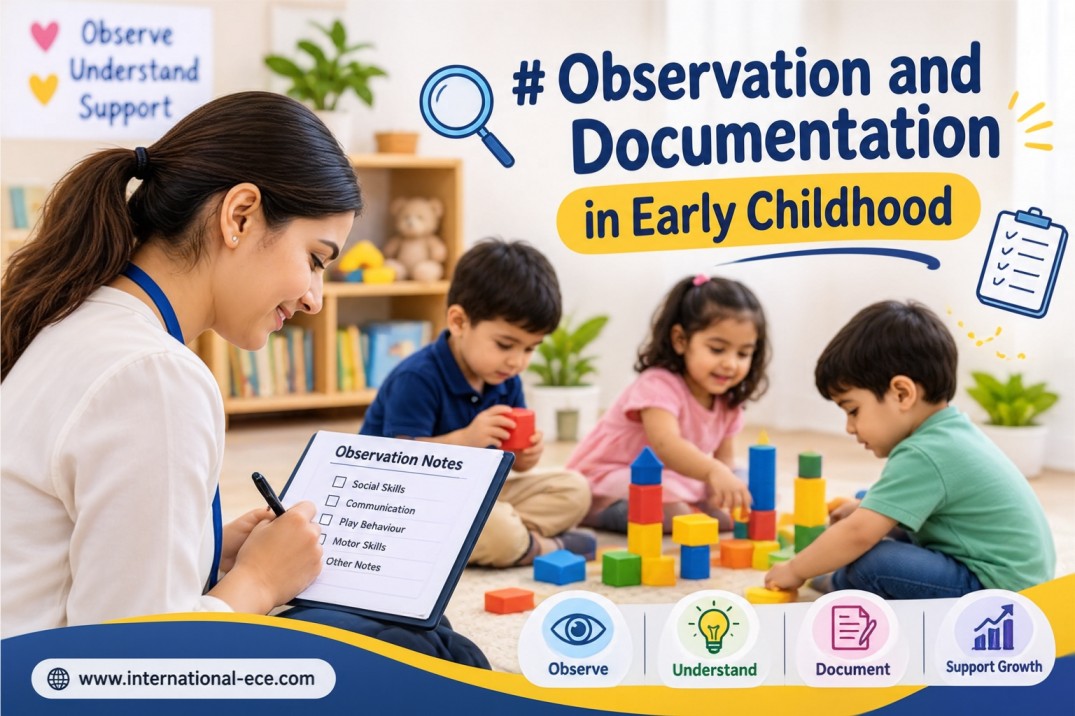
Observation is not a test. It is the most reliable way to understand what a young child knows, feels, and needs—and NEP 2020 and NCF-FS 2022 require Indian teachers to use it as the primary assessment method.
This guide gives you a practical, policy-aligned system for observing and documenting children’s learning in Indian preschools and Anganwadis. It includes tools, tables, and a daily checklist you can start using tomorrow.
Why Observation and Documentation Matter More Than Ever in Indian ECCE
The National Curriculum Framework for Foundational Stage 2022 states clearly that assessment at this stage “begins with OBSERVATION—not examination”. Teachers are expected to observe children naturally during storytelling, conversations, and play to understand their learning, development, interests, and responses
The Ministry of Education’s 2022 directive on formative assessment tools makes this operational. Schools must implement observation-based tools including anecdotal records—factual, non-judgmental narratives based on real-time classroom observations The Holistic Progress Card (HPC) under NEP 2020 relies on this evidence
Why this matters to you: Observation is no longer optional or “extra paperwork.” It is the mandated assessment method for the Foundational Stage. A teacher without a documentation system is a teacher without evidence.
What NEP 2020 and NCF-FS 2022 Actually Require
Three requirements stand out:
- Observation as the primary method. NCF-FS 2022 identifies observation and analysis of children’s work as the appropriate assessment approach, and encourages planning, evidence gathering, and reflection.
- Multiple tools, not one. The framework names anecdotal records, checklists, and event sampling as the tools teachers should use.
- Documentation that informs planning. NCF-FS page 133 states that observation helps the teacher “take informed decisions while planning for the next day, next week or month”.
Why this matters to you: You are not collecting data for a file that never gets opened. You are collecting evidence to plan tomorrow’s activities, identify children who need support, and communicate with parents.
The Difference Between Observing and Judging a Child
“Mira is brilliant at maths” is a judgment. “Mira placed four blocks in a line and said ‘train’” is an observation. The first closes the conversation. The second opens it.
NCF-FS and state curriculum documents consistently warn against labeling. A child who struggles with a task is not “slow.” A child who moves constantly is not “naughty.” The behaviour is the data; the label is the noise.
Why this matters to you: Judgment-based records are useless for planning and damaging for the child. Factual records give you something you can act on.
The Four Core Tools Every Indian Teacher Needs
Anecdotal Records: Short, Factual, Powerful
An anecdotal record is a brief, factual note about a significant moment. It records what the child actually said and did, not what you think it means. NCF-FS describes it as “a detailed account of a significant episode”.
A strong anecdotal record includes: date, time, setting, what happened (actions and words), and a brief interpretation separated from the observation itself. Himachal Pradesh’s pre-primary curriculum provides a clear model: observation first, then interpretation, then plan of action.
Why this matters to you: Anecdotal records take two minutes to write and give you a paper trail for parent conversations, referrals, and your own planning. They are the backbone of ECCE documentation.
Checklists: Tracking Milestones Without Guesswork
A checklist lists specific learning outcomes, behaviours, or developmental traits. The teacher marks whether the child demonstrates them—yes, no, or emerging
NCF-FS and NCERT materials recommend developmental checklists across domains: motor skills, language, social-emotional learning, and early numeracy and literacy. Checklists are efficient for tracking multiple children against a common set of milestones.
Why this matters to you: Checklists save time. But they only work when the items are specific and observable. “Is creative” is not a checklist item. “Uses materials in a new way during free play” is.
Running Records and Event Sampling: When to Use Which
A running record is a continuous, sequential account of everything a child does and says during a defined period. NCERT’s ECCE professional development package includes running record exemplars that separate observation from comment and interpretation
Event sampling records a specific behaviour whenever it occurs, helping the teacher understand it in context and over time. It is especially useful for behaviours that are infrequent but significant—aggression, withdrawal, or intense frustration.
Why this matters to you: Use running records when you need a rich, detailed picture. Use event sampling when you need to track a specific pattern. Do not use either for every child every day.
Step-by-Step: How to Record an Objective Observation
Use this five-step method every time you write an observation note.
- Choose one focus. Select one learning goal or question and observe a few children at a time. Do not try to record everything simultaneously.
- Write the context first. Date, time, setting, activity, materials, and who was present. A short note written after play is more accurate than memory at day’s end.
- Describe actions, not labels. Write what the child did and said. Avoid “good,” “naughty,” “bright,” or “slow.” Replace every adjective with a behaviour.
- Record support and child voice. Note prompts, language used, adaptations, and the child’s own words. A child who succeeds with modelling has demonstrated learning, not failure.
- Separate interpretation from observation. Write the facts first. Then, on a new line, write what you think it might mean. Then write what you will do next.
Why this matters to you: Objective observation protects the child from your assumptions and protects you from accusations of bias. It also makes your planning sharper.
Table: Observation Tools Compared—Best Use, Time Needed, and What to Record
| Tool | Best Used For | Time Needed | What to Record |
|---|---|---|---|
| Anecdotal record | Significant moments, surprises, firsts | 2–5 minutes | Context, exact words, actions, brief interpretation |
| Checklist | Tracking milestones across many children | 5–10 minutes for a group | Yes / No / Emerging against specific indicators |
| Running record | Detailed, sequential picture of one child | 10–20 minutes | Everything the child does and says, in order |
| Event sampling | Tracking a specific behaviour over time | As it occurs | What happened before, during, and after the event |
| Portfolio | Showing progress over months | Ongoing | Work samples, photos, dated observations, child’s own marks |
Why this matters to you: No single tool does everything. Anecdotal records give depth. Checklists give coverage. Portfolios give story. Use them together.
Checklist: A 15-Minute Daily Observation and Documentation Routine
You do not need hours of release time. Use this routine to build a consistent documentation habit.
- ☐ Before class: Choose one focus area for the day—language, social play, or fine motor.
- ☐ During free play: Keep a small notebook or sticky notes in your pocket. Write one factual sentence about two children.
- ☐ During circle time: Note one exact phrase a child says. Quote it, do not paraphrase.
- ☐ After class: Spend five minutes expanding your sticky notes into full anecdotal records.
- ☐ Once a week: Review three children’s notes for patterns. Ask: What is this child telling me?
- ☐ Once a month: Add two pieces of work to each child’s portfolio. Date everything.
- ☐ Before parent meetings: Pull three specific observations per child. Lead with facts, not opinions.
- ☐ Before planning next week: Read your notes from this week. What activity does the evidence suggest?
Why this matters to you: Fifteen minutes a day builds a record that transforms your teaching and your confidence in parent conversations.
Table: Sample Observation Entry—From Raw Note to Useful Plan
| Stage | What It Looks Like |
|---|---|
| Raw note (during play) | “Aanya, block corner, 10:20 am. Put three blocks in a line. Said ‘train.’ Didn’t let Rohan join.” |
| Full anecdotal record | “At 10:20 a.m., during free play in the block corner, Aanya placed three rectangular blocks in a horizontal line. She pointed to them and said, ‘Train.’ When Rohan approached and reached for a block, Aanya moved her body between Rohan and the blocks and said, ‘No. My train.’” |
| Interpretation | “Aanya is demonstrating symbolic play (blocks as train) and early counting/sequencing. She is also protecting her construction, which suggests she is not yet ready to negotiate shared play. This is developmentally typical for age 3.5–4.” |
| Plan of action | “Tomorrow: model turn-taking with a visual timer in the block corner. Pair Aanya with one child, not a group. Praise any attempt to hand over a block or say ‘your turn.’” |
Why this matters to you: This is what documentation looks like when it serves teaching. The raw note took thirty seconds. The full record took three minutes. The plan took one minute. That is four minutes for a significantly better tomorrow.
The Portfolio: Turning Scattered Notes into a Child’s Story
A portfolio is a folder, scrapbook, or box that holds evidence of a child’s learning over time—work samples, photographs, dated observations, and the child’s own marks and words NCERT materials describe portfolios as a way of compiling information about children’s learning and development.
In Indian classrooms with limited resources, a simple paper folder works. Date every item. Add a one-line note explaining why you kept it. Review it with the child: “Look at what you could do in July. Look at what you can do now.”
Why this matters to you: A portfolio turns documentation from a teacher’s obligation into a child’s story of growth. It is also the single most powerful artifact in a parent meeting.
Frequently Asked Questions
1. Is observation the only allowed assessment method in Indian ECCE?
For the Foundational Stage, NCF-FS 2022 and NEP 2020 position observation and analysis of children’s work as the primary methods. Explicit tests and examinations are considered inappropriate for this stage. Observation, anecdotal records, checklists, and portfolios are the recommended tools.
2. How do I find time to document when I have 35+ children?
You do not document every child every day. Choose a rotating focus: two or three children per day. Use sticky notes during play, then expand after class. The 15-minute routine in this guide is designed for large Indian classrooms with no helper.
3. What is the difference between an anecdotal record and a running record?
An anecdotal record captures a single significant episode in brief. A running record captures everything a child does and says during a defined period, in sequence. Anecdotal records are faster and more selective; running records are richer and more time-consuming.
4. Can I use a digital app instead of a paper notebook?
Yes, if your school provides one and you have reliable connectivity. NCERT and SCERT materials acknowledge the shift to digital documentation But paper remains the most reliable, low-cost, and immediate option in most Indian classrooms in 2027.
5. What should I do with observations that worry me?
Write the facts without interpretation first. Then speak to the school counsellor or head. If the pattern persists, share the dated notes with parents and recommend a developmental assessment. Early behavioural support produces measurable improvement in 70%–80% of children when implemented consistently.
6. How do observations connect to the Holistic Progress Card (HPC)?
The HPC under NEP 2020 is a multi-dimensional report built from evidence. Anecdotal records, checklists, and portfolio samples are the raw material for the HPC’s descriptions of progress and uniqueness Without systematic observation, the HPC becomes guesswork.