Professional Development for Preschool Teachers: Courses, Certifications and Upgrading Paths (2027)
Direct answer: The fastest professional development path for preschool teachers in India in 2027 is a Diploma in ECCE (1–2 years, ₹15,000–₹1,50,000), followed by NTT for quick entry and Montessori certification for premium schools. Under NEP 2020, ECCE is now a formal foundational-stage qualification, and CBSE expects 50 hours of continuous professional development every year.
If you are already teaching in a preschool, or planning to start in 2027, the biggest career jump does not come from experience alone. It comes from the right certification, chosen for the right school type, at the right cost.
Why Professional Development Matters More in 2027 Than Ever Before
NEP 2020 changed the status of early childhood education. The Foundational Stage (ages 3–8) is now part of formal schooling, not an optional pre-school add-on. That shift has created demand for trained ECCE teachers across government, private, and franchise preschools.
The gap is real: industry estimates suggest that more than 60% of current preschool teachers in India lack formal ECCE training. Schools are now hiring certified candidates first.
Why this matters to you: A certificate is no longer a “nice to have.” It is the filter schools use before they shortlist your resume.
Preschool Teacher Certification in India: The 4 Real Paths
Every path leads to a classroom. They differ in depth, cost, duration, and the type of school that recognises them.
1. Diploma in ECCE — The Gold Standard
ECCE covers child psychology, curriculum design, health, nutrition, and classroom management. It aligns with NEP 2020 and the National Curriculum Framework for Foundational Stage (NCF-FS 2022).
Duration: 1–2 years | Fee: ₹15,000–₹1,50,000 depending on institute | Eligibility: 10+2 pass.
IGNOU offers a PG Diploma in Early Childhood and Foundational Stage Education for ₹11,000, with 40 credits, a supervised practicum, and internship components — one of the most affordable NEP-aligned options. IGNOU’s DECE programme is even cheaper at around ₹3,000 for the full course.
Why this matters to you: ECCE carries the widest recognition across private preschool chains and government early-learning centres.
2. NTT (Nursery Teacher Training) — Fast and Affordable Entry
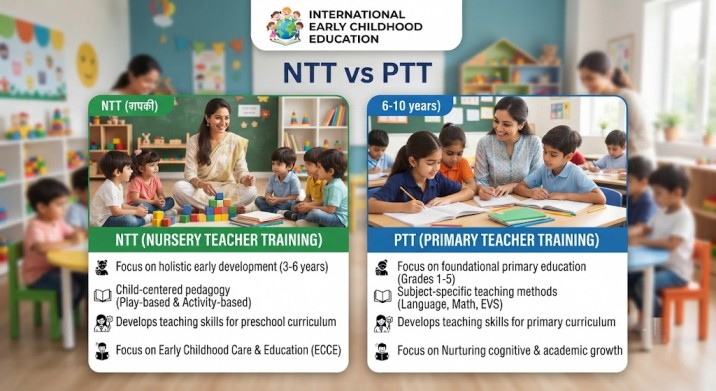
NTT focuses on nursery and pre-primary classroom practice: activity planning, early literacy and numeracy, and classroom routines. It is the fastest route into a preschool job.
Duration: 1 year | Fee: ₹10,000–₹80,000 | Eligibility: 10+2 pass.
One important warning: not every NTT course is NCTE-recognised. Always check recognition before paying.
Why this matters to you: NTT gets you in the door quickly, but it may limit you to entry-level roles in budget preschools.
3. Montessori Certification — Deep Method Training
Montessori training teaches the prepared environment, sensorial materials, practical life, language, and maths. It is the strongest qualification for Montessori-specific schools.
Duration: 6 months–2 years | Fee: ₹30,000–₹3,00,000+; AMI international diplomas sit at the top of this range. AMI diploma programmes in India are estimated at ₹1.3–₹2.5 lakh depending on the centre.
Why this matters to you: Montessori schools often pay a premium for AMI-trained teachers, but the course demands classroom hours and higher upfront investment.
4. B.Ed (Early Childhood) — For Government and Leadership Roles
A B.Ed with ECCE specialisation is the most comprehensive option. It is required for government early childhood centres and leadership roles under NEP 2020.
Duration: 2 years after graduation | Fee: ₹50,000–₹2,00,000 per year | Eligibility: Bachelor’s degree with 50%+ marks[reference:19].
Why this matters to you: This is the long-term path if you want to become a head teacher, curriculum coordinator, or government ECCE educator.
ECCE vs NTT vs Montessori: Which Certification Should You Choose?
There is no single “best” certificate. The right choice depends on the school you want to work in and the time and money you can invest.
| Certification | Best For | Duration | Fee Range (2027) | Recognition Strength |
|---|---|---|---|---|
| Diploma in ECCE | Private preschool chains, government ECCE centres | 1–2 years | ₹15,000–₹1,50,000 | High (NCTE-recognised options available) |
| NTT | Quick entry into nursery/pre-primary | 1 year | ₹10,000–₹80,000 | Varies; many are not NCTE-recognised |
| Montessori (AMI/Indian) | Montessori-specific schools | 6 months–2 years | ₹30,000–₹3,00,000+ | AMI is globally respected |
| B.Ed (Early Childhood) | Government schools, leadership roles | 2 years post-graduation | ₹50,000–₹2,00,000/year | Highest for government/aided schools |
Why this matters to you: Choosing a course without matching it to your target school type is the most common and most expensive mistake new teachers make.
Preschool Teacher Course Fees in India (2027 Comparison Table)
Fees vary widely by institute and city. The table below shows realistic 2027 ranges based on current published course fees.
| Course / Provider | Approximate Fee (2027) | Mode | Notes |
|---|---|---|---|
| IGNOU PG Diploma (ECFE) | ₹11,000 | Distance/ODL | 40 credits, practicum included |
| IGNOU DECE | ₹3,000–₹4,000 | Distance | Most affordable ECCE diploma |
| NTT (private institutes) | ₹10,000–₹80,000 | Classroom/distance | Check NCTE recognition |
| Montessori (Indian institutes) | ₹30,000–₹1,50,000 | Blended/classroom | Quality varies widely |
| AMI Montessori Diploma | ₹1,30,000–₹2,50,000 | In-person | Global gold standard |
| B.Ed (Early Childhood) | ₹50,000–₹2,00,000/year | Full-time | NCTE-recognised universities |
Why this matters to you: A ₹3,000 IGNOU DECE and a ₹2.5 lakh AMI diploma both say “trained teacher” on paper — but they open very different doors. Match the fee to the outcome you want.
Salary After Certification: What Changes in 2027
Certification does not just improve your classroom skills. It changes your salary band.
The average preschool teacher salary in India is around ₹6.49 lakh per year, with entry-level at roughly ₹4.85 lakh and senior-level at ₹7.63 lakh. But these averages hide a wide range: entry-level preschool roles in smaller cities often start at ₹15,000–₹25,000 per month, while experienced lead teachers in metro private schools cross ₹40,000–₹50,000 per month.
2027 pre-primary vacancies at established preschool chains are already advertising ₹3.2–₹6.8 LPA for teachers with 1–7 years of experience.
Why this matters to you: The salary jump after ECCE or Montessori certification is real, but it compounds only when you combine the certificate with 2–3 years of documented classroom experience.
Free and Low-Cost Professional Development Paths (NISHTHA, DIKSHA, SWAYAM)
You do not need to spend lakhs to keep learning. The Government of India runs structured CPD programmes for preschool and foundational-stage teachers.
NISHTHA ECCE (CBSE/NCERT): Online training in Early Childhood Care and Education, Foundational Literacy and Numeracy (FLN), digital safety, and action research. The 2026–27 cycle runs from October 2026 to March 2027, with enrolment closing on 10 March 2027 and course completion by 15 March 2027.
DIKSHA portal: Hosts NISHTHA modules, virtual labs, and state-level ECCE training content.
SWAYAM: Offers university-level courses in early childhood education at low or no cost.
Why this matters to you: NEP 2020 expects every teacher to complete at least 50 hours of CPD every year. Free government courses count toward this requirement and cost nothing.
How to Upgrade Your Qualification Step by Step
If you are currently teaching with an NTT certificate or no formal ECCE qualification, use this sequence.
- Audit your current qualification. Check whether your NTT or diploma is NCTE-recognised. If not, plan a recognised ECCE diploma next.
- Choose your target school type. Government/ECCE centre → B.Ed or ECCE. Premium private chain → ECCE. Montessori school → AMI or recognised Montessori diploma.
- Start with a low-cost recognised course. IGNOU DECE or PGDECFE lets you upgrade while working.
- Add one free CPD certificate per year. NISHTHA ECCE or a DIKSHA module keeps your CPD hours current.
- Document your classroom hours. Keep a record of practice teaching, observation hours, and parent communication experience — schools ask for this during interviews.
Checklist Before You Enrol in Any Course
- ☐ Is the course NCTE-recognised (or AMI-recognised for Montessori)?
- ☐ Does it include at least 200+ hours of supervised practice teaching?
- ☐ Is the total fee — including exam and material charges — clearly stated?
- ☐ Does the institute share placement data (percentage placed and salary range)?
- ☐ Can you complete it while working (weekend/online/distance mode)?
- ☐ Does the certificate mention NEP 2020 / NCF-FS alignment?
Why this matters to you: A five-minute checklist before paying saves two years of wasted fees and a certificate that schools do not accept.
City-Wise Demand: Where Preschool Teachers Are Needed Most
Demand is not evenly distributed. Metro cities (Mumbai, Bengaluru, Hyderabad, Delhi NCR) have the highest concentration of premium preschool chains and the highest salary ceilings. But Tier-2 cities — Indore, Jaipur, Patna, Lucknow, Coimbatore — are where new preschool franchises are opening fastest, and where certified teachers face less competition.
If you are in a Tier-2 or Tier-3 city, an ECCE diploma gives you a first-mover advantage in a market that is still short on trained teachers.
Why this matters to you: The same certificate can be worth more in a smaller city if you are one of the few certified preschool teachers there.
Frequently Asked Questions
1. Which certification is best for preschool teachers in India?
A Diploma in ECCE is the most widely accepted certification for preschool teachers in India, especially after NEP 2020 made early childhood education a formal foundational stage. NTT is faster and cheaper, but ECCE carries more weight with quality private schools and government ECCE centres.
2. Is NTT or ECCE better for a preschool job?
ECCE is better for long-term career growth and salary. NTT is better only if you need a quick, low-cost entry into a budget preschool. Many NTT courses are not NCTE-recognised, while ECCE diplomas from recognised institutes are preferred by premium preschool chains.
3. How much does a preschool teacher earn in India in 2027?
The average preschool teacher salary is around ₹6.49 lakh per year, but entry-level roles often start at ₹15,000–₹25,000 per month. 2027 pre-primary vacancies at established chains advertise ₹3.2–₹6.8 LPA for teachers with 1–7 years of experience, depending on city and certification.
4. Can I do an ECCE diploma online while working?
Yes. IGNOU offers distance-learning ECCE and PG Diploma programmes at very low fees, and many private institutes offer blended or online ECCE courses. Choose a programme that includes supervised practice teaching hours, even if the theory component is online.
5. What is the new qualification requirement for preschool teachers under NEP 2020?
NEP 2020 recommends a 6-month ECCE certificate for Anganwadi workers/teachers with 10+2 qualifications, and a 1-year ECCE diploma for those with lower qualifications. For private preschools, an ECCE diploma or B.Ed (Early Childhood) is increasingly the expected standard.
6. Are NISHTHA courses free for preschool teachers?
Yes. NISHTHA ECCE and FLN courses on the DIKSHA platform are free government CPD programmes. The 2026–27 cycle runs until March 2027, and completion counts toward the 50-hour annual CPD expectation under NEP 2020.