NTT vs PTT: Nursery Teacher Training or Primary Teacher Training — Which Course Is Right for You? (2027)
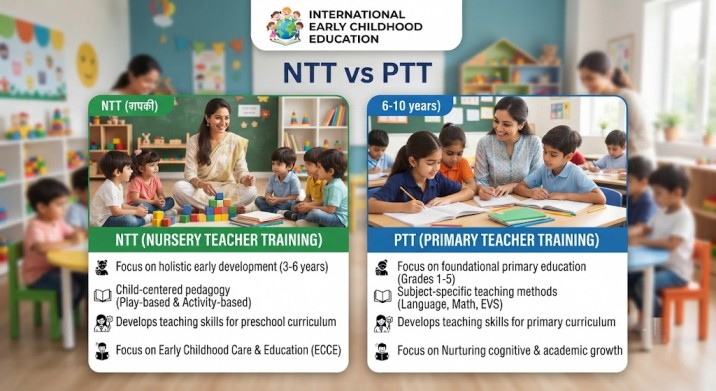
The right course depends on the age group you want to teach. NTT (Nursery Teacher Training) prepares you to teach children aged 2–6 in preschools, nurseries, and kindergartens. PTT (Primary Teacher Training) prepares you to teach Classes 1–5, covering ages 6–11 in formal primary schools. Both are 1–2 year diplomas open to 10+2 graduates, but they lead to different classrooms, different salaries, and different career paths.
Most course comparison pages give you a feature list and stop. This guide gives you the real numbers — fees, salary ranges, and the government-school eligibility trap that most PTT institutes do not mention. If you are choosing between NTT and PTT in 2027, the decision is simpler than it looks once you know three things: the age group, the salary ceiling, and the qualification each employer actually accepts.
One-Line Answer: The Age Group Decides the Course
NTT is for teaching nursery, LKG, UKG, and preschool children — roughly ages 2 to 6. The focus is play-based learning, child psychology, and early childhood development.
PTT is for teaching Classes 1 to 5 — roughly ages 6 to 11. The focus is subject pedagogy, curriculum planning, and structured classroom management.
Why this matters to you: If you enjoy working with toddlers and want a joyful, activity-led classroom, NTT is the natural fit. If you prefer teaching subjects like maths, English, or EVS to slightly older children, PTT is the better match. Choosing the wrong one means spending a year training for a classroom you do not actually want.
What Is NTT (Nursery Teacher Training)?
Who It Is For and What It Teaches
NTT is a diploma designed for people who want to teach in the early years. The curriculum covers child psychology and development, play-based teaching methods, story-telling and rhymes, art and craft, health and nutrition, and classroom management for young children. The teaching approach is activity-oriented — you learn to design play experiences, not deliver lectures.
The course is ideal for fresh 10+2 graduates, homemakers returning to work, and anyone who genuinely enjoys spending time with young children. No prior teaching experience is required.
Eligibility, Duration, and Typical Fees
Eligibility: 10+2 from a recognised board, usually with around 50% marks (varies by institute). Some institutes accept 10th pass for basic diploma levels.
Duration: Most NTT programmes run 1 year. Some institutes offer a 2-year advanced diploma, and a few offer 3–12 month certificate formats.
Fees: Typically ₹10,000–₹50,000 per year. Distance and online NTT programmes often fall in the ₹16,400–₹35,000 range, while classroom programmes in metro cities can be higher.
Why this matters to you: NTT is the shorter, cheaper, and more accessible entry into teaching. If you want to be in a classroom quickly, this is the fastest route.
What Is PTT (Primary Teacher Training)?
Who It Is For and What It Teaches
PTT trains teachers for the primary stage. The curriculum covers child pedagogy, educational psychology, curriculum planning, subject teaching methods, classroom management, and assessment techniques. The teaching approach is more structured than NTT — you are preparing children for formal academic learning, not just play.
PTT is suited to candidates who want to teach specific subjects and work in formal school environments. It is also a common pathway for graduates who want to move into academic coordination or curriculum roles later.
Eligibility, Duration, and Typical Fees
Eligibility: 10+2 from a recognised board with at least 50% marks. Some institutes prefer graduates, and a few accept 10th pass for certificate-level courses.
Duration: PTT is usually a 1-year diploma**, though some institutes offer **2-year programmes. Short certificate formats run 6 months.
Fees: Ranges are wider than NTT — from around ₹2,000 for a basic certificate to ₹1 lakh per year for a full diploma or degree-linked programme. A typical 1-year PTT diploma sits in the ₹15,000–₹50,000 band.
Why this matters to you: PTT can be as cheap or as expensive as NTT depending on the institute. The real cost difference is not the fee — it is the salary ceiling and the government eligibility rules, which we cover next.
NTT vs PTT: Side-by-Side Comparison
The Full Comparison Table
| Factor | NTT (Nursery Teacher Training) | PTT (Primary Teacher Training) |
|---|---|---|
| Target age group | 2–6 years (Nursery to KG) | 6–11 years (Classes 1–5) |
| Teaching approach | Play-based, activity-oriented | Subject-based, structured |
| Core subjects | Child psychology, play methods, art & craft, rhymes, health | Pedagogy, curriculum planning, subject methods, assessment |
| Eligibility | 10+2 (around 50% marks) | 10+2 (around 50% marks) |
| Duration | 1 year (some 2-year advanced diplomas) | 1 year (some 2-year diplomas; 6-month certificates) |
| Typical fees | ₹10,000–₹50,000 per year | ₹15,000–₹50,000 per year (can go up to ₹1 lakh) |
| Entry salary (private) | ₹12,000–₹25,000 per month | ₹18,000–₹35,000 per month |
| Career path | Nursery teacher, preschool teacher, daycare educator | Primary teacher, academic coordinator, curriculum planner |
| Government school eligibility | Not sufficient alone for government primary posts | Not sufficient alone — D.El.Ed/B.El.Ed + CTET/TET required |
Sources: Extramarks (2026), Shiksha (2025–2026), iDreamCareer (2024), AIECCE Academy (2025). Figures are estimates and vary by institute and city.
Why this matters to you: The table shows the salary gap clearly — PTT entry salaries are roughly 50% higher than NTT entry salaries in private schools. But that gap comes with a different classroom, a different skill set, and a different set of employer expectations.
Salary Comparison: NTT vs PTT in 2027
Private School Salary Ranges
NTT graduates in private preschools typically start at ₹12,000–₹25,000 per month**, with experienced educators in reputed schools reaching **₹4–6 LPA**. Preschool teachers across India average around **₹16,000 per month** based on aggregated data. In Kerala, nursery teachers earn ₹10,000–₹20,000 per month depending on the school and experience.
PTT graduates in private primary schools typically start at ₹18,000–₹35,000 per month**, with a broader range of **₹2.5–5.5 LPA** depending on the school. Some sources place private primary teacher starting salaries at ₹8,000–₹18,000 per month, which reflects the wide variation between budget and premium schools.
The Government School Reality (PTT Alone Is Not Enough)
This is the part most PTT institutes do not tell you. PTT alone does not make you eligible for government primary teacher posts. Government recruitment boards require D.El.Ed or B.El.Ed plus CTET or state TET qualification. A 1-year PTT diploma from a private institute is accepted by private schools, but it is not a substitute for the statutory qualification.
The salary difference is significant, though. A government primary teacher (PRT) at Pay Level 7 can earn a basic pay of ₹44,900–₹1,42,400, with a gross salary of ₹55,000–₹90,000 per month. At Pay Level 6, the gross is approximately ₹66,000–₹72,000 per month depending on the city.
Salary Table
| Path | Entry Salary | Experienced | Qualification Required |
|---|---|---|---|
| NTT — Private Preschool | ₹12,000–₹25,000/month | ₹4–6 LPA (reputed schools) | NTT diploma |
| PTT — Private Primary | ₹18,000–₹35,000/month | ₹2.5–5.5 LPA | PTT diploma |
| Government Primary (PRT) | ₹55,000–₹90,000/month (gross) | Higher with seniority | D.El.Ed/B.El.Ed + CTET/TET |
Sources: Extramarks (2026), Shiksha (2025–2026), AmbitionBox (2026), Schoolites salary calculator (2026), West Bengal teacher salary data (2026). Figures are estimates and vary by school, city, and pay commission.
Why this matters to you: If your goal is a government job, neither NTT nor a private PTT diploma is enough. You need D.El.Ed or B.El.Ed plus CTET/TET. If your goal is a private school job, PTT pays more at entry but NTT has a faster route to a classroom.
Career Scope: Where Each Course Takes You
Career Paths After NTT
- Nursery teacher / preschool teacher — the most direct path, in preschools and kindergartens.
- Daycare educator — in childcare centres like KLAY, Bright Horizons, and Amelio.
- Early childhood educator — in NGOs, government ICDS/Anganwadi programmes, and community education projects.
- Montessori teacher — if you add Montessori training, this opens premium and international preschools.
- Curriculum designer (early education) — in EdTech companies and publishers, with salaries ranging from ₹3 LPA to ₹16.7 LPA for senior roles.
- Nursery manager / centre head — with 3–5 years of experience, salaries reach ₹5–7 LPA.
Career Paths After PTT
- Primary school teacher — the most direct path, in private and CBSE schools.
- Academic coordinator — managing curriculum and teacher supervision across primary grades.
- Curriculum planner — designing lesson plans and teaching materials.
- Education consultant — advising schools and parents on primary education.
- Home tutor / online educator — a flexible option, especially in Tier-2 cities.
- Education counsellor — guiding students and parents on academic pathways.
Why this matters to you: NTT leads to roles that are deeply child-centred and often more flexible (daycare, part-time preschool). PTT leads to roles with more structure, higher entry pay, and a clearer path into academic coordination and school leadership.
The Hybrid Option: NPTT (Nursery Primary Teacher Training)
When One Course Covers Both Stages
NPTT combines NTT and PTT into a single programme covering the nursery stage through Class 5. Duration is typically 1–2 years**, eligibility is 10+2, and salary ranges from **₹15,000 to ₹35,000 per month** depending on the role and school.
NPTT is a practical choice if you are not sure which stage you want to teach, or if you want placement flexibility across preschools and primary schools. It is also useful in smaller cities, where a single school may ask you to handle multiple early grades.
Why this matters to you: If you cannot decide between NTT and PTT, NPTT gives you both skill sets. The trade-off is a slightly longer course and a syllabus that is broader rather than deeper.
NEP 2020 and the Future of Both Courses
ECCE Is Now a Policy-Mandated Stage
NEP 2020 restructured Indian school education into a 5+3+3+4 model**, with the foundational stage covering ages 3–8. Early Childhood Care and Education (ECCE) is now a policy-mandated stage, and CBSE requires schools to log **50 hours of Continuous Professional Development** per teacher annually.
A 2023 NCTE audit found that over 40% of school teachers in India had completed zero formal refresher training in the previous three years. That gap is pushing schools toward certified, formally trained teachers — which is good news for NTT and ECCE graduates.
Why the NTT/ECCE Qualification Is Gaining Value
The push for universal ECCE means more Balvatika classrooms, more structured preschools, and more demand for teachers who understand early childhood pedagogy. NTT is the most direct route into that demand. PTT remains valuable for primary grades, but the fastest-growing policy attention is on the early years.
Why this matters to you: If you are entering teaching in 2027, NTT is entering a policy tailwind. PTT is stable but less favoured by new policy spending.
Who Should Choose NTT and Who Should Choose PTT?
Choose NTT If…
- You genuinely enjoy working with toddlers and young children.
- You want to be in a classroom quickly (1-year diploma, lower fees).
- You are interested in play-based learning, child psychology, and early development.
- You want to work in a preschool, daycare, or Montessori setting.
- You are a homemaker or career switcher looking for a flexible, meaningful career.
Choose PTT If…
- You want to teach subjects like maths, English, or EVS to slightly older children.
- You want a higher entry salary and a clearer path into academic coordination.
- You are comfortable with structured lesson planning and assessment.
- You plan to eventually pursue D.El.Ed/B.El.Ed and CTET/TET for government roles.
- You want a broader range of career options beyond the classroom.
Why this matters to you: The best course is the one that matches the classroom you actually want to stand in. Salary matters, but a higher salary in a classroom you dislike is not a good trade.
7-Point Checklist Before Enrolling in NTT or PTT
- Do I want to teach ages 2–6 (NTT) or ages 6–11 (PTT)?
- Does the institute’s certificate get accepted by the schools I am targeting?
- Does the programme include supervised practice teaching or internship?
- Is the total fee — including materials and exam fees — within my budget?
- If I want a government job later, have I planned for D.El.Ed/B.El.Ed and CTET/TET?
- Have I spoken to 3 working teachers about their actual salary and daily work?
- Is the institute’s mode (online/offline/distance) practical for my schedule?
If the answer to questions 2, 3, or 5 is unclear, do not enrol yet.
Final Verdict
If you love toddlers and want the fastest route into a classroom: Choose NTT. It is shorter, cheaper, and directly aligned with the growing ECCE demand under NEP 2020.
If you want to teach subjects and earn more at entry level: Choose PTT. It pays ₹18,000–₹35,000 per month in private schools and opens doors to coordination roles.
If you cannot decide: Choose NPTT. It covers both stages in 1–2 years and gives you placement flexibility.
If you want a government primary job: Neither NTT nor a private PTT diploma is enough. Plan for D.El.Ed or B.El.Ed plus CTET/TET from the start.
Ready to choose the right teacher training course for your career?
Explore NTT, PTT, and NPTT programmes on international-ece.com →
Or fill this 2-minute form and get personalised guidance based on your age-group preference and budget.
Frequently Asked Questions (FAQ)
What is the main difference between NTT and PTT?
NTT trains you to teach children aged 2–6 in nurseries, preschools, and kindergartens, with a focus on play-based learning and child psychology. PTT trains you to teach Classes 1–5 (ages 6–11), with a focus on subject pedagogy, curriculum planning, and structured classroom management.
Which course pays more, NTT or PTT?
PTT pays more at entry level in private schools — ₹18,000–₹35,000 per month versus ₹12,000–₹25,000 for NTT. However, NTT salaries rise to ₹4–6 LPA for experienced educators in reputed preschools, and curriculum design roles can reach ₹16.7 LPA.
Can I teach primary school with an NTT certificate?
Most private primary schools prefer a PTT or D.El.Ed qualification for Classes 1–5. NTT is designed for the nursery and preschool stage. Some smaller schools may accept NTT for early primary grades, but it is not the standard qualification.
Is PTT enough for a government teaching job?
No. Government primary teacher posts require D.El.Ed or B.El.Ed plus CTET or state TET. A 1-year PTT diploma from a private institute is accepted by private schools but is not a statutory qualification for government recruitment.
What is NPTT, and should I choose it?
NPTT (Nursery Primary Teacher Training) combines NTT and PTT, covering nursery through Class 5 in 1–2 years. Choose it if you want placement flexibility across preschools and primary schools, or if you are unsure which stage you want to teach.
How much do NTT and PTT courses cost in India?
NTT typically costs ₹10,000–₹50,000 per year. PTT ranges from ₹2,000 for a basic certificate to ₹1 lakh per year for a full diploma, with most 1-year diplomas in the ₹15,000–₹50,000 band. Distance and online options are usually cheaper.