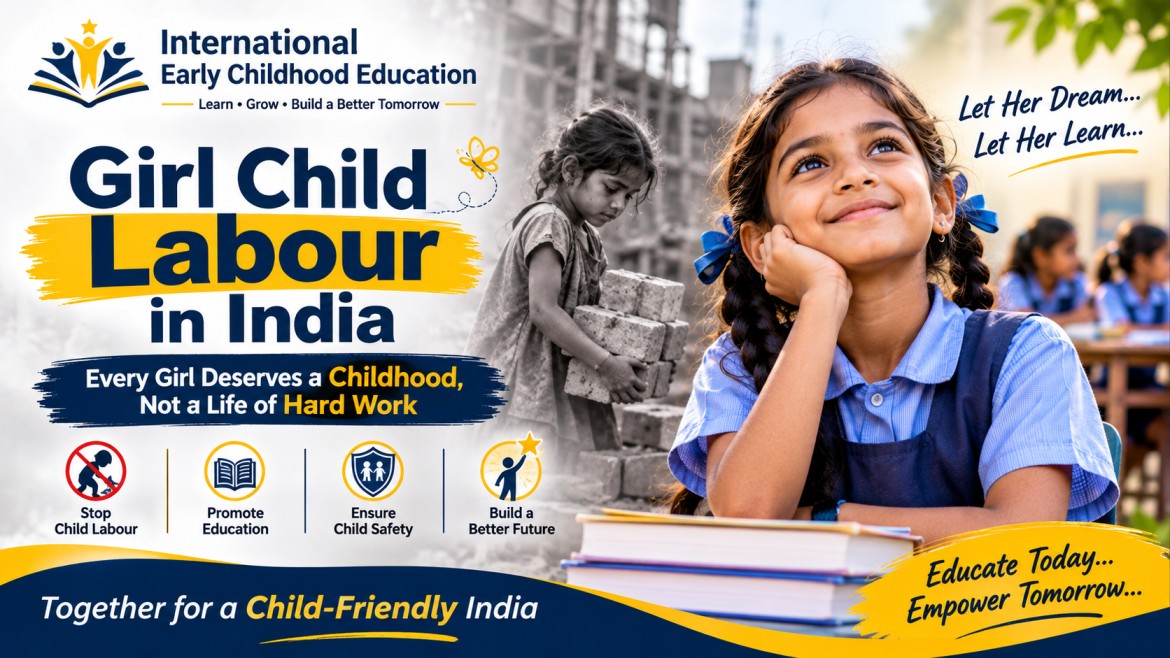
Girl Child Labour in India: Hidden Risks and the Role of Schools (2027)
Girl child labour in India is not just a poverty issue—it is a hidden child‑protection emergency that schools are uniquely placed to stop. In 2027, the girls most at risk are not in factories; they are behind closed doors in domestic work, family enterprises, and trafficking networks. Schools that act early can break the cycle.
What Is Girl Child Labour? (And Why It Stays Hidden)
Girl child labour refers to work that deprives a girl of her childhood, education, and safety. It includes paid and unpaid work in homes, farms, family enterprises, and informal industries. The Child Labour (Prohibition and Regulation) Amendment Act, 2016 prohibits employment of children below 14 years in all occupations, with limited family‑enterprise exceptions. Yet domestic work remains largely invisible.
The International Labour Organization estimates that globally 17.2 million children are in domestic work, and 67.1% of all child domestic workers are girls Because the work happens inside private homes, labour inspectors and teachers rarely see it. A rescued 15‑year‑old from Jharkhand was found working in Chennai; her employer was fined, but the damage to her schooling was already done
The Invisible Workforce: Domestic Work and Family Enterprises
In India, the 2019 Time Use Survey found that girls aged 6–17 spend 134 minutes a day on unpaid domestic services, compared with 79 minutes for boys. This “hidden work” does not appear in official labour surveys, but it pushes girls out of classrooms and into early marriage, trafficking, and intergenerational poverty.
Why this matters to you: If you run a school, a girl who is “absent” may not be sick—she may be working. Early identification is the first intervention.
2027 Reality Check: Girl Child Labour Statistics in India
India has no single, real‑time count of girl child labourers. The 2011 Census identified 43.53 lakh working children in the 5–14 age group. Independent estimates suggest the number of child labourers in 2025 was around 74.3 lakh, with seven states accounting for the majority. In Uttar Pradesh alone, more than 5,000 children were rescued from labour and trafficking in 2025–26, alongside over 17,000 child marriages prevented.
How Many Girls Are Working? (Estimated Figures)
UNICEF analysis of 2018–19 data shows that girls are more likely than boys to be “inactive”—neither in school nor in the labour force—which often masks unpaid domestic work and invisible exploitation. In Bihar, more than 60% of missing children are girls; many are trafficked for domestic work, forced marriage, and sexual exploitation.
Why this matters to you: Official figures undercount girls. Schools must rely on attendance patterns, not just government statistics.
5 Hidden Risks of Girl Child Labour Every School Must Know
Risk 1: Trafficking and Commercial Sexual Exploitation
Girls in domestic work are often one step away from trafficking. NCPCR data shows that 96% of children in labour in Delhi were trafficked from other states, and trafficking is increasingly linked to sexual abuse. A 2025 report documented a 250–300% rise in child sexual abuse material in India between 2022 and 2023.
Why this matters to you: A missing girl is a red flag. Schools need a trafficking‑sensitive absence protocol.
Risk 2: Health and Nutrition Collapse
Girls in labour face stunted growth, anaemia, and untreated injuries. Work in agriculture, forestry, and fishing accounts for 62.8% of girl child workers, exposing them to pesticides and physical strain
Why this matters to you: School health check‑ups can detect malnutrition and chronic fatigue before they become dropouts.
Risk 3: Education Deprivation and Dropout
India’s secondary school dropout rate was 8.2% in 2024–25, and nearly one in two students fails to complete Class 12. Girls are pulled out first when families face economic shocks. The transition from primary to secondary school is the highest‑risk period for starting work.
Why this matters to you: The biggest drop‑out spike happens at Class 8–9. That is when a school’s retention strategy matters most.
Risk 4: Early Marriage and Intergenerational Poverty
Child marriage and child labour are twins. In Uttar Pradesh, authorities prevented 17,303 child marriages in 2025–26 while rescuing over 5,000 children from labour. A girl who marries early almost never returns to school, and her children are more likely to work.
Why this matters to you: School‑based life‑skills programmes and KGBV residential facilities directly reduce early marriage risk.
Risk 5: Psychological Trauma and Stigma
Girls rescued from labour often carry trauma, shame, and fear of authority. Without counselling and bridge education, they fall back into exploitation. NGOs report that rescued girls need long‑term psychosocial support, not just rescue.
Why this matters to you: A girl who returns to school after rescue needs a trauma‑informed classroom, not punishment for absence.
Why Schools Are the First Line of Defence Against Girl Child Labour
There is broad consensus that improving access to quality schooling plays a prominent role in preventing and reducing child labour. Schools are the only institution that sees almost every girl regularly—and can act before labour becomes permanent.
Access, Retention, and Safety: The Three Pillars
Evidence from India shows that bicycles for girls in Bihar improved school participation and reduced paid work School feeding, scholarships, and life‑skills training lower the opportunity cost of schooling. KGBV residential schools protect girls from labour and early marriage while keeping them in education
Government Schemes That Schools Can Leverage (2027)
Samagra Shiksha provides free uniforms, textbooks, separate toilets, and girls’ stipends. As of December 2025, 5,269 KGBVs were functional across India, with 5,639 approved[ The scheme also includes self‑defence training for girls of Classes VI–XII and gender‑sensitisation modules for teachers.
| Intervention | Risk addressed | Estimated cost/benefit |
|---|---|---|
| Bicycle scheme (Bihar model) | Dropout, paid work | Low cost per girl; proven increase in retention[ |
| KGBV residential schooling | Trafficking, early marriage, labour | High impact for SEDG girls; 5,269 functional KGBVs |
| School feeding + scholarship | Opportunity cost of schooling | Reduces child labour and improves nutrition |
| Teacher training on child rights | Identification and referral | Low cost; improves reporting and rehabilitation |
Why this matters to you: You do not need a new budget line. Most protective interventions already exist under Samagra Shiksha—the gap is implementation.
Investment and ROI: What It Costs to Keep a Girl in School vs. Labour
The average annual opportunity cost of secondary schooling in India is estimated at ₹18,000–₹37,500 per student, with higher costs for boys than girls. But the cost of inaction is far higher: lost lifetime earnings, health costs, trafficking‑related trauma, and intergenerational poverty.
| Path | Immediate cost (estimated) | Long‑term outcome |
|---|---|---|
| Keep girl in school (with scheme support) | ₹5,000–₹15,000/year (family + state share) | Higher lifetime earnings, delayed marriage, educated next generation |
| Girl enters domestic work / labour | Short‑term income: ₹2,000–₹6,000/month | School dropout, health risks, trafficking exposure, intergenerational poverty |
| Rescue + rehabilitation after exploitation | ₹50,000–₹1,50,000+ (NGO/state cost) | Trauma, uncertain reintegration, lost years of education |
Why this matters to you: Prevention through schooling is cheaper than rescue and rehabilitation. Every girl retained in Class 9 is a potential trafficking case prevented.
Legal Framework: How Schools Can Use the Law to Protect Girls
The Child Labour (Prohibition and Regulation) Amendment Act, 2016 bans employment of children below 14 in all occupations and adolescents in hazardous work The POCSO Act, 2012 protects girls from sexual exploitation, and the Juvenile Justice Act, 2015 treats working children as children in need of care and protection. Domestic work is classified as hazardous for children below 14, but enforcement remains weak because it happens inside homes.
| Law | Protection | School action |
|---|---|---|
| Child Labour Amendment Act, 2016 | Bans child labour below 14; regulates adolescent work | Report suspected employment; maintain absence records |
| POCSO Act, 2012 | Protects against sexual abuse and exploitation | Mandatory reporting; child‑friendly complaint mechanism |
| JJ Act, 2015 | Working children are “children in need of care” | Refer to Child Welfare Committee; support rehabilitation |
| RTE Act, 2009 | Free and compulsory education up to 14 | Prevent denial of admission; track out‑of‑school girls |
Why this matters to you: Teachers are mandatory reporters in many cases. Knowing the law is not optional—it is part of child protection.
A Practical Checklist for Schools: 7 Steps to Prevent Girl Child Labour
Use this checklist to audit your school’s readiness in 2027.
- ☐ Maintain a gender‑disaggregated daily attendance register and flag girls absent for more than 3 consecutive days.
- ☐ Train at least two teachers as child‑protection focal points under POCSO and JJ Act provisions.
- ☐ Map out‑of‑school girls in the catchment area with Anganwadi and NGO partners.
- ☐ Activate Samagra Shiksha entitlements: uniforms, textbooks, stipends, and KGBV referrals.
- ☐ Run a termly life‑skills and child‑rights session for adolescent girls.
- ☐ Establish a confidential referral pathway to the Child Welfare Committee and local NCPCR helpline.
- ☐ Track reintegration of rescued girls through bridge courses and remedial education.
Why this matters to you: A checklist turns policy into practice. Most schools already have the schemes—they lack a monitoring routine.
Real Stories from Indian Cities and Villages
In Jhansi, Uttar Pradesh, all 496 gram panchayats are being declared child‑labour‑free as part of the state’s 2027 targe In Bihar, police recovered 6,567 missing girls in 2025 alone, many of whom had been trafficked for domestic work and forced marriage. In Tamil Nadu, activists are demanding a state survey of child domestic workers because gated apartments in Chennai hide thousands of girls behind closed doors
These are not distant statistics. They are the girls who sit—or should sit—in your classroom.
How international-ece.com Supports Schools and Educators
At international-ece.com, we help schools build protective, inclusive early‑childhood and primary environments. Our resources on early childhood education programmes and teacher training on child rights give educators practical tools to identify at‑risk girls and keep them learning.
Whether you run a KGBV, a low‑fee private school in Indore, or a government primary school in Patna, the first step is the same: notice the absent girl, ask why, and act before labour becomes permanent.
Frequently Asked Questions (FAQ)
1. What are the main causes of girl child labour in India?
Poverty, gender discrimination, lack of accessible schools, migration, and early marriage are the main drivers. Families often see girls’ work as “help” rather than labour, which keeps it hidden and under‑reported.
2. How does child labour affect girls’ education?
Girls in labour miss school, drop out early, and rarely return. The transition from primary to secondary school is the highest‑risk period. Without bridge education, rescued girls struggle to re‑enter formal schooling.
3. What is the role of schools in preventing child labour?
Schools can identify absent girls, provide scheme entitlements (uniforms, stipends, KGBV), run life‑skills sessions, and refer cases to child‑protection authorities. Regular attendance tracking is the single most effective early‑warning tool.
4. Which government scheme helps girl child education in India?
Samagra Shiksha supports free uniforms, textbooks, girls’ stipends, and self‑defence training. KGBV provides residential schooling for girls from disadvantaged groups up to Class XII. As of 2025–26, 5,269 KGBVs are functional
5. Is domestic work considered child labour in India?
Yes. The Child Labour Amendment Act, 2016 prohibits domestic work for children below 14 and classifies it as hazardous. However, enforcement is difficult because the work happens inside private homes.
6. How can teachers identify a child labourer in the classroom?
Look for repeated absence, fatigue, malnutrition, untreated injuries, reluctance to go home, and sudden withdrawal. A confidential conversation and a referral to the Child Welfare Committee can prevent deeper exploitation.