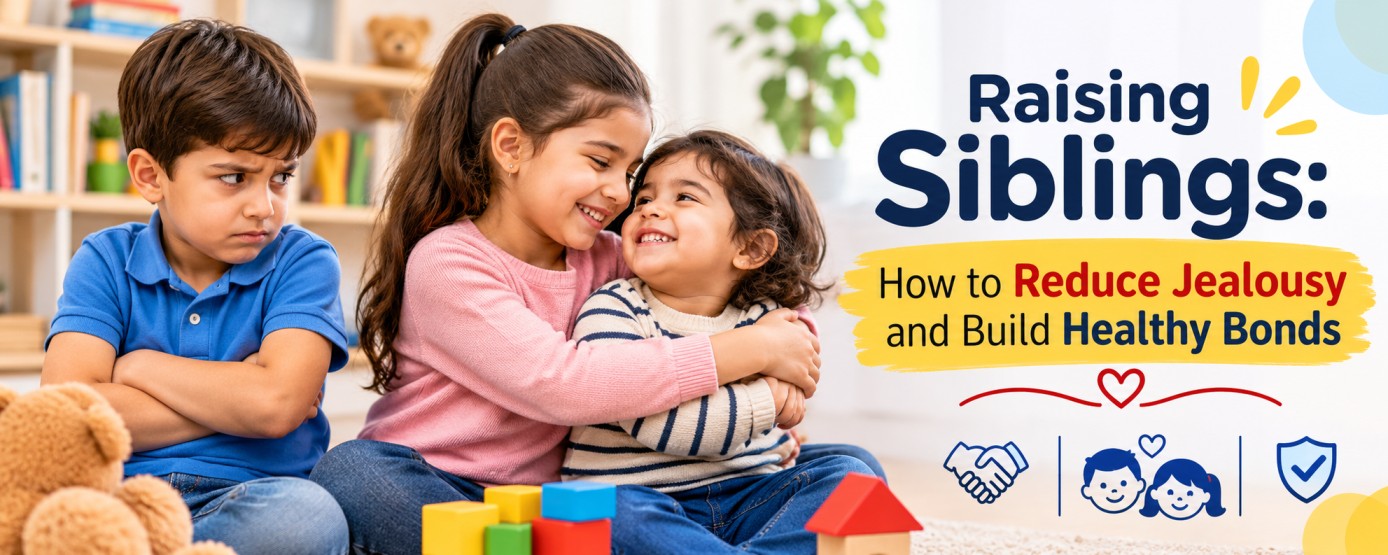
Raising Siblings: How to Reduce Jealousy and Build Healthy Bonds (2027)
Direct answer: Sibling jealousy reduces when parents stop comparing children, give each child 10–15 minutes of daily one-on-one time, and teach turn-taking instead of forced sharing. Healthy bonds grow from fairness over equality — not from eliminating conflict.
If you are raising two or more children in India in 2027, you already know the soundtrack: “She got more.” “He started it.” “Why does he always get the first piece?”
You are not failing. You are parenting siblings.
Why Sibling Jealousy Happens — And Why It’s Not a Parenting Failure
Sibling rivalry is a normal developmental stage, especially between ages 1 and 6. The jealousy is rarely about the toy. It is about access to you.
A young child’s attachment system is wired for primary access to caregivers. A new sibling feels like a genuine threat to that access — not a moral failing, not “bad behaviour”
Research is consistent: authoritative parenting (warmth + clear boundaries) is negatively associated with sibling conflict, while authoritarian, permissive, and neglectful styles are positively associated with it.
Why this matters to you: If you are shouting more than connecting, the research says you are feeding the rivalry — not fixing it.
Signs Your Child Is Jealous (Not Just Annoyed)
Jealousy in children rarely sounds like “I am jealous.” It looks like behaviour.
Regression: The “Baby Talk” Comeback
Your toilet-trained 4-year-old suddenly wants a bottle. Your independent 6-year-old starts clinging. Regression is a child saying: “If the baby gets this, maybe I should too.” It is temporary and common.
Aggression, Withdrawal, and Attention-Seeking
Hitting the younger sibling, pulling away from family time, or escalating tantrums are all jealousy signals. The child is not “bad.” The child is communicating displacement in the only language available
Why this matters to you: Punishing the feeling teaches the child to hide it. Correct the behaviour, but validate the emotion first[
The India-Specific Triggers Most Parenting Blogs Ignore
Western sibling-rivalry advice often misses the cultural water Indian families swim in.
Joint Family Comparison Culture
“Your cousin got 90. Why did you get 75?” “Your sister eats everything — why are you so fussy?” In many Indian extended families, comparison is constant and often well-intentioned. It still frames siblings as competitors
Grandparent Favouritism and Gender Rules
Grandparents may visibly prefer the eldest grandchild, the only grandson, or the child who resembles a favourite relative. Children notice this with extraordinary precision. Different curfews or freedoms for sons and daughters also feed resentment when children experience them as unfair.
Why this matters to you: You cannot control every relative. But you can name the unfairness privately, refuse to participate in public comparison, and protect your child’s sense of being equally valued.
7 Evidence-Based Strategies to Reduce Sibling Jealousy
A comprehensive review of child-development research identified seven core strategies for managing sibling rivalry: individual identity, fairness over equality, conflict-resolution skills, quality time, clear boundaries, parental self-regulation, and professional help when needed.
Here is how those strategies translate into daily Indian family life.
1. Protect 10–15 Minutes of One-on-One Time Daily
This is the single most repeated recommendation across Indian and international parenting sources. Ten to fifteen minutes of daily, protected one-on-one time with each child reduces jealousy more reliably than any lecture or punishment.
It does not have to be a grand outing. Chai with your older child before school. Ten minutes of drawing with your younger one while dinner cooks.
2. Kill Comparisons — Even the “Positive” Ones
“Look how nicely your brother eats” is not harmless. It ranks children against each other. When children feel genuinely valued for who they are — not compared — cooperation increases and jealousy drops
3. Teach Turn-Taking Instead of Forced Sharing
Forced sharing teaches children that their claim does not matter. Turn-taking teaches negotiation and patience. A timer, a queue, a simple rule — “your turn, then her turn” — works better than “give it to your sister because she is younger”.
4. Step Back Before You Step In
The AAP recommends allowing siblings to attempt resolution when the conflict is not physical or dangerous. Those negotiations — however clumsy — build advocacy, listening, and compromise.
Intervene when someone is hurt, scared, or the fight is one-sided. Otherwise, breathe.
5. Create Shared Rituals, Not Shared Toys
Shared toys cause conflict. Shared rituals build identity. A Saturday pancake tradition, a weekly family game, a bedtime story where each child adds a line — repeated moments of collaboration become the memories that hold siblings together.
6. Validate the Feeling, Correct the Behaviour
“You feel angry because the baby gets more time. That is okay. Hitting is not okay.” This two-step response protects the relationship while setting the boundary. Research on sibling jealousy consistently supports emotional validation before correction.
7. Use Authoritative Parenting, Not Authoritarian
Warmth plus structure. High expectations plus responsiveness. The meta-analytic evidence is clear: authoritarian parenting (control without warmth) is the strongest predictor of sibling rivalry, while authoritative parenting is associated with the lowest conflict levels.
What to Do When Jealousy Turns Physical or One-Sided
Not all conflict is rivalry. When one child is regularly hurt, scared, or targeted, it is sibling bullying — not normal rivalry — and it needs adult intervention.
| Normal Rivalry | Sibling Bullying (Act) |
|---|---|
| Both children participate | One child is always the aggressor |
| Short-lived, often over toys or attention | Repeated, intentional, and enjoyed by the aggressor |
| Children can return to play afterwards | The target becomes withdrawn, fearful, or compliant |
| Separate, cool down, teach | Separate, protect the target, seek professional guidance |
Why this matters to you: Calling bullying “just sibling stuff” teaches the targeted child that home is not safe. It teaches the aggressor that harm has no consequence.
Age-by-Age Cheat Sheet for Indian Parents
| Age | What Jealousy Looks Like | What Helps Most |
|---|---|---|
| 1–3 years | Hitting, regression, clinging, refusing food | One-on-one time, naming feelings, involving in baby care |
| 4–7 years | “It’s not fair,” tattling, competition for praise | Turn-taking, private praise, no comparisons, shared rituals |
| 8–12 years | Comparison with marks, friends, or privileges; withdrawal | Fairness over equality, private conversations, conflict-resolution coaching |
| Teens | Resentment over freedom, privacy, or parental attention | Respect autonomy, avoid public comparison, mediate without taking sides |
What Healthy Sibling Bonds Actually Look Like (It’s Not Zero Conflict)
A healthy sibling bond is not a home with no fights. It is a home where:
- Children can disagree without fear of losing the relationship.
- Parents correct behaviour without ranking the child.
- Each child has protected access to at least one parent daily.
- Rituals create shared identity — “we are the kind of family who…”
Research confirms that positive sibling bonds formed in childhood are linked to lower rates of loneliness, anxiety, and depression in adult life. The goal is not peace. The goal is repair — the slow, repeated practice of coming back together after conflict.
Your 5-Minute Daily Checklist for a Calmer Home
Checklist — copy this and put it on the fridge.
- ☐ Did each child get at least 10 minutes of uninterrupted one-on-one time today?
- ☐ Did I avoid comparing one child to the other — even “positively”?
- ☐ When conflict started, did I pause before intervening?
- ☐ Did I validate the feeling before correcting the behaviour?
- ☐ Did we do one shared ritual today (meal, story, game, prayer)?
- ☐ Did I criticise a behaviour — not a child?
Why this matters to you: Consistency beats intensity. Five calm minutes every day will change the sibling dynamic faster than one big “talk” once a month.
Frequently Asked Questions
Is sibling jealousy normal?
Yes. Sibling jealousy is a normal developmental stage, especially between ages 1 and 6. It usually begins when a new baby arrives and an older child feels displaced. It is not a sign of bad parenting. With fair treatment, one-on-one time, and consistent boundaries, most children grow through it.
How do I stop my older child from hitting the baby?
Separate them immediately without shaming the older child. Say: “I will not let you hurt the baby. You are angry. Hitting is not okay.” Then give the older child 10–15 minutes of dedicated attention later that day. Hitting is a signal of displacement, not a character flaw.
Should I force my children to share?
No. Forced sharing teaches children that their claim does not matter. Teach turn-taking instead — use a timer or a simple queue. Turn-taking builds negotiation and patience, while forced sharing often increases resentment between siblings.
What is the difference between sibling rivalry and sibling bullying?
Rivalry is mutual, short-lived, and often over toys or attention. Bullying is repeated, one-sided, and intentional — one child is always the aggressor, and the target becomes fearful or withdrawn. Bullying needs adult protection and professional guidance; rivalry needs coaching and calm boundaries.
Does age gap affect sibling jealousy?
Yes. Sibling rivalry most commonly peaks when the age gap is less than two years, and during developmental stages around ages 1–3 and 8–12. A smaller gap means both children want the same things at the same time, which increases friction.
How can Indian parents handle joint-family comparison?
Refuse to participate in public comparison, even when relatives do it. Privately tell your child: “I do not compare you. You are enough.” Name the unfairness without attacking the relative. Your child needs one adult who sees them as an individual, not a rank in a family competition.