Play-Based Learning and Assessment: NEP-Aligned Methods for Preschool Teachers (2027)
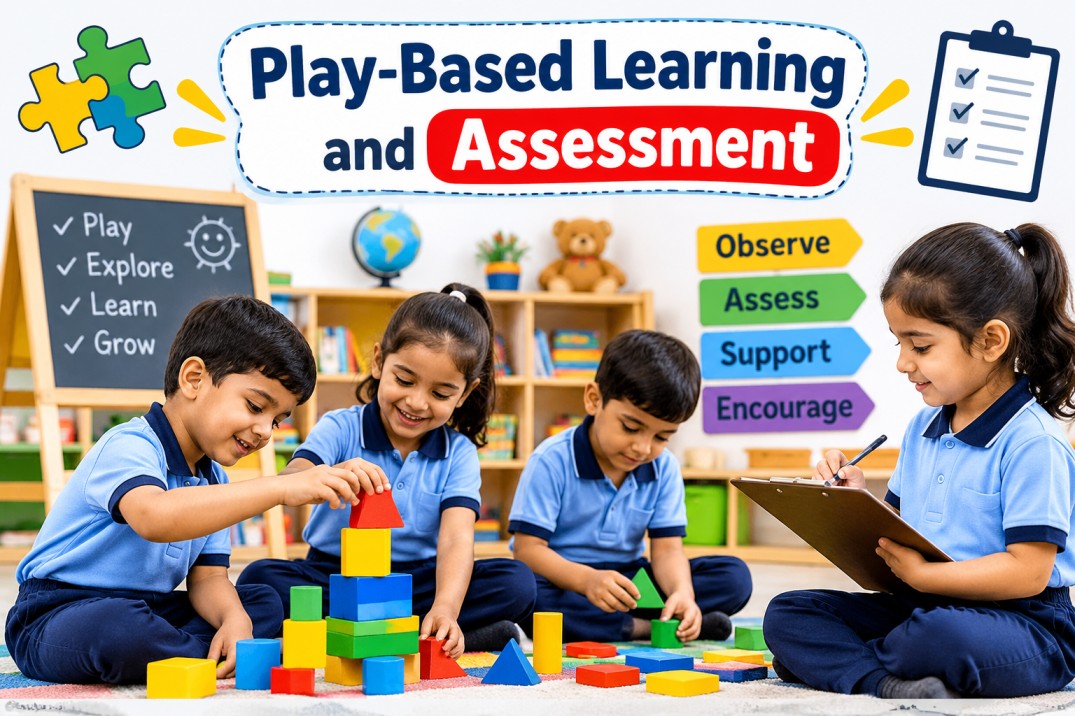
Direct answer: Under NEP 2020, preschool teachers must use play as the primary vehicle for learning and assess children through observation, conversation, and portfolio evidence — not written tests. The National Curriculum Framework for the Foundational Stage (NCF-FS) makes observation-based, formative assessment the official mode of tracking progress for children aged 3–8.
If you teach in a Balvatika, Anganwadi, or private preschool in Mumbai, Indore, Patna, or Jaipur, this guide gives you the exact methods, tools, and daily routines the policy expects in 2027.
What Does NEP 2020 Actually Say About Play-Based Learning?
NEP 2020 reorganised school education into a 5+3+3+4 structure. The first five years — three years of preschool plus Grades 1 and 2 — form the Foundational Stage. For this stage, the policy mandates play-based, activity-based, and inquiry-driven learning.
The NCF-FS, launched in October 2022, operationalises this vision for children aged 3–8. It explicitly discourages rote routines and sets competency-based, developmentally appropriate expectations
The 5+3+3+4 Structure and the Foundational Stage
The Foundational Stage covers ages 3–8. Three years of preschool (Anganwadi or Balvatika) are now recognised as a continuum of formal education, not a separate “pre-school” phase. This means preschool teachers are no longer outside the formal system — they are the first formal teachers a child meets.
Why this matters to you: Your classroom observations now feed into the same competency framework that primary teachers use. Your records matter for the child’s Holistic Progress Card.
Why NEP Calls Play “Purposeful,” Not “Free Time”
Research from Indian preschools shows that play is still widely misunderstood — sometimes treated as free time or the opposite of learning NEP 2020 rejects this view. Play is the method through which language, thinking, creativity, and social-emotional skills develop.
NEP 2020 and NCF-FS list storytelling, music, art, games, exploration, conversation, and hands-on activities as legitimate learning pathways.
Play-Based Learning vs Rote Learning: What Changes for the Teacher?
The shift is not just about adding toys to the classroom. It changes what the teacher does minute by minute.
The Teacher’s Role Shifts from Instructor to Facilitator
In a rote classroom, the teacher delivers content and checks recall. In a play-based classroom, the teacher designs experiences, observes children during play, asks open questions, and records evidence of learning.
What Research Says About Play and School Readiness
A 2026 study of Indian preschools found that educators no longer question why play-based learning matters — the real challenge is how to implement it consistently. The same research identified four recurring barriers: misunderstanding of play, lack of practical support, Grade 1 transition pressure, and parental demand for visible worksheets.
| Dimension | Rote Classroom | NEP-Aligned Play-Based Classroom |
|---|---|---|
| Teacher’s primary action | Delivers instruction, checks recall | Designs play experiences, observes, asks open questions |
| Evidence of learning | Worksheets, written tests | Observation notes, portfolios, conversation records |
| Child’s role | Passive receiver | Active explorer and initiator |
| Assessment timing | End of unit | Embedded in everyday activity (“on-the-go”) |
| Parent communication | Marks and ranks | Holistic Progress Card across domains |
Why this matters to you: If your preschool still runs worksheet-heavy “prep” classes, you are out of step with NCF-FS. The framework discourages rote routines.
NEP-Aligned Assessment: It Is Not an Exam
Assessment at the Foundational Stage is not about marks, report cards, or ranking. It is about understanding each child’s growth across multiple domains.
Observation, Not Testing
NCF-FS makes observation-based, formative assessment the primary mode of tracking progress. Formal testing does not give a fair or accurate view of young children’s learning because they develop at different paces and across many areas at once.
Assessment should emerge through play, storytelling, exploration, interaction, songs, movement, and meaningful engagement.
The Holistic Progress Card (HPC) Explained
NCERT and PARAKH have developed the Holistic Progress Card to operationalise this vision. The HPC documents development across six domains: Physical Development; Socio-Emotional and Ethical Development; Cognitive Development; Language and Literacy Development; Aesthetic and Cultural Development; and Positive Learning Habits.
Why this matters to you: If your school does not yet use an HPC-style report, you are missing the official communication tool that parents and primary schools will increasingly expect.
Competency Domains Teachers Must Track
The PARAKH Taxonomy assesses learning through three interconnected abilities: Awareness (what the child knows and notices), Sensitivity (how the child responds to people and situations), and Creativity (imagination, flexibility, original expression). These are not assessed separately — they are observed within everyday activities.
Practical Play-Based Assessment Methods for Indian Preschools
You do not need an app or a tablet to start. These four methods work in low-resource and high-resource settings alike.
Method 1 — On-the-Go Observation
Watch children during free play, guided play, and routine transitions. Note what they do, say, and try. This is the “on-the-go” assessment principle recommended in NCF-FS.
Method 2 — Guided Conversations
Ask open questions during play: “What will happen if you add this block here?” “Why do you think the character felt sad?” Guided conversations are listed as an official assessment technique.
Method 3 — Portfolio and Artefact Collection
Keep samples of children’s drawings, constructions, and story retellings. Photographs and short video clips can be shared with parents as evidence of progress.
Method 4 — Pretend Play and Role Play
Pretend play reveals language, social understanding, and self-regulation. NCF-FS and state ECCE guidelines explicitly include pretend play and role play as assessment methods.
Why this matters to you: These methods require zero additional testing time. They replace the worksheet pile with a 3-minute observation note after each play block.
Tools and Resources Every Preschool Teacher Should Know
Jaadui Pitara and e-Jaadui Pitara
The Ministry of Education launched Jaadui Pitara — 53 play-based learning-teaching materials for ages 3–8 — in February 2023. It is available in 23 languages and includes toys, puzzles, story cards, flashcards, and teacher handbooks aligned to NCF-FS. Its digital extension, e-Jaadui Pitara, launched in February 2024 with multilingual stories, songs, and AI-based support bots.
NCF-FS and NISHTHA (ECCE)
NCF-FS is the curriculum framework. NISHTHA (ECCE) is the national teacher training module that covers play-based activity planning, toys, and developmental goals. The Ministry has also trained over 8.9 lakh Anganwadi workers under the Poshan Bhi Padhai Bhi programme.
Why this matters to you: These are free, government-backed resources. You do not need to buy expensive imported curriculum kits to comply with NEP 2020.
How Much Does NEP-Aligned Teacher Training Cost? (Investment Table)
Training is the biggest implementation gap. Research shows teachers understand the theory but need practical support to move from instruction to facilitation. The Central Square Foundation has noted that achieving child-centred pedagogy requires extensive teacher professional development.
| Item | Estimated Cost (₹) | Notes |
|---|---|---|
| NISHTHA / DIET workshop (government) | ₹0 – ₹2,000 | Free or highly subsidised; depends on state |
| Private play-based pedagogy workshop (2–3 days) | ₹3,000 – ₹8,000 per teacher | Industry estimate; Tier-1 vs Tier-2 pricing varies |
| Jaadui Pitara kit (print + toys) | ₹1,500 – ₹4,000 | Government-subsidised; private versions cost more |
| Observation/portfolio stationery per classroom | ₹800 – ₹1,500 per year | Notebooks, folders, printing, basic camera/phone use |
| Annual refresher training (online) | ₹2,000 – ₹5,000 per teacher | Industry estimate |
Why this matters to you: A preschool can begin NEP-aligned assessment with under ₹5,000 per teacher if it uses government resources. The barrier is not money — it is the shift in daily habit.
Common Implementation Challenges — and How to Solve Them
- “Play is just free time.” → Use NCF-FS language: play is purposeful. Show one observation note per day to prove learning is happening.
- Teachers feel untrained. → Start with one method (on-the-go observation) for two weeks. Add a second method only after the first becomes routine
- Parents demand worksheets. → Share a weekly photo or short note showing what the child practised through play. Explain the HPC domains in parent meetings.
- Grade 1 pressure. → Align with local primary teachers. NEP expects preschool and Grade 1 to work as one Foundational Stage continuum[.
A Daily Checklist for Play-Based Assessment
Use this checklist at the end of each day. It takes 5–7 minutes.
- ☐ Did I observe at least 3 children during free or guided play?
- ☐ Did I record one specific behaviour or quote for each child?
- ☐ Did I ask at least one open-ended question during play?
- ☐ Did I collect one artefact (drawing, construction photo, story retelling) for the portfolio?
- ☐ Did I note any child who needs a targeted conversation tomorrow?
- ☐ Did I update one domain on the Holistic Progress Card tracker?
Why this matters to you: This checklist turns NEP policy into a repeatable habit. It is the difference between “we believe in play” and “we can show evidence of learning through play.”
Why This Matters to You (and Your Preschool’s Future)
Preschools that can demonstrate NEP-aligned play-based assessment will have a clear advantage in 2027 and beyond. Parents are becoming more aware of the difference between worksheet-driven “prep” and genuine Foundational Stage learning. Teachers who can document observation-based progress are more valuable to Balvatikas, private preschools, and Anganwadi upgradation programmes.
The policy window is open. NCF-FS is in place. Jaadui Pitara is available. NISHTHA training is free. The only missing piece is daily classroom practice.
Internal link suggestion 1: Anchor text: “preschool franchise opportunities” → link to your franchise listing page for early childhood education brands.
Internal link suggestion 2: Anchor text: “NEP-aligned teacher training programmes” → link to your teacher training or ECE course page.
Frequently Asked Questions
1. Is play-based learning mandatory under NEP 2020?
Yes. NEP 2020 mandates play-based, activity-based, and inquiry-driven learning for the Foundational Stage (ages 3–8). NCF-FS explicitly discourages rote routines and makes observation-based assessment the primary tracking method.
2. How do teachers assess children without tests?
Teachers use on-the-go observation, guided conversations, portfolio collection, and pretend play observation. These methods are embedded in everyday classroom activity and do not require separate testing sessions.
3. What is the Holistic Progress Card?
The HPC is an NCERT/PARAKH tool that documents a child’s development across six domains: physical, socio-emotional, cognitive, language and literacy, aesthetic and cultural, and positive learning habits
4. Where can teachers get free NEP training?
NISHTHA (ECCE) on DIKSHA is the national free training module. The Ministry has also trained over 8.9 lakh Anganwadi workers under Poshan Bhi Padhai Bhi
5. What is Jaadui Pitara?
Jaadui Pitara is a set of 53 play-based learning-teaching materials for ages 3–8, available in 23 languages. It includes toys, puzzles, story cards, and teacher handbooks aligned to NCF-FS.
6. Do private preschools also have to follow NEP 2020?
NEP 2020 provides the national framework, and states are customising it for local needs. Progressive private preschools have already adopted play-based learning. For 2027 admissions and parent trust, alignment with NCF-FS is becoming a competitive necessity.