Privatisation of ECE: Opportunities and Risks for Child Rights (2027 Guide)
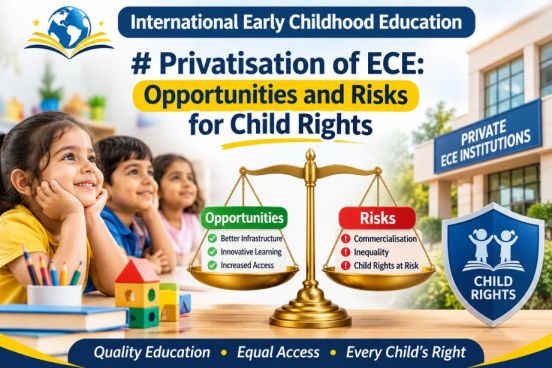
Privatisation of ECE can expand access, improve infrastructure and create jobs, but it also risks unequal access, high fees and weak child-rights safeguards. In 2027, the key is regulation that keeps quality and child rights at the centre of every private ECE centre.
This guide is for Indian preschool owners, educators, Anganwadi supervisors and parents. It connects global evidence from UNESCO, OECD and UNICEF with India’s NEP 2020 and the realities of Tier-2 and Tier-3 cities.
What Is Privatisation of Early Childhood Education?
Privatisation of ECE means early childhood services are delivered by private players instead of the state alone. This includes private preschools, play schools, daycare chains, franchise centres and low-fee private schools.
UNESCO and the OECD note that private provision in early childhood has grown faster than in most other education levels worldwide.
Why this matters to you: If you run a private ECE centre, your policies directly affect a child’s rights to safety, play and learning.
How Privatisation of ECE Looks in India
India has a mixed ECE system. Government Anganwadi centres and pre-primary sections sit alongside private play schools and preschool chains. In cities like Mumbai, Indore, Patna and Jaipur, private centres dominate the 3–6 age group (industry estimate).
Why the Privatisation Debate Matters in 2027
By 2027, more Indian families will seek preschool education as demand for foundational learning rises. The NEP 2020 strongly prioritises the foundational stage for ages 3–8.
Private players will fill much of this demand. Whether that helps or harms children depends on regulation and ethics.
Why this matters to you: Policy choices made in 2027 will shape early learning quality for the next decade.
Opportunities of Privatisation in ECE
1. Wider Access and More Choice
Private centres reach areas where government provision is thin, especially in Tier-2 and Tier-3 towns and urban colonies.
2. Better Infrastructure and Learning Materials
Private preschools often invest in play equipment, teacher training and parent communication tools.
3. Faster Teacher Training and Innovation
Private networks can run short, practical teacher-training programs. Organisations like international-ece.com support ECE educators with online and offline training.
4. Job Creation for Young Women
ECE is a major employer of women. Private centres create teaching, daycare and administrative roles.
5. Stronger Parent Awareness
Competitive private markets often improve parent education around early learning and child safety.
Risks to Child Rights
1. Unequal Access and Equity Gaps
High fees can exclude low-income families. UNICEF consistently stresses equity in early childhood services.
2. Weak Regulation and Quality Variation
Not all private centres follow child-teacher ratio, safety or curriculum standards. Quality varies widely across cities.
3. Commercial Pressure on Play-Based Learning
Some centres push early writing and rote learning to show “results” to parents. This conflicts with child development research.
4. Safeguarding and Child Protection Gaps
Inadequate staff screening, CCTV policies and complaint systems can expose children to risk.
5. Teacher Exploitation
Low salaries and insecure contracts affect teacher quality, which indirectly harms children.
6. Hidden Costs for Families
Activity fees, transport and uniform costs can stretch household budgets in Tier-2/3 cities (industry estimate).
Why this matters to you: A cheap or premium fee does not guarantee child-rights compliance. Policies and audits matter more.
Opportunities vs Risks: Comparison Table
| Area | Opportunity | Risk to child rights |
|---|---|---|
| Access | More centres in Tier-2/3 towns | Poor families priced out |
| Quality | Investment in teacher training and materials | Uneven standards without audits |
| Curriculum | Innovation and play-based tools | Rote learning to show fast results |
| Safety | Better infrastructure and CCTV | Weak screening and complaint systems |
| Teachers | More ECE jobs | Low pay and insecure contracts |
| Parents | More choice and awareness | Marketing pressure and hidden fees |
India Snapshot: Private vs Public ECE by City Type (2027)
| City type | Typical private ECE fee (monthly, estimated) | Main child-rights concern |
|---|---|---|
| Metro (Mumbai, Delhi) | ₹6,000–₹25,000 | High fees, commercial pressure, quality gaps |
| Tier-2 (Indore, Jaipur) | ₹2,500–₹8,000 | Unregulated centres, uneven teacher training |
| Tier-3 (Patna and smaller towns) | ₹1,200–₹4,000 | Safety standards, staff screening, hidden costs |
| Anganwadi / public | Free or nominal | Infrastructure and staffing gaps |
Fee figures are industry estimates and vary by city, brand and facilities. Always verify current fees directly with the centre.
Why this matters to you: Knowing typical fees helps you judge whether a centre is overpriced or under-resourced.
7-Step Action Plan for Regulators and Preschool Owners (2027)
- Mandate a simple ECE licence with clear safety and staffing rules.
- Set age-appropriate child-teacher ratios and publish them.
- Require police verification and child-protection training for all staff.
- Make fee transparency and refund rules compulsory.
- Run annual quality audits using a standard child-rights framework.
- Create a grievance and inspection system parents can access.
- Link public funding or recognition to compliance and outcomes.
Child Rights Checklist for Private ECE Providers
- ☐ Every staff member is police-verified and trained in child protection.
- ☐ Child-teacher ratio is age-appropriate and written in policy.
- ☐ Curriculum is play-based, not rote or exam-focused.
- ☐ Fees and hidden costs are disclosed in writing before admission.
- ☐ A parent-accessible complaint and feedback system exists.
- ☐ Safeguarding, first-aid and emergency drills are conducted regularly.
- ☐ Teachers receive fair pay and regular training.
- ☐ Children with disabilities are included, not screened out.
How NEP 2020 and Global Frameworks Guide Private ECE
NEP 2020 and the NCERT Foundational Stage framework stress play-based, equitable and child-centred learning. Global bodies like UNESCO and the World Economic Forum link early childhood quality to long-term learning outcomes.
For structured support, explore our ECE membership and quality audit services and our teacher training programs.
Why this matters to you: Aligning with national and global standards builds trust and protects children.
Frequently Asked Questions
What are the benefits of privatisation in early childhood education?
Privatisation can expand access, improve infrastructure, create ECE jobs and speed up teacher training. In Indian Tier-2 and Tier-3 cities, private centres often reach families where public provision is limited. Benefits grow only when regulation ensures quality and child safety.
What are the risks of private preschools to child rights?
Risks include high fees that exclude poor families, uneven quality, rote learning pressure, weak staff screening and hidden costs. Without audits and complaint systems, children can face safety and safeguarding gaps. Transparency and licensing reduce these risks.
Does privatisation improve ECE quality?
Not automatically. Private investment can improve facilities and training, but quality varies widely. According to OECD and UNESCO evidence, quality depends more on regulation, teacher qualifications and child-teacher ratios than on ownership alone.
How is ECE regulated in India?
India has no single national ECE regulator for all private centres. Rules vary by state and local bodies, with NEP 2020 and NCERT frameworks guiding curriculum. Licensing, safety and staffing standards remain inconsistent, especially in Tier-2 and Tier-3 towns.
Why is ECE a child rights issue?
Early childhood is a critical development window. Children have rights to safety, play, quality learning and non-discrimination. UNICEF and UNESCO treat early childhood care and education as part of basic child rights, not a private luxury.
What is the role of government in ECE?
Governments set standards, license centres, fund public provision and monitor quality. They also protect equity so poor families are not excluded. In 2027, governments must regulate private ECE as strongly as they expand public ECE.