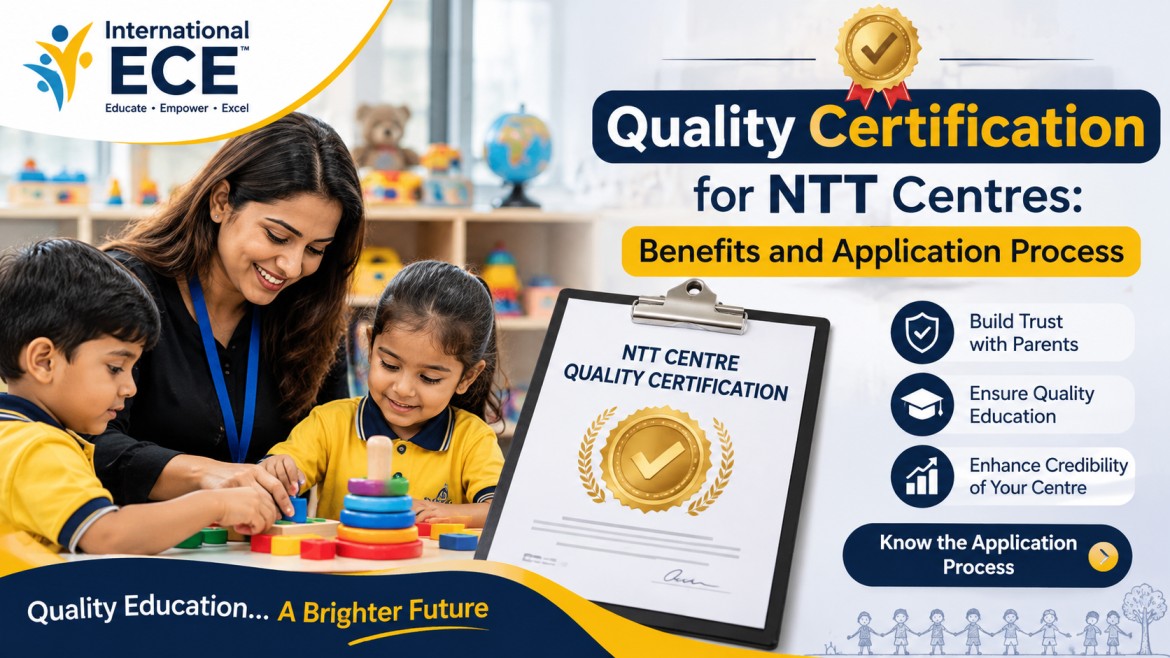
Quality Certification for NTT Centres: Benefits and Application Process
Quality certification for NTT centres is an independent audit that verifies your nursery teacher training institute meets defined standards in faculty, curriculum, infrastructure, and student outcomes. In 2026, it is the fastest way for an NTT centre to prove credibility to students, parents, and placement partners.
This guide covers the exact benefits, eligibility rules, documents, costs, and the step-by-step application process — written for Indian institute owners, not for academics.
What Is Quality Certification for NTT Centres?
NTT (Nursery Teacher Training) courses are largely delivered by private institutes across India. There is no single national regulator covering every NTT diploma, which leaves students unsure about which centre is genuine.
Quality certification fills that gap. An independent body audits your centre against a published standard and issues a certificate with a grade and validity period.
Why this matters to you: When a student in Patna or Indore compares two NTT centres, the certified one wins the admission — almost every time.
Why NTT Centres Need Quality Certification in 2026
Student awareness has changed. Enquiries now start with “Is your certificate valid?” and “Who has certified your centre?” — a direct result of the coaching and training sector scams reported between 2022 and 2025 (industry estimate).
Student and Parent Trust
A visible certificate on your wall, your brochure, and your website removes the biggest objection: “Is this institute real?” Trust converts enquiries into paid admissions.
Regulatory and Compliance Edge
State education departments and local bodies increasingly ask training institutes for documentation during inspections. A certification file ready on your desk shortens the inspection and reduces notices.
Why this matters to you: One inspection notice can freeze your admissions for a full season. A certificate file prevents that.
Key Benefits of Quality Certification for NTT Centres
Higher Admissions and Fee Confidence
Certified centres can justify a 10–20% fee premium over uncertified competitors in the same city (industry estimate, 2025). Parents pay for proof, not promises.
Stronger Placement Partnerships
Play schools and preschools prefer hiring from audited NTT centres because the training quality is verified. This directly improves your placement record — your strongest marketing asset.
Standardised Teaching and Administration
The audit forces you to document lesson plans, attendance, faculty qualifications, and assessment records. Your centre runs better even if you never mention the certificate in an ad.
| Area | Uncertified NTT Centre | Quality Certified NTT Centre |
|---|---|---|
| Student trust at enquiry | Needs verbal assurance | Certificate shown instantly |
| Fee premium possible | No | 10–20% higher (industry estimate) |
| Placement tie-ups | Hard to close | Easier with audit report |
| Inspection readiness | Scattered files | Complete documented file |
| Marketing claims | Self-declared | Third-party verified |
Why this matters to you: Certification changes what you can legally and credibly claim in your advertisements.
Eligibility Criteria for NTT Centre Certification
Most certifying bodies apply a similar baseline. Confirm these before you apply:
- Institute registered as a trust, society, or private limited company
- Minimum 12 months of operation (some bodies accept 6 months)
- At least 2 qualified faculty members for NTT-level teaching
- Defined syllabus with theory and practical teaching hours
- Physical classroom space with basic safety compliance
- Documented student records and assessment process
Why this matters to you: Applying before you meet the baseline wastes the application fee and delays you by one full cycle.
Documents Required for NTT Centre Certification
Keep this checklist ready before starting the application:
- ✅ Institute registration certificate (trust deed / society registration / COI)
- ✅ PAN card and GST registration (if applicable)
- ✅ Address proof of premises (rent agreement or ownership document)
- ✅ Faculty qualification certificates and CVs
- ✅ Detailed syllabus with subject-wise hours
- ✅ Sample student admission form and fee receipt format
- ✅ Attendance and assessment record samples
- ✅ Photographs of classrooms, library, and practical training area
- ✅ Last 12 months student enrolment data
- ✅ Placement record (if available)
Step-by-Step Application Process for NTT Centre Certification
Here is the standard six-step process followed by most ECE certification bodies in India:
- Enquiry and standard selection — Request the certification standard document and confirm which grade you are applying for.
- Self-assessment — Fill the self-audit form honestly. Fix obvious gaps before the auditor arrives.
- Application submission — Submit the form with documents and the application fee.
- Document review — The body verifies your paperwork, usually within 7–15 days.
- On-site audit — An auditor visits your centre, checks records, and interviews faculty and students.
- Certification decision — You receive a grade, a certificate with validity dates, and an improvement report.
Why this matters to you: Steps 1 and 2 are free. Doing them properly is what decides whether you pass on the first audit.
Cost and Timeline of NTT Centre Certification
| Item | Estimated Cost (₹) | Timeline |
|---|---|---|
| Application fee | ₹5,000–₹15,000 | Day 1 |
| Documentation and file preparation | ₹3,000–₹10,000 | 1–2 weeks |
| On-site audit fee | ₹8,000–₹25,000 | 1 day visit |
| Faculty upskilling (if required) | ₹10,000–₹30,000 | 2–4 weeks |
| Infrastructure fixes (if required) | ₹0–₹50,000 | Varies |
| Total first-year cost | ₹25,000–₹1,10,000 | 30–60 days |
These are estimated ranges based on the Indian training-institute sector in 2025. Actual fees vary by certifying body, city, and centre size.
Certification Grades Compared
| Grade | What It Usually Means | Best For |
|---|---|---|
| A Grade | All standards met with strong faculty and placement records | Established centres targeting premium fees |
| B Grade | Core standards met, minor gaps flagged | Centres with 1–3 years of operation |
| C Grade | Basic compliance only, improvement plan required | New centres building credibility |
Why this matters to you: A B Grade with a clear improvement plan is better than waiting two years for a perfect A Grade application.
ROI: What Certification Returns to Your Centre
| Return Area | Typical Impact (Industry Estimate) |
|---|---|
| Admission conversion rate | Up 15–25% on enquiries |
| Fee premium | 10–20% above local average |
| Placement tie-ups | 2–4 new preschool partners per year |
| Referral admissions | Rises once students see a verified certificate |
| Payback period | Usually one admission season |
Common Mistakes NTT Centres Make During Certification
- Submitting fake faculty certificates — instant rejection and a blacklist risk.
- Ignoring the self-assessment step — auditors find gaps you could have fixed for free.
- Preparing only for the visit — records must exist for the full year, not just audit week.
- Choosing the cheapest certifying body — students check the body’s reputation before trusting the certificate.
- Letting the certificate lapse — an expired certificate damages trust more than having none.
Why this matters to you: Any one of these mistakes can cost you a full admission cycle.
How International ECE Supports NTT Centres
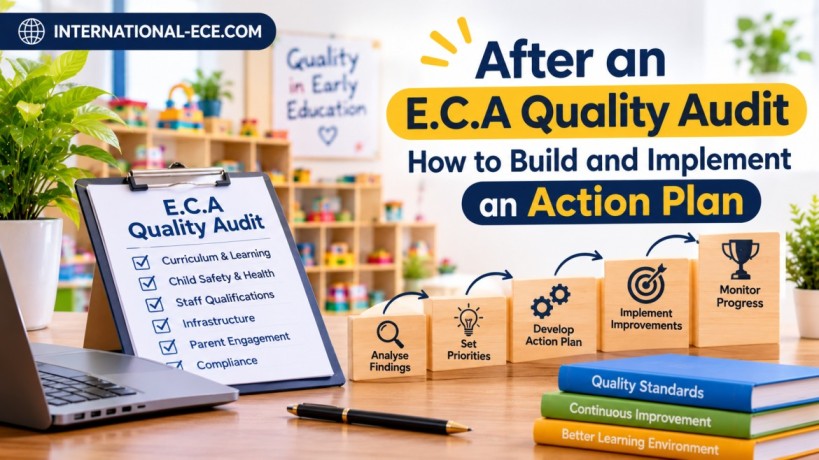
International Early Childhood Education runs ECA quality audits for NTT centres, schools, and hospitals, along with teacher training and awareness programs.
If you are preparing for certification, start with their quality audit and training support before you file your application. It reduces the number of audit findings significantly.
Why this matters to you: A pre-audit review is cheaper than a failed application and a delayed season.
Frequently Asked Questions (FAQ)
What is quality certification for NTT centres?
It is an independent audit that verifies your NTT institute meets set standards in faculty, syllabus, infrastructure, and student records. A certifying body reviews your documents, visits your centre, and issues a graded certificate with a validity period.
How long does the certification process take?
Usually 30 to 60 days from application to certificate. Document review takes 7–15 days, the on-site audit is scheduled within 2–3 weeks after that, and the final decision follows the audit report.
What is the cost of NTT centre certification in India?
Estimated total first-year cost is ₹25,000 to ₹1,10,000. This includes the application fee, audit fee, documentation, and any faculty upskilling or infrastructure fixes your centre needs before the visit.
Is quality certification mandatory for NTT centres?
It is not mandatory under a single central law, since NTT courses are largely offered by private institutes. However, it is strongly recommended and often expected by students, parents, and preschools hiring your trainees.
What documents are needed for NTT centre certification?
Institute registration certificate, PAN and GST details, premises proof, faculty qualifications, detailed syllabus, sample admission and fee formats, attendance and assessment records, classroom photographs, and enrolment data for the last 12 months.
How long is the certificate valid?
Most certifying bodies issue certificates valid for 1 to 3 years. Renewal usually requires an updated self-assessment, a fresh audit, and proof that earlier improvement recommendations were implemented.
Final Word
Quality certification is not a formality. It is the proof students look for before paying fees — and the reason preschools trust your trainees.
Want to start with a pre-certification quality audit? Fill this form and our team will review your NTT centre’s readiness before you apply.