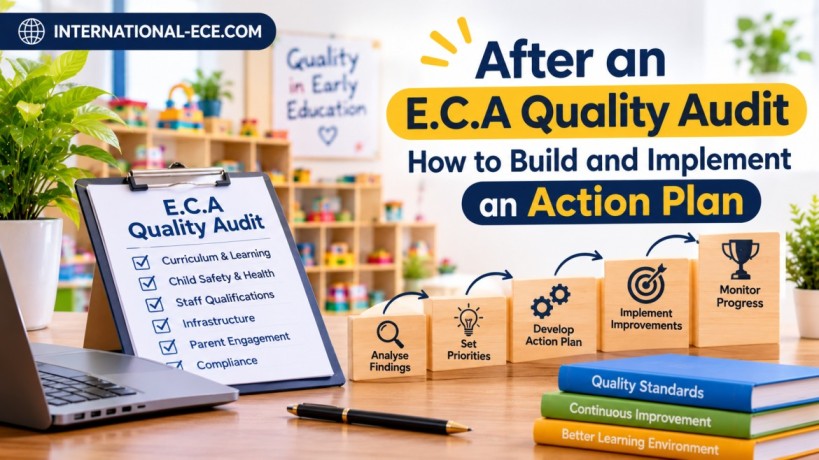
After an E.C.A Quality Audit: How to Build and Implement an Action Plan
Direct answer: After an ECA quality audit, an effective action plan starts by separating high-risk safety gaps from developmental improvement areas. Prioritise no more than five findings, convert each into a SMART goal with a named owner and a deadline, and sequence implementation across one academic term. The ECA audit certificate requires at least 80% compliance on self-audit parameters, and ECA offers post-audit training to help centres reach that threshold.[reference:0]
What the ECA Audit Actually Tells You
An ECA audit is not a report card. It is a diagnostic tool. The Early Childhood Association designed its Quality Audit Tool to help centres “elevate their quality” across structural and program dimensions—not to punish weaknesses.[reference:1]
Structural quality vs. process quality
ECA explicitly distinguishes between structural quality and program quality. Structural quality covers what you can see and count: staff-child ratios, physical infrastructure, safety equipment, qualifications, and records. Program quality covers what happens between teachers and children: interactions, teaching practices, curriculum delivery, and emotional climate.[reference:2]
Your audit report will flag gaps in both. The action plan must address both—but not at the same speed. Structural gaps are usually faster to fix. Process gaps require training, observation, and time.
| Audit dimension (ECA focus area) | Typical finding type | Action plan priority level |
|---|---|---|
| Health, Nutrition and Safety | Missing fire extinguisher, incomplete emergency contacts, unsafe outdoor surface | Immediate (within 7–14 days) |
| Staffing and Professional Development | Untrained staff, missing first-aid certification, no CPD records | High (within 30–45 days) |
| Learning Environment and Facilities | Inadequate play materials, poorly labelled storage, cramped activity zones | Medium (within one term) |
| Teaching Practices and Curriculum | Teacher-directed instruction, lack of play-based evidence, no observation notes | Medium–long term (one to two terms) |
| Involving Families and Child Assessment | No documented PTM record, informal assessment only | Medium (within one term) |
Why this matters to you: If you treat every finding as equally urgent, you will exhaust your staff and fix nothing properly. The ECA report is a menu, not a verdict.
Reading the audit report beyond the score
ECA certification requires 80% compliance on self-audit parameters. If your centre scored below 80%, ECA gives you time and training to reach the threshold before a re-audit, at no extra cost.[reference:3] That means the report is a roadmap to certification, not a rejection letter. Look for patterns: if three findings cluster under “Health, Nutrition and Safety,” the root cause may be a single missing staff member or an outdated daily checklist. Fix the system, not just the symptom.
Step 1 — Prioritise: Not Every Gap Needs Fixing on Day One
A play school with 25 findings cannot implement 25 changes in a month. The action plan must rank findings by risk and effort.
Risk-based prioritisation
Any finding that directly affects a child’s physical safety moves to the top. This is non-negotiable. NCPCR’s regulatory guidelines for private play schools emphasise safe and child-friendly infrastructure, adequate staff, and emergency preparedness as baseline requirements.[reference:4] If your ECA report flags a missing boundary wall, exposed wiring, or an incomplete emergency contact register, those items enter the action plan before curriculum enhancements.
Quick wins vs. long-term investments
Separate findings into two columns: quick wins (fixable within 2–4 weeks with existing resources) and long-term investments (requiring budget approval, hiring, or training). Quick wins build momentum and show staff that the audit leads to visible change. Long-term items need a phased plan, not a rushed purchase.
Why this matters to you: A parent touring your centre will notice a repaired outdoor surface or a displayed ECA certificate long before they notice a revised curriculum document.
Step 2 — Build the Action Plan with SMART Goals
The most common post-audit failure is a vague intention: “We will improve teacher training.” That sentence cannot be implemented, measured, or reviewed. Replace it with a SMART goal: Specific, Measurable, Attainable, Relevant, and Time-framed.[reference:5]
What a good ECA action plan looks like
| Audit finding | SMART goal (example) | Owner | Deadline | Success measure |
|---|---|---|---|---|
| Two staff lack current first-aid certification | By 30 April 2026, both identified staff complete a recognised paediatric first-aid course. | Centre Head | 30 April 2026 | Certificates filed; 100% staff coverage |
| No documented parent communication log | By 15 May 2026, every classroom maintains a daily WhatsApp report log for 100% of children. | Class Coordinator | 15 May 2026 | Four weeks of complete logs; parent acknowledgment |
| Outdoor play surface has loose gravel | By 30 April 2026, replace gravel with impact-absorbing rubber matting in the outdoor play zone. | Admin Manager | 30 April 2026 | Invoice + photo evidence; safety inspection sign-off |
| Teachers rely on worksheets for pre-writing | By end of Term 2 (July 2026), each teacher demonstrates two play-based pre-writing activities per week, documented in observation notes. | Academic Head | 31 July 2026 | Weekly activity logs; peer observation records |
Assigning responsibility and deadlines
Every action item needs one named owner. “The team will handle it” is not ownership. For a small standalone play school in Indore or Patna, the owner may be the centre head or the senior-most teacher. For a chain in Mumbai or Bengaluru, the owner may be a cluster coordinator. The owner reports progress fortnightly. The principal or director reviews monthly.
Why this matters to you: An action plan without names and dates is a wish list. ECA’s re-audit will look for evidence, not intentions.
Step 3 — Implement Without Disrupting the Classroom
Children notice when adults are stressed. Implementation must be sequenced so that classroom routines stay stable while improvements happen in the background.
Sequencing improvements across terms
Term 1: safety and compliance items (fire safety, records, staff certifications). Term 2: environment and materials (play corners, labelling, outdoor equipment). Term 3: teaching practice and family involvement (observation notes, PTM documentation, parent communication logs). This order protects children first, then improves the learning experience.
Staff training and buy-in
ECA offers workshops and training to help centres understand both structural and program quality after an audit.[reference:6] Use that support. But internal buy-in matters just as much. Explain why a change is happening, not just what is changing. A teacher who understands that daily observation notes reduce parent complaints is more likely to maintain the practice than one who is simply told to write more.
Why this matters to you: A rushed implementation that disrupts nap time or free play will generate parent complaints that outweigh the audit benefit.
Step 4 — Monitor, Review, and Prepare for Re-audit
An action plan is a living document. Review it every fortnight, not once a quarter.
Simple progress-tracking methods
Use a one-page tracker with three columns: Done, In progress, and Blocked. Update it in every staff meeting. Take photographs of physical improvements and file them by audit dimension. Keep training certificates, parent communication logs, and observation notes in a single “ECA evidence folder”—digital or physical. When the re-audit happens, you will not scramble.
What ECA looks for in a re-audit
ECA’s re-audit follows the same self-audit parameters. If your centre was below 80%, ECA gives time and training to reach the threshold before returning.[reference:7] The re-audit is not a trick. It is a confirmation that the systems you built are now running without extra effort. Demonstrate consistency, not one-time effort.
Why this matters to you: The ECA certificate is valid for three years for standalone centres, with a nominal renewal process thereafter.[reference:8] Build systems that outlast the audit, or you will repeat the same work in three years.
A Practical Action Plan Checklist
- ☐ Read the full ECA report, not just the overall score.
- ☐ Separate findings into “immediate safety risk” and “developmental improvement.”
- ☐ Select no more than five priority findings for the first action cycle.
- ☐ Convert each finding into a SMART goal with one named owner.
- ☐ Set a realistic deadline for each goal—safety items first, practice changes later.
- ☐ Identify quick wins that can be completed within 30 days.
- ☐ Sequence implementation across one academic term, not one week.
- ☐ Create a single evidence folder for certificates, photos, logs, and training records.
- ☐ Review progress every fortnight in staff meetings.
- ☐ Book ECA’s post-audit training support if process-quality gaps are significant.
Common Mistakes After an ECA Audit
- Fixing only what is easy. The safety findings are often the least glamorous and the most important.
- Writing the plan alone. Teachers who are not involved in planning will not implement with conviction.
- Setting deadlines that ignore the school calendar. Do not schedule major changes during admission season or annual-day preparation.
- Treating the 80% threshold as the goal. The threshold gets you certified. The systems get you a better school.
- Not documenting. If it is not written down or photographed, it did not happen—for ECA, for parents, or for your own team.