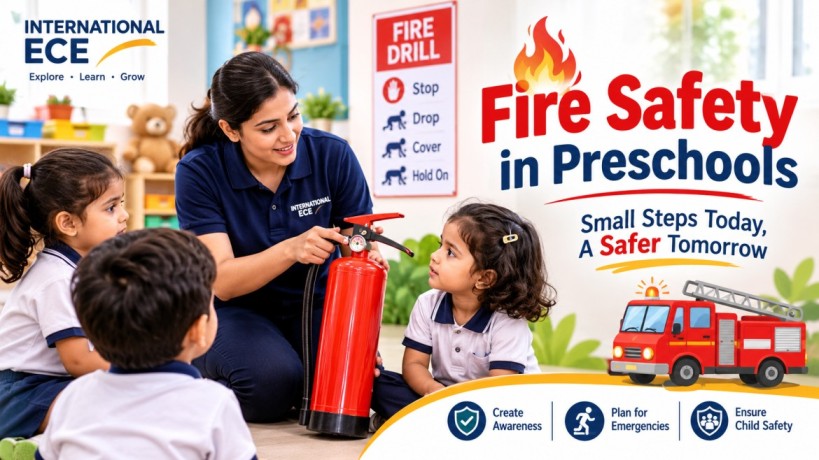
Fire Safety in Preschools: Emergency Exits, Drills and Equipment Checks
Direct answer: Fire safety in Indian preschools rests on three non-negotiable systems: at least two unobstructed emergency exits with self-glowing signage and emergency lighting, fire drills conducted at least once every six months as per NCPCR guidelines, and fire extinguishers inspected monthly with annual professional maintenance under IS 2190. Delhi recorded 64 fire incidents in educational institutions in 2024 alone—up from 47 in 2023—making these systems a legal and moral necessity, not a formality. (Sources: NCPCR school safety recommendations; IS 2190:2010; Delhi Fire Services data reported by Times of India, May 2025.)
Why Fire Safety in Indian Preschools Is Not Optional
Young children cannot evacuate themselves. A four-year-old does not know what a fire alarm means, cannot reach a door handle comfortably, and will likely freeze or hide under stress. Every fire safety decision in a preschool must start from that reality.
What the data shows
Fire incidents in Indian educational institutions are rising, not falling. Delhi Fire Services data shows 47 fire-related incidents in educational establishments in 2023, rising to 64 in 2024. Between January 2023 and May 2025, the city recorded 130 such incidents in schools and coaching centres combined. A fire official noted that educational institutions face “unique challenges” because of high occupancy density, and that evacuation is especially time-consuming in multi-storey buildings where large numbers of students must be escorted out safely.
Preschools are the most vulnerable segment within this category. Children aged 3–6 need adult assistance to evacuate. NDMA and NCPCR guidelines explicitly recognise this: students in playgroups and preschools must be assigned an adult or a buddy to assist them during evacuation[reference:2].
Why this matters to you: A fire safety plan designed for a primary school will not work for a preschool. The plan must account for children who cannot self-evacuate.
The legal framework you must know
Four overlapping frameworks govern fire safety in Indian preschools:
- NCPCR Regulatory Guidelines for Private Play Schools: Require fire safety measures as a condition of registration and mandate fire drills at least once every six months, with a Fire Mock Drill report maintained by the school[reference:3].
- NDMA School Safety Guidelines (2016): Require annual mock drills, installation of fire extinguishers, safety audits, and training of students and teachers in disaster preparedness[reference:4]. Schools must also consult the District Disaster Management Authority for drills[reference:5].
- National Building Code (NBC) 2016 / NBCS 2026: Classifies nursery and kindergarten schools under Group B (Educational Buildings) and prescribes specific fire and life safety provisions, including exit design, emergency lighting, and signage[reference:6].
- IS 2190:2010 (Reaffirmed 2020): Defines selection, installation, and maintenance requirements for first-aid fire extinguishers, including monthly inspections and annual professional maintenance[reference:7].
Why this matters to you: If a fire inspector or NCPCR registration officer visits, they will check against these documents. A verbal assurance that “we have extinguishers” is not compliance.
Emergency Exits: The First Line of Defence
An exit that children cannot reach, see, or open is not an exit. It is a wall with a sign. NBC 2026 requires every occupied area in a school to have easy access to at least two independent escape routes, with exit doors opening in the direction of travel and staircases protected from smoke ingress[reference:8]. For preschools, classrooms should preferably be located on lower floors to enable faster evacuation[reference:9].
Exit routes and the two-way rule
Every classroom, activity room, and nap area must have two independent ways out. “Independent” means they do not lead into the same dead-end corridor. If one route is blocked by fire or smoke, the other must remain usable. This is not a design preference—it is a life-safety requirement under NBC and NDMA guidelines.
Signage, emergency lighting and door direction
Exit routes must be marked with signage that remains visible during a power failure. NCPCR and NBC guidance require self-glowing or radium-tape exit signage conforming to IS 12349:1988, and emergency lighting powered from an independent source to illuminate corridors, staircases, and exits[reference:10][reference:11]. Telangana Fire Services specifies battery backup of at least 1.5 to 2 hours for emergency lighting in escape routes[reference:12]. Exit doors must open outward, in the direction of travel, and remain free from obstruction at all times[reference:13].
Keeping exits clear (and why it fails)
The most common exit failure in Indian preschools is not structural. It is housekeeping. Stored furniture, stacked nap cots, festival decorations, or a temporarily parked scooter can block a corridor that was compliant during the last inspection. Fire officials specifically flag poor housekeeping and inadequate maintenance of fire protection systems as recurring causes of school fire incidents[reference:14].
Why this matters to you: A monthly walk-through of every exit route, logged with a signature, is the cheapest fire safety measure you will ever implement.
Fire Drills: Frequency, Practice and Records
A drill is not a performance for parents. It is a rehearsal for the worst day. NCPCR recommends that schools conduct fire mock drills at least once every six months and maintain a Fire Mock Drill report for inspection[reference:15]. NDMA’s School Safety Guidelines additionally call for annual mock drills as part of a broader safety audit cycle[reference:16]. Flamekite’s review of Indian fire safety training requirements confirms that schools are expected to drill every six months under NDMA’s 2016 policy[reference:17].
How often should Indian preschools conduct fire drills?
| Source | Drill frequency | Preschool-specific note |
|---|---|---|
| NCPCR play school guidelines | At least once every 6 months | Drill report must be maintained |
| NDMA School Safety Guidelines (2016) | Annual mock drills as part of safety audit | Coordinate with District Disaster Management Authority |
| Best practice for preschools | Every term (3–4 times per year) | Young children need repetition to build muscle memory |
Making drills realistic for children aged 3–6
A loud siren and shouting adults will terrify a three-year-old. The drill must teach the behaviour without causing lasting fear. NDMA guidance for preschools recommends assigning an adult or a buddy to every child who needs assistance[reference:18]. Use a calm, practised routine: a specific sound or song, a teacher-led line, a designated assembly point, and a headcount. Practise “stop, drop and roll” in a playful, non-threatening way. The goal is automatic response, not panic.
What to record after every drill
NCPCR auditors and fire inspectors look for documentation, not assurances. Maintain a drill register with: date and time, number of children and staff who participated, time taken to evacuate, any issues identified (blocked exit, child who hid, staff who did not hear the alarm), and corrective actions taken. The register should be signed by the centre head[reference:19]. Keep records on the premises—fire authorities may ask for them during inspection[reference:20].
Why this matters to you: A drill without a written record is invisible to regulators, insurers, and parents who ask “when was your last fire drill?”
Fire Safety Equipment Checks: Extinguishers, Alarms and More
Equipment that is installed but not maintained is worse than no equipment—it creates false confidence. IS 2190:2010 sets clear maintenance levels for fire extinguishers, and NBC 2026 requires broader fire protection systems for educational occupancies.
Choosing the right extinguishers for a preschool
Preschools face three main fire risks: electrical fires (wiring, panels, appliances), kitchen fires (cooking oil, LPG), and Class A fires (paper, cloth, teaching materials). The National Safety Council of India recommends ABC extinguishers in classrooms and corridors, and CO₂ extinguishers in electrical rooms and computer areas[reference:21]. Kitchens require a fire blanket for pan and oil fires, plus an ABC extinguisher for other kitchen risks and ideally a gas detector for LPG leaks[reference:22]. DDA circulars specify one CO₂ (2.5 kg) or ABC extinguisher per 300 sqm of covered area, with a minimum of two per floor[reference:23].
Inspection and maintenance schedule under IS 2190
| Maintenance level | Frequency | Who performs it | What to check |
|---|---|---|---|
| Monthly inspection | Every month | School safety team / user | Pressure gauge, safety pin, seal, visibility, accessibility; log entries mandatory |
| Quarterly / half-yearly maintenance | Every 3–6 months | Trained technician | Weight, leakage, nozzle condition, hose integrity |
| Annual maintenance / refilling | Once a year | Authorised agency | Complete discharge, refill, pressure test |
| Hydraulic pressure test | Every 3 years (dry powder); every 5 years (CO₂) | Authorised agency | Pressure vessel integrity |
Source: IS 2190:2010 (Reaffirmed 2020), as summarised by fire safety practitioners[reference:24].
Maintain a Fire Extinguisher Register with serial numbers, locations, inspection dates, refill dates, test dates, and signatures of the responsible person[reference:25]. Defective or expired extinguishers must be tagged “Not in Use” and replaced immediately[reference:26].
Alarms, detectors and kitchen-specific equipment
Extinguishers alone are not enough. Schools should have smoke detectors in electrical panels, server rooms, and storage areas, plus a fire alarm system with manual call points that staff can trigger[reference:27][reference:28]. Kitchens should have a fire blanket and, ideally, an automatic kitchen hood suppression system if cooking is done on-site[reference:29]. Emergency lighting and exit signage must be tested monthly alongside extinguishers—a sign that does not glow in the dark is not a sign.
Why this matters to you: An inspector will ask for your maintenance register before they ask how many extinguishers you have. The register is the proof.
A Practical Fire Safety Checklist for Preschool Administrators
- ☐ At least two independent, unobstructed exits from every classroom and activity area.
- ☐ Exit doors open outward and are never locked or blocked during school hours.
- ☐ Self-glowing exit signage on every escape route (IS 12349:1988 compliant).
- ☐ Emergency lighting with battery backup tested monthly.
- ☐ ABC extinguishers in classrooms and corridors; CO₂ extinguishers in electrical rooms.
- ☐ Fire blanket in the kitchen; gas detector for LPG if cooking on-site.
- ☐ Monthly extinguisher inspection logged with signature.
- ☐ Annual professional refill and pressure test completed and documented.
- ☐ Fire drill conducted at least every six months, with a written report.
- ☐ Every child aged 3–6 assigned an adult or buddy for evacuation assistance.
- ☐ Assembly point marked and known to all staff.
- ☐ Emergency numbers (fire station, 101/112) displayed at the entrance and office.
- ☐ Valid fire NOC or fire safety certificate from the local fire department.
- ☐ Electrical audit completed within the last 12 months.
Common Fire Safety Failures in Indian Preschools
- Exits blocked by “temporary” storage. The most common and most dangerous failure. A corridor is not a storeroom.
- Extinguishers installed but never inspected. A pressure gauge in the red zone means the extinguisher will not work.
- Drills done once for the inspector, never again. Children forget. Staff forget. Muscle memory requires repetition.
- No adult assigned to children who cannot self-evacuate. Preschool evacuation is not a “follow the teacher” exercise. It is a hand-holding exercise.
- Signage that is not visible in the dark. Ordinary printed signs fail during power cuts. Self-glowing signage is required for a reason.
- No fire NOC or expired certificate. NCPCR registration and local fire authority compliance both depend on valid documentation.