
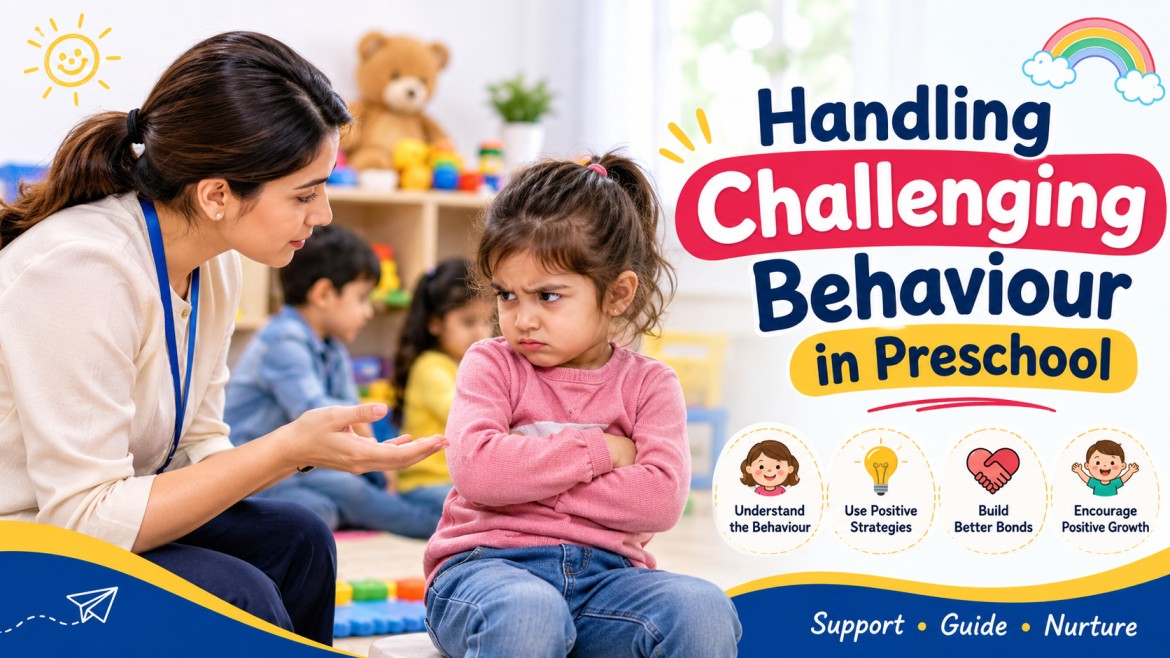
Handling Challenging Behaviour in Preschool: A Step-by-Step Teacher Guide (2027)
Challenging behaviour in preschool is communication, not defiance. A calm teacher, a safe environment, and a consistent seven-step response reduce escalation and teach the child a better way to ask for what they need.
This guide gives Indian preschool and Anganwadi teachers a practical, legally compliant sequence for the hardest moments in the classroom. It aligns with NEP 2020, the NCF for the Foundational Stage 2022, and India’s child-protection law.
Why Challenging Behaviour Is Rising in Indian Preschools—and What NEP 2020 Says
Behaviour difficulties affect an estimated 10%–15% of school-aged children in India. In a Dharwad district study of 334 preschool children, 47% fell in the “borderline” range and 13.8% in the “clinical” range on the ASEBA Child Behavior Checklist. A separate urban study found that teachers identified 36% of schoolchildren as having significant behaviour problems.
These numbers are not a failure of children. They reflect a system under pressure: large class sizes, untrained staff, and few behaviour-support resources.
NEP 2020 and the National Curriculum Framework for Foundational Stage 2022 take a clear position. Behaviour is “the unspoken language through which children act out feelings and thoughts”—not evidence that a child is “bad” or wants to “trouble” the teacher. The policy asks teachers to guide, not punish.
Why this matters to you: You are not expected to “control” children. You are expected to understand what the behaviour is trying to say, keep everyone safe, and teach a replacement skill.
What Counts as “Challenging Behaviour” in an Indian Classroom?
The NCF-FS 2022 lists four categories of difficult behaviour that harm children or disrupt the classroom:
- Aggressive behaviour: hitting, biting, pinching, throwing objects.
- Antisocial behaviour: inappropriate language, name-calling, refusing to share.
- Disruptive behaviour: running around, shouting, tearing books, breaking toys.
- Inappropriate expression: excessive crying, pouting, whining.
Indian preschool teachers also report defiance, impulsivity, separation anxiety, difficulty sharing, attention-seeking, and social withdrawal as common patterns.
Why this matters to you: Naming the behaviour accurately helps you choose the right response. A biting child and a crying child may need different first steps.
The Legal Line: What Teachers Can and Cannot Do
India’s legal architecture is unambiguous. Corporal punishment is prohibited under Section 17 of the Right to Education Act, 2009. The Juvenile Justice Act, 2015, and NCPCR guidelines endorse nonviolent, dignity-respecting behaviour management. The NCF-FS states that discipline “does not mean punishing,” and physical punishment is never acceptable.
Why this matters to you: A teacher who shouts, shames, or physically punishes a child is not only harming the child—she is exposing herself and the school to legal risk. Positive guidance is the only defensible path.
Step 1: Regulate Yourself Before You Regulate the Child
Children read adult tone, posture, and speed before they process words. A rushed or angry response adds pressure to an already overwhelmed child.
Before you move toward the child, take one slow breath. Lower your voice. Slow your walk. Keep your hands visible and relaxed.
Calm does not mean passive. It means controlled, clear, and emotionally available.
Why this matters to you: Your nervous system is the first behaviour-management tool in the room. If you escalate, the child escalates. If you stay steady, the child borrows your steadiness.
Step 2: Make Safety the First Priority—Every Time
If the child is kicking, hitting, throwing objects, or moving toward something unsafe, quietly create space. Move hard or breakable items away. Guide other children to another activity if needed.
Use one short boundary: “I will not let you hit. I am here to keep everyone safe.”
Do not turn the moment into a public lecture. Do not demand an apology while the child is still dysregulated.
Why this matters to you: Safety is non-negotiable. But safety is protected through calm boundaries, not through force or humiliation.
Step 3: Use Fewer Words at the Peak of the Storm
When a child is highly distressed, long explanations do not land. Reasoning, repeated questions, threats, and demands for eye contact make things worse.
Use short phrases:
- “You are safe.”
- “I am here.”
- “That was hard.”
- “We can talk when your body is calmer.”
Then wait. Silence is not neglect. Silence is space for the child’s nervous system to settle.
Why this matters to you: Every extra sentence you speak during a meltdown is another demand on a brain that cannot process demands. Fewer words mean faster recovery.
Step 4: Acknowledge the Feeling Without Giving Up the Boundary
Validation and limits can exist together. A teacher can say: “You are angry because you wanted another turn. It is okay to feel angry. The blocks still need to be packed away.”
This does two things at once. It tells the child that their feeling is acceptable. It also tells them that the classroom expectation has not changed.
Why this matters to you: Children who feel understood calm down faster than children who feel dismissed. But children who are given no boundary learn that meltdowns work. You need both halves.
Step 5: Offer a “Time-In,” Not a Time-Out
Traditional time-out isolates the child. NCPCR and child-protection guidelines recommend “time-in” instead: the child is brought closer to the teacher or a trusted adult for support and reflection, rather than being excluded
In practice: sit near the child. Offer a glass of water. Offer a cushion or a soft toy. Stay quiet. When the child is calm, briefly reflect: “Your body was very angry. What could you do next time instead of hitting?”
If the school has a calm-down corner, make it a comfort corner—not a punishment zone. The difference is entirely in your tone and your framing.
Why this matters to you: Time-in keeps the relationship intact while teaching regulation. Time-out teaches the child that big feelings lead to abandonment.
Step 6: Teach the Missing Skill Tomorrow
Behaviour is a gap in skills, not a character flaw. The child who hits does not yet know how to ask for a turn. The child who screams does not yet know how to say “I’m frustrated.”
Tomorrow—when everyone is calm—teach the replacement behaviour explicitly. Positive behaviour support research recommends systematically teaching children what to do instead: asking for help, using emotion words, waiting for a turn, or using a calming routine.
Use a two-minute mini-lesson during circle time. Role-play the scenario. Praise the child immediately when they use the new skill, even partially.
Why this matters to you: If you only respond to the crisis, you will be responding to the same crisis every day. The real work happens the next morning.
Step 7: Document, Communicate, and Escalate Carefully
After the incident, write a short note: what happened before the behaviour, what the behaviour was, what you did, and what happened after. This is the ABC model—Antecedent, Behaviour, Consequence—used in behaviour support.
If the behaviour is frequent, intense, or dangerous, speak to the parent calmly and without blame. Share the note. Ask what happens at home. If the pattern persists, recommend a developmental or behavioural assessment through the school counsellor or a child-development centre.
Early behavioural support produces measurable improvement in 70%–80% of children when implemented consistently over 12–20 weeks.
Why this matters to you: A written record protects the child, protects you, and helps everyone see patterns instead of isolated bad days.
Table: Common Behaviours, What They Usually Mean, and the First Step
| Behaviour | What It Often Means | Your First Step |
|---|---|---|
| Hitting or biting | “I want that toy and I have no other way to get it.” | Block the hit calmly. State the boundary. Teach “my turn, your turn” tomorrow. |
| Falling on the floor, screaming | “I am overwhelmed and I cannot process this transition.” | Reduce words. Stay nearby. Offer water or a quiet corner. Reflect later. |
| Refusing to sit in circle time | “I need to move, or I need a role.” | Give a job: line leader, book holder, light switcher. |
| Crying when parent leaves | “I am scared and I do not trust that you will come back.” | Short goodbye ritual. Consistent comfort object. Predictable return time. |
| Snatching toys, refusing to share | “Sharing is a skill I have not learned yet.” | Model turn-taking. Use a visual timer. Praise the first attempt. |
| Name-calling or inappropriate language | “I am testing boundaries or repeating what I hear.” | Do not over-react. State the norm. Teach an alternative phrase. |
Why this matters to you: The same behaviour can have different causes. The table gives you a starting hypothesis, not a label.
Checklist: A 10-Minute Daily Behaviour-Prevention Routine
Most challenging behaviour is preventable. Use this checklist before the first child walks in.
- ☐ Check the environment. Remove breakable or throwable objects from reach. Clear the floor.
- ☐ Post the routine. Use pictures for children who cannot read. Point to the next activity.
- ☐ Plan transitions. Use a song, a five-minute warning, or a sand timer before every change.
- ☐ Prepare filler games. Keep three quick games ready for waiting time—lunch, van, turn-taking
- ☐ Identify one child who needs a job today. Give responsibility before disruption begins.
- ☐ Check your own state. Are you rushed, hungry, or frustrated? Take one breath before the door opens.
- ☐ Review yesterday’s incident note. What was the trigger? Can you remove it today?
- ☐ Plan one specific praise for the child who struggled yesterday. Catch them doing it right.
Why this matters to you: Ten minutes of prevention saves thirty minutes of crisis management. The calmest classrooms are designed, not lucky.
Frequently Asked Questions
1. Is time-out allowed in Indian preschools?
Time-out is not illegal, but NCPCR and child-protection guidelines recommend non-punitive alternatives like time-in. Isolation or shame-based exclusion is risky and not aligned with NCF-FS. Use a calm-down corner as comfort, not punishment
2. What if the child’s parents say “hit back” or “slap him, he’ll listen”?
Explain calmly that physical punishment is prohibited under the RTE Act, 2009, and NCF-FS 2022. Share the classroom guidance approach. If the parent insists, involve the school head. Your legal obligation is to protect the child.
3. How do I handle behaviour in a class of 35+ children with no helper?
Use whole-class prevention first: routines, songs, jobs, and filler games. For individual incidents, use proximity—move near the child, lower your voice, and give one short instruction. Do not try to counsel a child while 34 others are unsupervised.
4. When should I refer a child for professional help?
Refer when behaviour is frequent, intense, lasts beyond the typical age range, or harms the child or others. Signs include tantrums longer than 20 minutes regularly, severe aggression, and persistent refusal to follow simple routines. Speak to the parent and the school counsellor.
5. Does positive guidance mean I never say “no”?
No. Boundaries are essential. Positive guidance means stating the boundary without shame, violence, or humiliation. “I will not let you hit” is a boundary. “You are a bad boy” is a label. The first teaches; the second damages.
6. How long does it take to see change?
With consistent replacement-skill teaching and a stable routine, most children show measurable improvement within 4–8 weeks. Clinical behaviour support programmes report 70%–80% improvement over 12–20 weeks. Consistency matters more than intensity.