How to Teach Children Gratitude, Empathy and Sharing (2027 Guide)
Children are not born grateful, empathetic or generous. These are developmental skills that grow through modelling, practice and consistent routines In 2027, with Indian families busier than ever, teaching these three values at home and in early childhood settings has become both harder and more important.
This guide gives you age-wise, research-backed strategies — no fluff, no guilt. Whether you are a parent in Mumbai, a preschool teacher in Indore, or an early educator in Patna, these steps work in real Indian homes and classrooms.
Why Gratitude, Empathy and Sharing Matter More Than Ever in 2027
India’s early childhood landscape is shifting. NEP 2020 and NCF-FS 2022 now explicitly include “Reflection & Gratitude” and “Social, Emotional & Character Development” as core developmental areas. Schools are being asked to nurture compassionate, culturally rooted children — not just academic performers.
At the same time, research shows that children who lack empathy by age four are three times more likely to face social difficulties throughout school. Gratitude practice is linked to better sleep, stronger relationships and lower anxiety in children. Sharing and turn-taking are foundational for every friendship and classroom interaction a child will ever have.
The Indian Context: Why This Is Urgent Now
Indian parents often confuse gratitude with good manners. Saying “thank you” is a social script; gratitude is a psychological state. In a competitive, comparison-heavy environment, children can easily drift toward entitlement rather than appreciation. The good news: these skills are teachable, and the early years are the best window.
Why this matters to you: The habits you build in 2027 will shape how your child relates to people, money and community for decades.
What Gratitude Really Means (It’s Not Just “Thank You”)
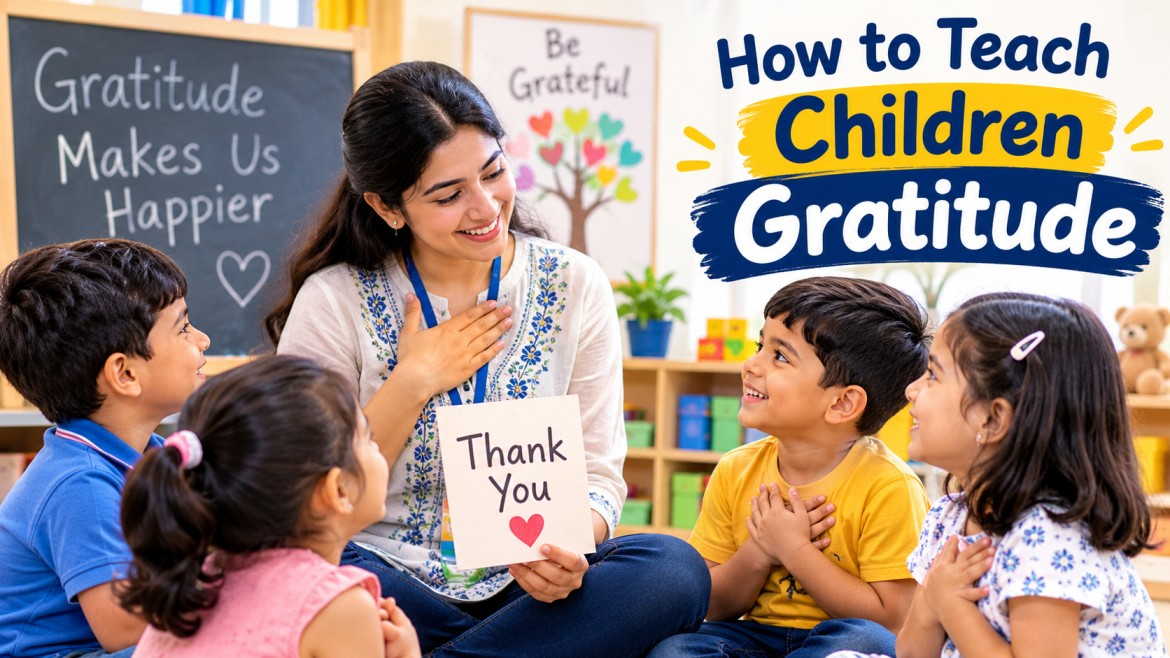
Developmental psychologist Andrea Hussong frames genuine gratitude in four connected steps. Skip any step and you get a hollow “thanks, Mum.”
The Four Steps of Genuine Gratitude
- Notice — the child recognises something good (a meal, a ride, help with homework).
- Think — the child understands why it happened and who made it happen.
- Feel — the child experiences a warm emotion connected to that awareness.
- Act — the child expresses thanks or returns the kindness in some way.
Most Indian parents stop at step one (“say thank you”). The real work is in steps two to four — helping children connect the good thing to the person and effort behind it.
Why this matters to you: When your child understands the effort behind a meal, a school bag packed on time, or a grandparent’s sacrifice, gratitude stops being a rule and becomes a relationship.
How Empathy Develops — And How to Support It at Every Age
Empathy is not a personality trait some children have and others don’t. It is a developmental skill that unfolds in predictable stages. There are two parts: emotional empathy (feeling what others feel) and cognitive empathy (understanding what others might be thinking). Emotional empathy begins in infancy; cognitive empathy fully develops around age six or seven.
Age-by-Age Empathy Milestones
| Age | What Empathy Looks Like | What You Can Do |
|---|---|---|
| 6–12 months | Emotional contagion — baby cries when another baby cries | Stay calm and responsive; name feelings softly. |
| 18–24 months | Basic helping behaviours; offers a toy to a distressed adult | Notice and narrate the caring act. |
| 2–3 years | Genuine concern; tries to help in concrete way | Use simple emotion words: “She is sad. You helped her.” |
| 3–4 years | Beginning perspective-taking; understands others may feel differently | Read stories and pause: “How does the rabbit feel?” |
| 5–7 years | Can identify emotions in pictures and real situations | Role-play simple conflicts; ask “What might he be thinking?” |
What Works (and What Backfires)
What works: naming emotions dozens of times a day, reading and discussing stories with rich characters, coaching in the moment of conflict (“Look at her face. What might she be feeling?”), and modelling repair when you yourself were harsh.
What backfires: lecturing about kindness, forcing apologies before the child feels anything, and shaming with “How would you like it if…” These shut down the very empathy you are trying to build.
Why this matters to you: A child who can name and understand feelings is far more likely to share, comfort and cooperate — without you having to police every interaction.
How to Teach Sharing Without Forcing It
Sharing is a big ask for little people. Toddlers and preschoolers are still learning to navigate emotions, express themselves and connect with others Forcing sharing before a child is developmentally ready creates resentment, not generosity.
Why Toddlers Struggle with Sharing
Between ages one and three, children are building a sense of ownership. “Mine” is not selfishness — it is a healthy developmental stage. Sharing becomes meaningful only when the child feels secure about their belongings first.
Turn-Taking Strategies That Actually Work
- Start with side-by-side play. Let children build or draw next to each other with their own materials before expecting cooperation.
- Narrate sharing moments. “Gordon is using the red truck. When he’s finished, you can have a turn.” This models respectful language
- Use a visual timer. A sand timer or kitchen timer gives children concrete reassurance that their turn is coming.
- Celebrate small wins. “I saw you pass the ball to Yatra. That was thoughtful.” Acknowledgment grows the behaviour.
- Read books about sharing. Stories let children see familiar challenges through a character’s eyes.
Why this matters to you: Children who learn to wait and take turns in 2027 will handle classroom queues, sibling conflicts and friendships with far less friction.
Age-Wise Activities: Gratitude, Empathy and Sharing in Action (2027)
Ages 2–3: Noticing and Naming
- Gratitude: At bedtime, say one thing you are thankful for. Your child hears the sequence acted out.
- Empathy: Name feelings in real time: “You feel happy. Papa feels tired.”
- Sharing: Practise side-by-side play with duplicate toys; narrate turn-taking.
Ages 4–5: Stories and Simple Actions
- Gratitude: Create a “gratitude jar” or gratitude tree. Add one note or leaf each day.
- Empathy: Pause picture books and ask, “What might the character be feeling? What could make them feel better?
- Sharing: Use a visual timer for turns with a favourite toy.
Ages 6–8: Perspective and Responsibility
- Gratitude: Write a thank-you note or draw a picture for a grandparent, security guard or cleaner — someone whose effort often goes unnoticed.
- Empathy: Replay a conflict scene: “What might your friend have been thinking?”
- Sharing: Involve your child in choosing old toys or clothes to donate. Connect gratitude to responsibility.
The Parent’s Role: Modelling Matters More Than Lecturing
Children learn attitudes by watching, not by listening to speeches. When you say “Thank you for helping me clean up” out loud, your child sees gratitude in action. When you repair after losing your temper — “I was frustrated. That wasn’t fair to you. I’m sorry” — you teach empathy more powerfully than any worksheet
Simple Daily Habits That Build Character
- Morning or bedtime gratitude: Each person shares one specific thing they are thankful for
- Narrate appreciation at meals: “I appreciated that Baba made dinner tonight; I was tired.”
- Notice caring moments: Praise the child’s character, not just the behaviour — “You are a caring person”.
- Keep complaints in check: Avoid excessive complaining about money or work in front of children; it shapes their default lens.
Why this matters to you: You do not need a curriculum to teach character. You need consistency. Five minutes a day beats a one-hour lecture once a month.
How international-ece.com Approaches This in Early Childhood
At international-ece.com, we believe social-emotional learning is not an add-on — it is the foundation. Our approach aligns with India’s NCF-FS 2022 and NEP 2020 frameworks, which explicitly include gratitude, empathy and social interaction as core developmental areas.
In our early childhood programmes, educators narrate appreciation during snack time, use puppets and stories to explore feelings, and coach children through turn-taking in real time. We do not force apologies; we help children understand the impact of their actions. We do not drill “thank you”; we help children notice the effort behind the kindness.
Aligning with NCF-FS 2022 and NEP 2020
The National Curriculum Framework for Foundational Stage (NCF-FS 2022) places “Social, Emotional & Character Development” alongside literacy and numeracy. It also includes “Reflection & Gratitude” as a daily experience for young learners. Our programmes are designed around these priorities, so children build character while they build skills.
If you are looking for an early childhood partner that treats gratitude, empathy and sharing as seriously as reading and numbers, explore our programmes or speak to our team.
A Simple Weekly Checklist for Parents and Educators
- ☐ We named at least one emotion out loud each day.
- ☐ We shared one specific gratitude at a meal or bedtime.
- ☐ We read one story and discussed a character’s feelings.
- ☐ We noticed and praised one caring or sharing act.
- ☐ We modelled repair after a conflict (“I’m sorry I shouted”).
- ☐ We used a timer or turn-taking tool during play.
- ☐ We involved the child in one small act of giving or helping.
Final Thoughts: Start Small, Stay Consistent
You do not need perfect children. You need consistent, warm repetition. Pick one activity from this guide and do it for seven days. Then add another. By 2027’s end, gratitude, empathy and sharing will feel less like rules you enforce and more like habits your family lives.
The early years are short. The character you nurture now will outlast every academic milestone.
Frequently Asked Questions
1. At what age can children truly understand gratitude?
The capacity for gratitude begins emerging around age two and develops into the late teens. At ages 2–5, children can notice good things and thank the person present, but the “why” is still forming. Modelling does most of the work at this stage.
2. My child refuses to share. Is that normal?
Yes. Toddlers and preschoolers are still learning to navigate ownership and emotions. Forcing sharing before the child is ready creates resentment. Start with side-by-side play, use visual timers and narrate turn-taking respectfully.
3. How do I teach empathy to a child who seems “cold”?
Empathy is a skill, not a fixed trait. Focus first on emotional vocabulary — naming feelings in your child and others dozens of times a day. Then use stories and role-play to practise perspective-taking. Avoid shaming; it shuts down empathy rather than building it.
4. Should I force my child to say “sorry”?
Forced apologies teach children to perform remorse, not feel it. Instead, coach in the moment: “Look at her face. What might she be feeling? What could you do to help?” Repair and understanding matter more than the word “sorry”.
5. How can schools support gratitude and empathy alongside academics?
Schools can integrate social-emotional learning into daily routines — morning circles, story discussions, cooperative play and reflection time. India’s NCF-FS 2022 explicitly includes “Reflection & Gratitude” and “Social, Emotional & Character Development” as core areas
6. What is one simple daily habit that makes the biggest difference?
A one-minute gratitude share at bedtime or dinner. Each person names one specific thing they are thankful for and why. This builds the four-step gratitude sequence — notice, think, feel and act — over time