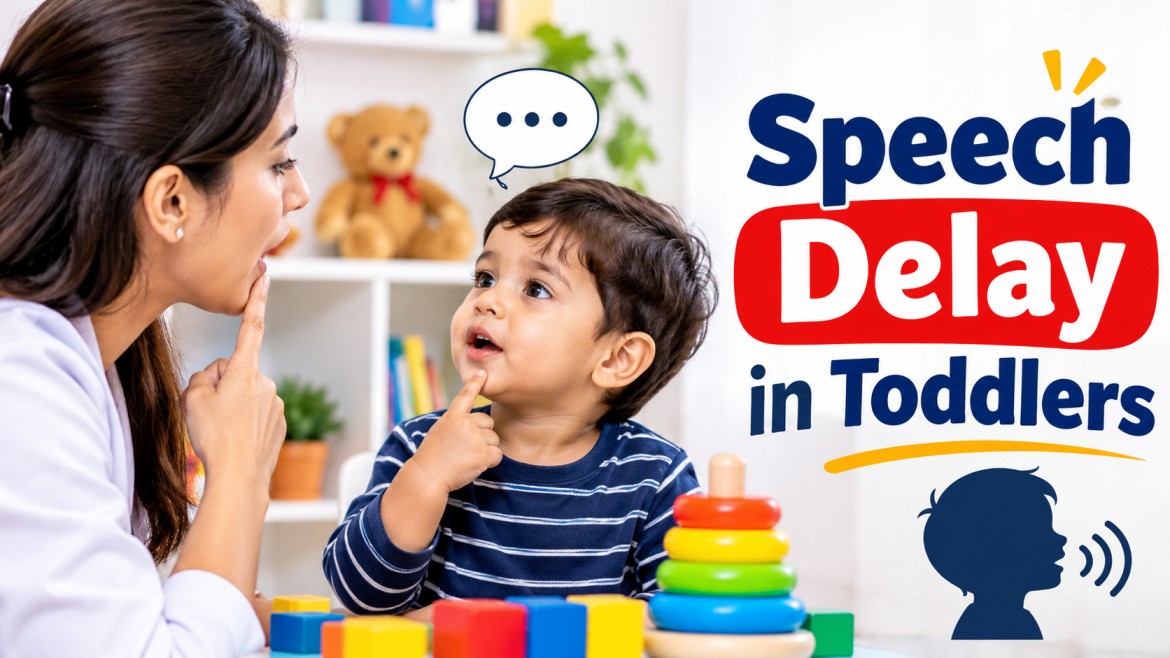
Speech Delay in Toddlers: When to Wait and When to Seek Help (2027 Guide)
if your toddler is still communicating—pointing, gesturing, understanding simple instructions and adding new words steadily. Seek help immediately if there are no words by 18 months, no two-word phrases by 24 months, loss of any previously gained speech, or limited social connection. In India, free screening and early intervention are available through RBSK and District Early Intervention Centres (DEICs).
In 2027, Indian parents are bombarded with conflicting advice. Grandparents say wait. The internet says panic. Your paediatrician sees the child for ten minutes and says they look fine. This guide separates genuine red flags from noise—with research, Indian policy context and a clear action plan.
The Direct Answer: Wait Only If Communication Is Growing
The word “wait” is dangerously vague. Waiting is safe only when the child is communicating, even if not with many words. Waiting is risky when the child is disconnecting—not pointing, not responding to name, not following simple instructions, not making eye contact.
A true late talker still tries to communicate. They understand what you say, use gestures, enjoy interaction and make steady progress. A child with a broader delay may have limited connection alongside limited communication.
What “Wait and See” Actually Means
“Wait and see” should mean: monitor for a defined period (usually 8–12 weeks), provide rich language stimulation at home, and review. It should not mean: do nothing for a year and hope. The early years are not magic, but the window for language development is real. A careful look today is far less costly than discovering at age four that two years of early intervention time were lost.
Why this matters to you: The difference between safe waiting and risky waiting is observable. This guide gives you the signs.
Speech vs Language: What the Terms Actually Mean
Professionals separate communication into two areas. Speech is how your child says sounds and words—pronunciation, clarity, fluency. Language is how your child understands and uses words to communicate—vocabulary, combining words, following directions, using gestures.
Expressive vs Receptive Language
Expressive language is using words and sentences. Receptive language is understanding words and directions. Many toddlers experience a combination of both expressive and receptive delays. A child may understand everything but speak very little (expressive delay), or may struggle to understand simple instructions even though they speak clearly (receptive delay).
Why this matters to you: Knowing which area is affected helps you ask the right questions and advocate for the right support.
Late Talker vs Speech Delay: What’s the Difference?
A late talker is typically a toddler aged 18–30 months who is slower to start using spoken words but is otherwise developing as expected. Late talkers usually have good understanding, strong play skills, typical social interest, use gestures (pointing, waving, showing) and make steady progress, even if slow.
A speech or language delay means communication skills are developing more slowly than expected, and the gap may be significant or persistent. A delay can affect expressive language, receptive language, speech clarity or social communication. About 50–70% of late talkers catch up, but 30–50% continue to have language difficulties later.
The “Connected but Quiet” Profile
A common profile is a two-year-old who understands a lot, follows simple directions, communicates with gestures or sounds, and connects well socially—but has fewer spoken words than expected. This child may still benefit from support, but the overall communication profile looks different from a child who is also disconnecting socially.
Why this matters to you: “Quiet but connected” is a safer profile than “limited connection plus limited communication.” The second needs immediate evaluation.
Speech Delay Red Flags: When NOT to Wait
Every child develops at their own pace. But certain signs are developmental red flags that should prompt an evaluation—not another six months of waiting.
Age-by-Age Red Flags (12–36 Months)
| Age | Red Flag | Source |
|---|---|---|
| 6 months | No vocal sounds (cooing, babbling) | Times of India / Paediatric experts |
| 9 months | No babbling | Times of India / Paediatric experts |
| 12 months | No gestures (pointing, waving); not responding to name | Times of India / Paediatric experts |
| 16–18 months | No meaningful words; fewer than 10 words | IAP-aligned guidance / RASYA Clinic |
| 18 months | No words at all | Times of India / The Carely |
| 24 months | No two-word phrases (e.g., “more milk,” “papa go”); fewer than 50 words | Times of India / Cadabam’s CDC |
| Any age | Loss of previously acquired speech or skills (regression) | Times of India / The Carely |
The Regression Rule
Regression is always a strong sign that a child needs immediate evaluation. If a child who was saying words stops talking, or loses skills they previously had, do not wait. This is not a “phase.” It requires a professional assessment.
Why this matters to you: These are not vague worries. They are measurable, observable signs that professionals use to decide whether to act.
Typical Milestones vs Delay: A Comparison Table
Milestone charts are blunt tools—children do not develop in straight lines. But broad ranges give you a useful reference for when to monitor and when to act.
| Age | Typical Milestone | Potential Sign of Delay |
|---|---|---|
| 12 months | First meaningful words (mama, dada, ball); babbling with varied sounds; responds to name | No babbling, no gestures, does not respond to name |
| 18 months | 5–20 meaningful words; follows simple one-step directions; points to show interest | No words; rarely attempts to communicate needs; does not follow simple instructions |
| 24 months | 50+ words; begins combining two words; understands simple questions | Fewer than 50 words; no two-word phrases; over-reliance on gestures; speech mostly unintelligible to parents |
| 36 months | Short sentences (3+ words); understood by familiar listeners; communicates for different reasons | Not using short sentences; difficult for even family to understand; limited social communication |
What “Normal” Looks Like in Indian Homes
Indian children often grow up in multilingual environments. A toddler in Mumbai may hear Marathi, Hindi and English; a child in Indore may hear Hindi and English; a child in Patna may hear Bhojpuri and Hindi. The number of words a child says in any one language may be smaller, even though total language exposure is rich. Bilingualism does not cause speech delay. However, it can make delay harder to spot in the early years—which is why careful observation matters.
Why this matters to you: Comparing your child to a monolingual milestone chart can create unnecessary panic. Comparing them to their own trajectory is more useful.
What Causes Speech Delay in Indian Toddlers?
Speech delay is rarely caused by one thing. A 2025 Indian study identified multiple risk factors, including not being breastfed within one hour of birth, NICU admission, neonatal hyperbilirubinemia, low maternal education, family history of fluency disorder, screen time over 2 hours per day, and inadequate stimulation. On multivariate analysis, no single factor retained significance—suggesting multifactorial causation.
Screen Time: What the 2026 Indian Research Shows
A 2026 Indian cross-sectional study found that children with higher daily screen time were significantly more likely to have speech and language delay, and the risk rose with each extra hour. Indian toddlers average about 2.2 hours of screen time a day—above every recommended limit. The Indian Academy of Pediatrics and WHO recommend zero screen time under age 2 (except video calls) and under one supervised hour for ages 2–5.
Screens slow speech because they replace live interaction. A toddler learns the word “ball” by looking at a ball, hearing a parent say “ball,” rolling it back and forth and being praised. A screen breaks that loop: fewer words heard, no back-and-forth response, replaced play, shorter attention and disturbed sleep.
Bilingual Homes: Myth vs Fact
Myth: Bilingual homes cause speech delay. Fact: Bilingualism does not delay speech. Children in bilingual homes may take slightly longer to separate languages, but they gain cognitive advantages later. The number of words a child says in one language may be smaller, but total language exposure is rich.
Hearing, Joint Attention and Other Factors
Hearing loss is a critical factor. India detects hearing loss at an average age of 2 years—far too late for optimal language development. Joint attention (shared focus with another person) is another key predictor. A child who does not point to share interest, or who does not follow another person’s gaze or point, may need a developmental assessment.
Why this matters to you: Most causes are not the child’s fault and are not permanent. Identifying the contributing factors is the first step to addressing them.
What to Do First: A Step-by-Step Action Plan (2027)
- Check hearing. Even if your child responds to loud sounds, subtle hearing loss can affect speech. A hearing evaluation is a foundational first step. Government facilities offer free screening.
- Reduce screen time. Aim for zero under 18 months (except video calls) and under one hour of co-viewed, high-quality content for ages 2–5. Replace screen time with face-to-face talk, reading, singing and play.
- Increase face-to-face talk. Narrate your day. Read picture books and pause for the child to point or vocalise. Sing action songs. Play turn-taking games. The formula is simple: talk, read, sing, play, repeat.
- Book a developmental assessment. If red flags are present, do not wait. In India, RBSK screening and DEIC assessments are free at government facilities.
Why this matters to you: Action reduces anxiety. Even if everything turns out fine, a careful look today is far less costly than waiting until age four.
Free and Low-Cost Help in India (RBSK, DEIC, Government Schemes)
Many Indian parents assume speech therapy is unaffordable. Private sessions in metro cities cost ₹500–₹2,000 per session at clinics, and ₹1,000–₹3,000 at private hospitals. But free and low-cost options exist.
What RBSK and DEIC Offer
The Rashtriya Bal Swasthya Karyakram (RBSK) , launched in 2013, provides free screening for children up to 18 years. District Early Intervention Centres (DEICs) under RBSK offer free early intervention, including speech-language therapy, for children with developmental delays. Government medical college hospitals and district hospitals also run paediatric, speech and occupational therapy out-patient services at minimal or no cost. National institutes like AYJNISHD (Bandra, Mumbai) offer speech-language therapy and hearing evaluation.
Cost of Private Speech Therapy in Indian Cities
| Setting | Estimated Cost per Session | Notes |
|---|---|---|
| Government DEIC / RBSK | Free | Early intervention therapy and follow-up provided free at government facilities |
| Government medical college / district hospital | Minimal or free | Out-patient services may have small registration fees |
| Private SLP clinics | ₹500–₹2,000 (estimated) | Quality varies; available in most Tier-1 and Tier-2 cities |
| Private hospitals (Apollo, Fortis) | ₹1,000–₹3,000 (estimated) | Higher cost, multidisciplinary support |
Why this matters to you: Cost should not be the reason you delay an assessment. Free options exist. Start there.
How international-ece.com Supports Language Development
At international-ece.com, language development is not left to chance. Our educators create rich, face-to-face language environments—narrating play, reading with pauses for response, using songs and action rhymes, and coaching turn-taking in real time. We monitor communication milestones and partner with parents when a child needs additional support.
Aligning With NCF-FS 2022 Language Outcomes
NCF-FS 2022 includes language and literacy as a core developmental domain for ages 3–8. It emphasises oral language, storytelling, rhyme, and meaningful communication—not rote learning. It also explicitly addresses developmental delay, using the example of a child whose speech is slow but who is supported patiently by friends and teachers, with close communication between school, parents and doctors. Early identification and inclusive support are built into the framework.
If you are looking for an early childhood partner that treats language development as a foundation, not an afterthought, explore our programmes or speak to our team.
A Quick Checklist: Is My Toddler’s Speech on Track?
- ☐ By 12 months: my child babbles, uses gestures (pointing, waving) and responds to their name.
- ☐ By 18 months: my child says at least 5–10 meaningful words and follows simple one-step directions.
- ☐ By 24 months: my child uses 50+ words and combines two words spontaneously.
- ☐ My child points to share interest, not just to request.
- ☐ My child makes eye contact and enjoys back-and-forth interaction.
- ☐ My child has not lost any previously acquired speech or skills.
- ☐ My child’s screen time is within recommended limits (zero under 18 months; under 1 hour for ages 2–5).
- ☐ I have discussed communication milestones at my child’s last well-child visit.
If you tick most boxes, monitor and continue rich language stimulation. If several boxes are unticked, book an assessment.
Final Thoughts: The Cost of Waiting Is Higher Than the Cost of Checking
Waiting is not always wrong. Waiting while communication is growing is reasonable. Waiting while a child is disconnecting is a risk. The early years are the most important window for language development. A careful look today—even if everything turns out fine—is far less costly than discovering at age four that early intervention time was lost.
In 2027, India has free screening, free early intervention and national curriculum frameworks that prioritise early identification. The system exists. Use it.
Concerned about your toddler’s speech? Explore our early childhood programmes or fill the form to speak with our team about language development support.
Frequently Asked Questions
1. When should a toddler start talking?
Around 12 months, most children say their first meaningful words. By 18 months, expect at least 5–10 words. By age 2, two-word phrases should appear. By age 3, short sentences. If there are no words by 18 months or no two-word phrases by 2 years, seek help.
2. What are the red flags for speech delay?
No babbling by 9 months, no gestures by 12 months, no words by 18 months, no two-word phrases by 24 months, poor response to name, limited eye contact, and loss of previously acquired speech at any age. Regression is always a red flag.
3. Is speech delay caused by screen time?
Heavy screen time is consistently linked with slower speech development. Indian toddlers average about 2.2 hours a day, above recommended limits. Screens replace live interaction, which is how language is learned. Reduce screen time and increase face-to-face talk.
4. Does bilingualism cause speech delay?
No. Bilingualism does not delay speech. Children in bilingual homes may take slightly longer to separate languages, but they gain cognitive advantages later. The number of words in one language may be smaller, but total language exposure is rich.
5. Is speech delay a sign of autism?
No. Autism is not defined by speech delay alone. Many children with speech delay do not have autism. However, delays should be evaluated, not dismissed, so that needed support is not missed.
6. What free help is available in India for speech delay?
RBSK provides free screening for children up to 18 years. District Early Intervention Centres (DEICs) offer free early intervention, including speech-language therapy. Government medical college hospitals also run speech therapy out-patient services at minimal or no cost