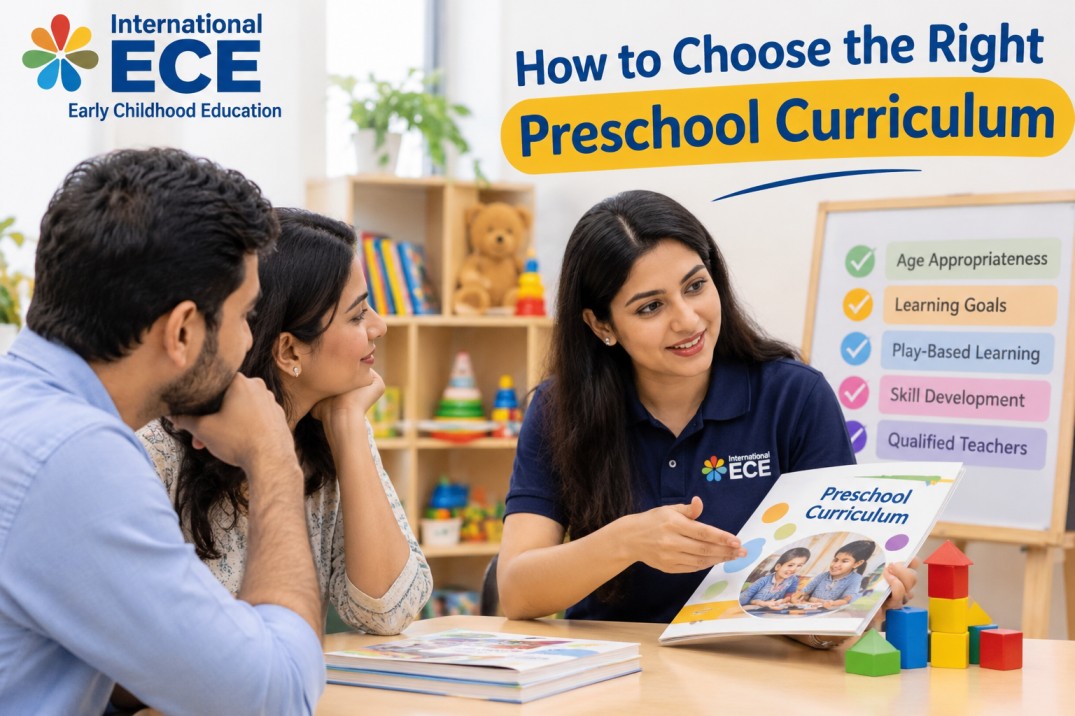
How to Choose the Right Preschool Curriculum: Play-Based vs Academic (2027 Guide)
Direct answer: For children aged 3–6 in India, the evidence strongly favours a play-based preschool curriculum over a formal academic one, especially before age 5. But the real question is not “play or academics.” It is whether the school uses play purposefully to build language, numeracy, and social skills — or uses worksheets and rote writing to push academic outcomes too early.
India’s National Education Policy 2020 mandates play-based, activity-based, and inquiry-based learning for the foundational stage. Yet many private preschools still market themselves on “academic readiness,” and many parents equate early writing with quality. This guide compares both approaches honestly, using Indian policy, research evidence, and real classroom practice. No fluff. Just what you need to choose well.
What Is the Difference Between Play-Based and Academic Preschool Curriculum?
Why this matters to you: The label on the brochure is not the curriculum. You need to know what actually happens inside the classroom between 9 a.m. and 12 p.m.
Play-Based Preschool: Definition and Core Principles
A play-based preschool uses child-led play as the primary vehicle for learning. Teachers design the environment — blocks, art materials, sand, water, pretend-play corners, storybooks — and then observe, scaffold, and extend children’s natural curiosity. The child chooses the activity. The teacher connects it to developmental goals such as communication, problem-solving, empathy, and motor coordination
Play-based does not mean unstructured chaos. Quality play-based programs follow a curriculum framework. Every game, story, or activity links to a specific learning outcome. The difference is that the learning is embedded in play, not delivered through worksheets.
Academic Preschool: Definition and Common Features
An academic preschool prioritises formal instruction in literacy and numeracy. Children sit at desks, complete worksheets, practise letter formation, and receive homework. The day is teacher-directed. The measure of success is often how early a child can write the alphabet or recite numbers.
Many academic preschools in India follow a “downward extension” of the early primary curriculum — using methods designed for older children on 3- and 4-year-olds who are not developmentally ready for them. Educators note that this can restrict natural expression and reduce play time.
What Does NEP 2020 Say About Preschool Curriculum in India?
Why this matters to you: Policy is not just for schools. It tells you what the government and early childhood experts consider appropriate practice for your child’s age.
The Policy-Parent Perception Gap
NEP 2020 explicitly emphasises “flexibility, multi-faceted approaches, and play-based, activity-based, and inquiry-based learning” for early childhood. The National Curriculum Framework for Foundational Stage (NCF-FS) 2022 and the National Curriculum for ECCE 2024 (“Aadharshila”) both centre play-based pedagogy for children aged 3–6.
But there is a documented gap between policy and parent behaviour. Research describes a “policy-perception paradox” in India: the policy mandates play-based pedagogy, while many families continue to favour early academic rote learning. Private preschools often respond to parent demand, not just policy, which is why academic preschools still thrive in cities like Mumbai, Jaipur, and Indore.
Why the National Curriculum Framework Favours Play
The NCF-FS positions play as the cornerstone of learning in the foundational years, not a break from learning. It highlights how play fosters a joyful, stress-free environment and supports all-round development. The framework recognises that young children learn best through whole-body engagement — movement, play, and sensory experience — rather than sitting still and writing.
Play-Based vs Academic Preschool: Side-by-Side Comparison
Why this matters to you: This table shows what a typical day actually looks like in each type of preschool. Use it when you visit schools.
| Feature | Play-Based Preschool | Academic Preschool |
|---|---|---|
| Who leads the activity | Child chooses; teacher scaffolds and extends | Teacher directs; child follows instructions |
| Main learning tool | Play materials, games, stories, pretend play, outdoor exploration | Worksheets, textbooks, writing practice, flashcards |
| Seating arrangement | Flexible — floor play, group corners, outdoor areas | Desks in rows, children seated for extended periods |
| Homework | Rare or none | Common, even for 3–4 year olds |
| Primary outcome focus | Language, social-emotional skills, curiosity, problem-solving | Letter recognition, writing, number recall |
| Assessment style | Observation-based, developmental checklists | Tests, worksheets, comparison against benchmarks |
| NEP 2020 alignment | Strong alignment with national curriculum framework | Often misaligned with foundational-stage guidelines |
Classroom Day Structure
In a quality play-based classroom, you will see children moving between interest areas — blocks, art, books, sand, pretend play — with teachers observing and joining conversations. In an academic preschool, you will see children sitting at desks, completing worksheets, and practising writing for long durations.
Learning Outcomes and School Readiness
Both approaches claim to prepare children for Class 1. The difference is what “ready” means. Academic preschools define readiness as early literacy and numeracy. Play-based programs define readiness as the foundation for learning: attention, curiosity, language, self-regulation, and the ability to work with others. Research on play-based pedagogy shows it supports foundational literacy and numeracy when guided by trained adults.
Benefits of Play-Based Learning: What the Evidence Shows
Why this matters to you: These are not ideological claims. They are outcomes documented in research and policy frameworks.
Cognitive and Academic Benefits
Play — particularly pretend play — is an effective strategy for introducing new concepts and revisiting previously taught material[. Children extend classroom learning into free play, which reinforces understanding. Randomised evaluations in Delhi found that math games played with peers improved children’s mastery of mathematics both immediately and a year later. Toy-based and game-based pedagogy has a defensible evidence base for early numeracy and, to a lesser extent, literacy.
Social-Emotional and Behavioural Benefits
Playing with others teaches cooperation, empathy, self-regulation, and how to be part of a group. Children in academic programs are often observed to have more behaviour problems than those in play-based programs. Play also facilitates peer learning and collaborative problem-solving, which builds the social skills children need for the transition to primary school.
Drawbacks of an Overly Academic Preschool
Why this matters to you: If a school promises your 3-year-old will write sentences by December, you need to ask what is being sacrificed.
Stress and Developmental Mismatch
Forcing academic skills too early — especially before age 4 — can create stress, cut into play time, and reduce natural curiosity. The curriculum in such preschools is often developmentally inappropriate: children are required to sit in one place and write for long durations, while holistic development is ignored. When children are not developmentally ready for formal writing, the result is frustration, not accelerated learning.
What Indian Parents Report
In one study, 45% of parents agreed that the pre-primary curriculum overburdens young children, and many expressed a preference for a play-way, activity-based curriculum At the same time, parent demand for early writing and English-speaking classes creates pressure on schools to push academics earlier than is appropriate The tension is real: parents want what is best, but cultural expectations often equate early writing with good schooling.
7 Questions to Ask When Choosing a Preschool Curriculum
Why this matters to you: These questions separate marketing language from actual practice. Ask them during your school visit.
- “What does my child’s day look like from arrival to pick-up?”
Ask for a sample timetable. Count how many minutes are child-led play versus teacher-directed seatwork. - “How do you teach early literacy and numeracy through play?”
A quality play-based school will explain specific games, stories, and materials — not vague claims about “holistic learning.” - “How much time does my child spend sitting at a desk versus moving and playing?”
If the answer is more than 15–20 minutes of continuous seatwork for a 3- or 4-year-old, ask why. - “What is your homework policy for this age group?”
Homework for preschoolers is a red flag. Play-based programs rarely assign it. - “How do teachers assess progress — through observation or worksheets?”
Observation-based assessment aligns with NEP 2020 and developmental science. - “What is the teacher’s training in early childhood pedagogy?”
NEP 2020 mandates play-based pedagogy, but teacher training in India is inconsistent Ask specifically about ECE qualifications. - “Can I see the classroom in action during a typical day?”
Observe. Are children choosing activities? Are teachers on the floor with them, or standing at a board?
Preschool Curriculum Checklist for Indian Parents
Why this matters to you: Use this checklist when comparing two or three preschools in your city. A school does not need every box ticked, but the pattern matters.
| Checklist Item | What “Good” Looks Like |
|---|---|
| ☐ NEP 2020 alignment | School can explain how its curriculum follows play-based, activity-based learning |
| ☐ Child-led activity time | At least 60–90 minutes of free play and interest-area exploration daily |
| ☐ No formal homework before age 5 | No worksheets sent home; reading and storytelling encouraged instead |
| ☐ Trained ECE teachers | Teachers with early childhood qualifications, not just general B.Ed degrees |
| ☐ Observation-based assessment | Developmental checklists and notes, not tests or rank cards |
| ☐ Outdoor and sensory play | Daily access to outdoor space, sand, water, or sensory materials |
| ☐ Parent communication | Regular updates on observations, not just “performance reports” |
| ☐ Balanced school-readiness approach | For 5–6 year olds, some structured early literacy and numeracy is appropriate — but still through engaging, play-linked methods |
Play-Based vs Academic: Which Is Right for Your Child?
Why this matters to you: There is no universal “best” school. There is a best fit for your child’s age, temperament, and your family’s goals.
Age Matters: 3–4 vs 5–6 Years
For children aged 3–4, play-based is the developmentally appropriate choice. Formal writing before age 4 is not linked to long-term academic advantage and can create stress For children aged 5–6 — the final preschool year — a quality program gradually introduces early literacy and numeracy in a way that feels natural and connected to their experiences The key word is gradually. A 5-year-old can handle some structured pre-writing and number games. A 3-year-old should not be sitting at a desk for 45 minutes.
City and School-Type Realities in India
In Tier-1 cities like Mumbai and Bengaluru, you will find a wider range of play-based and international-model preschools. In Tier-2 and Tier-3 cities like Indore, Patna, and Jaipur, academic preschools may dominate the market because of parent demand and competitive admission pressures. If you are in a city with fewer play-based options, look for a school that blends both: a structured day with substantial play time, trained teachers, and no homework before age 5. The label matters less than the daily experience.
Frequently Asked Questions About Preschool Curriculum Choice
Is play-based preschool better than academic preschool?
For most children under 5, yes — the evidence and NEP 2020 both favour play-based learning. But the better question is whether the school uses play purposefully. A quality play-based program links every activity to developmental goals. A poor academic program drills worksheets. Choose based on daily practice, not the label.
Will my child fall behind in Class 1 if they attend a play-based preschool?
No evidence supports this fear. Play-based learning builds the foundation for later academics: attention, language, curiosity, and self-regulation. Children who develop these skills are better positioned to learn formal reading and writing in primary school. Early drilling can create stress without long-term advantage.
What does NEP 2020 say about preschool curriculum?
NEP 2020 mandates play-based, activity-based, and inquiry-based learning for the foundational stage (ages 3–8). The National Curriculum Framework for Foundational Stage and the 2024 ECCE curriculum both centre play as the primary pedagogy, not a break from learning.
How much homework is appropriate for a preschooler?
None before age 5. For the final preschool year (age 5–6), occasional sharing of a book or a simple game is enough. Formal worksheets and writing homework for 3- and 4-year-olds are developmentally inappropriate and not supported by evidence.
What if the only good preschool near me is academic?
Look for a middle path. Ask whether the school has substantial play time, trained ECE teachers, and no homework for younger children. If the academic load is heavy, compensate at home with unstructured play, outdoor time, and storytelling. You can also ask the school about its balance between seatwork and active learning.
How do I know if a preschool’s “play-based” claim is genuine?
Visit during a typical day. Genuine play-based classrooms show children choosing activities, teachers on the floor observing and joining, and a visible curriculum framework linking play to learning goals. If “play-based” means 20 minutes of free play followed by two hours of worksheets, it is academic in practice.
Final Thoughts: Choose the Approach, Not the Label
Every preschool in India will claim to be “child-centred” or “holistic.” The difference is what happens at 10 a.m. on a Tuesday. A play-based school with trained teachers, a clear framework, and no homework for 3-year-olds is not “soft.” It is developmentally appropriate. An academic preschool that pushes writing before a child can hold a crayon comfortably is not “rigorous.” It is misaligned with how young children learn.
Use the comparison table and checklist in this guide. Ask the seven questions. Visit the classroom. Then choose based on what you see, not what the brochure says.