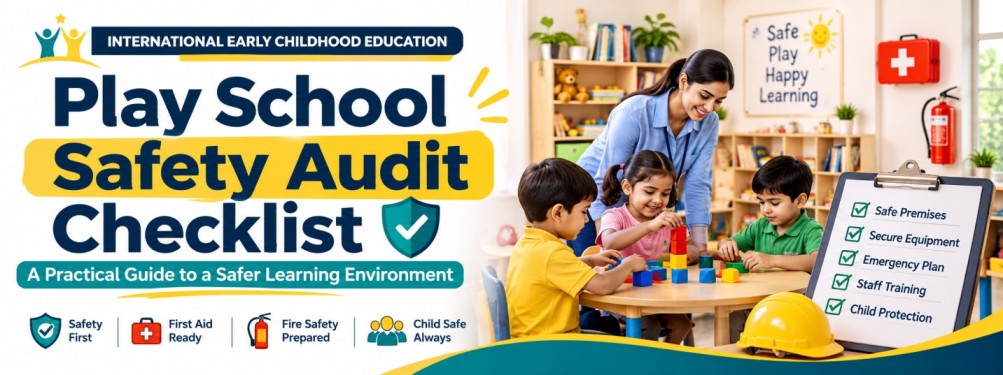
Play School Safety Audit Checklist: NCPCR Compliance Guide for India 2027
A play school safety audit in India checks five areas: building and physical safety, staff verification under POCSO, health and first aid, transport and pickup controls, and CCTV data handling. The NCPCR Regulatory Guidelines for Private Play Schools provide the base checklist, and state inspections in 2027 increasingly require documented proof—not verbal assurances.
Why this matters to you: A missing fire NOC or an unverified bus driver can shut your play school down. An audit-ready file protects your children, your reputation and your licence.
What a play school safety audit actually covers
The NCPCR’s Check-list on Safety & Security against Physical, Emotional & Sexual Abuse is the most widely referenced national framework for play schools. State child rights commissions and WCD departments adapt it for inspections. The checklist is not a marketing tool—it is the document an inspection team walks through, point by point, before recommending recognition.
Most audits fail not because schools lack cameras or teachers, but because they cannot produce written records: the fire certificate, the police verification file, the signed affidavit, the evacuation plan on the wall. Auditors ask for paper, not promises.
The five core areas every auditor inspects
- Building and physical safety—electrical fittings, corridors, staircases, play equipment, boundary wall.
- Fire and disaster readiness—fire extinguishers, evacuation plan, NOC where applicable.
- Staff verification and child protection—police verification, POCSO affidavits, named Child Protection Officer.
- Health, hygiene and first aid—first aid kit, quarterly health check-ups, clean toilets, safe drinking water.
- Transport and access control—driver verification, vehicle fitness, authorised pickup, attendance logs.
Why 2027 is the year to get serious
State enforcement is tightening. In March 2026, Jammu and Kashmir notified standardised inspection checklists for play schools under the D-BRAP 2025 framework, requiring a valid Building Safety Certificate and Fire Safety Certificate at inspection[reference:0]. In Gurgaon, the WCD department moved to shut down more than 700 unregistered play schools that lacked fire safety, CCTV and child-friendly toilets[reference:1]. The pattern is clear: inspections are moving from advisory to enforcement.
Why this matters to you: If your file is incomplete in 2027, you are not just risking a fine. You are risking closure mid-session, when parents have already paid fees.
Building and physical safety: the non-negotiable basics
The NCPCR checklist begins with the building itself. Auditors look for a boundary wall or fencing, barrier-free access, separate child-friendly toilets for boys and girls, low-level wash basins, potable drinking water, and pest control records[reference:2]. Classrooms must have cross-ventilation and working lighting. Ceiling tiles and plaster must be intact—no damp walls, no hanging material.
Corridors and staircases must be clear of obstruction. Classroom doors and emergency exits must open freely. A floor evacuation plan must be displayed, not stored in a drawer.
Electrical safety and childproofing
Every switchboard below five feet must be covered and marked. Water coolers and electrical appliances must be checked for shock risk. No sparks or short circuits should have occurred in the past week. High-voltage wires should not run near the play area. Access to electrical installations should be limited to staff who need it[reference:3]. Extension cords on the floor, open wiring and loose sockets are common audit failures in Tier-2 and Tier-3 city play schools.
Fire safety NOC and evacuation readiness
Fire extinguishers must be in place and within expiry. The evacuation plan must be displayed and explained to staff. Where the building exceeds the local height or floor-area threshold, a Fire NOC is mandatory. Under Bihar Fire Service Rules, 2021, an educational building needs a fire NOC if it is 9 metres or taller or any floor exceeds 500 sq m[reference:4]. Similar thresholds exist in other states.
A 2026 investigation found that over half of Indian schools lack basic fire safety infrastructure, and in Delhi, an estimated 35% operate without full fire safety compliance[reference:5].
Why this matters to you: A fire extinguisher on the wall is not compliance. The auditor wants the refill date, the evacuation diagram and a staff member who can explain the drill.
Staff verification and child protection: POCSO is not optional
The POCSO Rules, 2020 require every institution in regular contact with children—including play schools and creches—to conduct police verification and background checks of all staff, teaching and non-teaching, regular and contractual[reference:6]. The NCPCR checklist adds two signed affidavits at joining: one confirming the employee has never been convicted under the Juvenile Justice Act, 2015 or child labour laws, and one confirming they have not been accused under the POCSO Act[reference:7].
Police verification and signed affidavits
Verification must cover everyone with child contact—teachers, helpers, bus drivers, bus attendants, security guards and temporary staff. A common gap is verifying teachers but not the transport team. Auditors in 2027 are asking for the verification register, not just the principal’s word.
Child Protection Officer and POCSO reporting
The school must name a senior, trained staff member as Child Protection Officer. All staff must know the reporting mechanism. The ChildLine number and POCSO e-Box details must be displayed prominently. Children should be taught safe and unsafe touch, and parents should be made aware of the same[reference:8]. If an allegation is made, the alleged offender’s access to children must be restricted immediately.
Why this matters to you: One unverified staff member is enough to fail the audit. Build a single register that lists every adult who enters the child area, their verification date and their affidavit.
Health, hygiene and first aid: daily checks that auditors verify
The NCPCR guidelines specify the contents of the first aid kit: band-aids or bandages, cotton wool, disinfectant, ORS packets, scissors, a thermometer and antiseptic ointment[reference:9]. The kit must be accessible, not locked in the principal’s cupboard. Expiry dates should be checked monthly.
Every child must have a health check-up once a quarter by a registered medical practitioner, with records kept. The school must also maintain a record of any child or staff member attending with an infectious illness.
Food safety and illness protocols
If the play school serves food, the kitchen must follow FSSAI hygiene norms. The PTA is expected to monitor junk food compliance. For illness, the school should have a written protocol: who informs the parent, who administers medicine, and how a doctor-on-call is reached.
Table 1: First aid kit checklist for play schools
| Item | Minimum quantity | Check frequency |
|---|---|---|
| Adhesive band-aids / bandages | 20 pieces | Monthly |
| Cotton wool | 1 roll | Monthly |
| Antiseptic solution / ointment | 1 bottle | Expiry date |
| ORS packets | 5 sachets | Expiry date |
| Scissors (child-safe) | 1 pair | Monthly |
| Digital thermometer | 1 unit | Battery check monthly |
| Disposable gloves | 10 pairs | Monthly |
| Doctor-on-call contact sheet | 1 laminated copy | Quarterly update |
Why this matters to you: A parent will forgive a scraped knee. They will not forgive a school that cannot find a band-aid or a thermometer when their child needs one.
Transport and pickup-drop safety: the weakest link in most audits
Transport is where play school safety audits most often break down. The NCPCR checklist and state transport norms require fitness certificates for every vehicle, the school’s name and contact number displayed on the vehicle, and a responsible staff member or attendant in addition to the driver[reference:10]. The driver and attendant must carry a mobile phone. Girl children should not sit on the front seat.
Driver verification and vehicle fitness
The driver’s police verification is mandatory. The vehicle fitness certificate must be current. The permit and insurance must be valid. For vans, the maximum number of children must follow the vehicle’s registered capacity, not what “fits”.
Authorised pickup and attendance logs
Only adults on the parent’s approved list should be allowed to collect a child. If someone else arrives, written authorisation from the parent is required. Attendance must be marked at arrival and at pickup[reference:11]. A child should never be left alone—not during breaks, not at the gate, not in the van.
Why this matters to you: Most pickup disputes happen because the front desk relies on memory. A photo-ID check and an approved-pickup register take two minutes and prevent a police complaint.
CCTV, data privacy and parent access in 2027
CCTV is now a standard expectation in play school safety audits, but the rules go beyond having cameras. The NCPCR checklist asks for CCTV surveillance with data kept secure and cameras installed for monitoring by the supervisor, not for public streaming[reference:12]. CBSE’s 2025 directive to affiliated schools requires audio-video CCTV at entry points, corridors, classrooms and play areas—excluding washrooms—with at least 15 days of storage[reference:13].
Coverage rules and storage duration
Cameras should cover entry and exit gates, corridors, classrooms, the play area and the pickup zone. Toilets and washrooms are strictly no-camera zones. Storage should be at least 15 days for school-linked settings; creches and daycares in several states are expected to retain 30 days. Personal mobile access to feeds should be disabled.
Parent access without violating the DPDP Act
Under the DPDP Act, a child’s video image is personal data, and processing generally requires verifiable parental consent. Parents have a right to request access to their child’s data, but the school must balance that against the privacy of other children in the frame. The practical answer for play schools in 2027 is supervised viewing of recorded, redacted footage—not unrestricted live streaming. Maintain a viewing log with date, time, requester and staff present.
Why this matters to you: A live feed on a parent’s phone exposes every other child in the room. A supervised clip in your office protects everyone and still answers the parent’s concern.
The 2027 play school safety audit checklist (copy-paste format)
Use this checklist before your next inspection or internal audit. Each item should have a document or photograph behind it.
- ☐ Building Safety Certificate from a registered engineer or local authority.
- ☐ Fire NOC where the building exceeds local height or floor-area thresholds.
- ☐ Fire extinguishers in date, with refill records.
- ☐ Evacuation plan displayed on every floor.
- ☐ Boundary wall or fencing with a single supervised entry.
- ☐ Electrical switchboards below five feet covered and marked.
- ☐ Corridors and staircases free of obstruction.
- ☐ Play equipment age-appropriate, non-toxic, no sharp edges.
- ☐ Potable drinking water with a recent test report.
- ☐ Separate child-friendly toilets for boys and girls, with low wash basins.
- ☐ First aid kit stocked per Table 1, with expiry log.
- ☐ Quarterly health check-up records for every child.
- ☐ Police verification register covering all staff, including transport.
- ☐ Signed POCSO affidavits from every employee.
- ☐ Named Child Protection Officer with training record.
- ☐ ChildLine number and POCSO e-Box displayed prominently.
- ☐ CCTV coverage of entry, corridors, classrooms and play area (no toilets).
- ☐ 15-day minimum storage; 30 days for creche/daycare settings.
- ☐ Approved-pickup register with photo-ID verification.
- ☐ Attendance log marked at arrival and pickup.
- ☐ Vehicle fitness certificates and driver police verification for transport.
- ☐ Parent communication of the child protection policy at admission.
Why this matters to you: If you cannot tick every box today, you now have a priority list. Start with the items that carry legal risk: fire NOC, POCSO verification and pickup controls.
What non-compliance costs: penalties, closure and reputation
India has no single national licence for play schools, but enforcement is fragmented and increasingly strict. Gurgaon’s WCD department moved to close over 700 unregistered play schools that failed basic safety criteria[reference:14]. Jammu and Kashmir’s 2026 inspection framework requires building and fire certificates before recognition[reference:15]. Under the DPDP Act, children’s-data breaches can attract penalties up to ₹200 crore.
The bigger cost is trust. A single safety incident can empty a play school faster than any fee increase. Parents in Mumbai, Indore, Patna and Jaipur now ask for the fire NOC and the pickup policy before they ask about the curriculum.
Why this matters to you: Compliance is cheaper than a closure notice. A ₹15,000 fire extinguisher refill and a ₹5,000 police verification file are small compared with the cost of losing 40 admissions.
City-wise compliance cost estimate for a 40-child play school
Costs vary by city, building type and vendor. The table below is an industry estimate for a 40-child play school moving from partial compliance to audit-ready status.
Table 2: Estimated 2027 compliance cost for a 40-child play school (industry estimate)
| Cost item | Mumbai | Indore | Patna | Jaipur |
|---|---|---|---|---|
| Building safety certificate (engineer fee) | ₹8,000–₹15,000 | ₹5,000–₹10,000 | ₹4,000–₹8,000 | ₹5,000–₹10,000 |
| Fire NOC / fire safety upgrade | ₹15,000–₹40,000 | ₹10,000–₹25,000 | ₹8,000–₹20,000 | ₹10,000–₹25,000 |
| CCTV upgrade (8 cameras + 15-day storage) | ₹35,000–₹60,000 | ₹25,000–₹45,000 | ₹22,000–₹38,000 | ₹25,000–₹45,000 |
| Police verification (per staff, approx.) | ₹300–₹500 | ₹200–₹400 | ₹200–₹350 | ₹200–₹400 |
| First aid kit + quarterly health check | ₹8,000–₹15,000/year | ₹6,000–₹12,000/year | ₹5,000–₹10,000/year | ₹6,000–₹12,000/year |
| Total first-year estimate | ₹66,000–₹1,70,000 | ₹46,000–₹1,17,000 | ₹39,000–₹96,000 | ₹46,000–₹1,17,000 |
Why this matters to you: A Tier-2 play school can become audit-ready for under ₹50,000 if the building already has basic fire equipment. The expensive part is delay, not the checklist.
FAQs: Play school safety audit in India
1. Is a play school safety audit mandatory in India?
There is no single national law, but NCPCR guidelines are adopted by state child rights commissions and WCD departments. States like Jammu and Kashmir have notified mandatory inspection checklists. Registration or recognition is increasingly tied to a safety audit.
2. What documents are checked in a play school safety audit?
Auditors ask for the Building Safety Certificate, Fire NOC where applicable, police verification register, POCSO affidavits, first aid kit records, quarterly health check-up records, CCTV storage proof, vehicle fitness certificates and the approved-pickup register.
3. What is the staff-child ratio for play schools in India?
Many states follow one teacher and one caretaker for every 20 children as the baseline. Gurgaon’s WCD guidelines use this ratio. Some educators recommend a lower ratio for younger children, but the 1:20 norm is the most commonly cited regulatory benchmark.
4. Can parents demand CCTV footage from a play school?
Parents can request access to their child’s data under the DPDP Act, but schools should offer supervised viewing of redacted footage rather than an unedited copy. Live streaming to parents’ phones is not recommended because it exposes other children without consent.
5. What is the penalty for running an unsafe play school?
Penalties range from closure and deregistration to fines. Under the DPDP Act, children’s-data breaches can attract penalties up to ₹200 crore. Several states are now actively shutting down unregistered play schools that fail basic safety checks.
6. How often should a play school conduct a safety audit?
An internal walk-through should happen monthly. A full documented audit should happen every six months. A external or third-party audit is advisable annually, and immediately after any incident, staff change or infrastructure modification.