10 Essential Skills for Play School Teachers Beyond Training (2027)
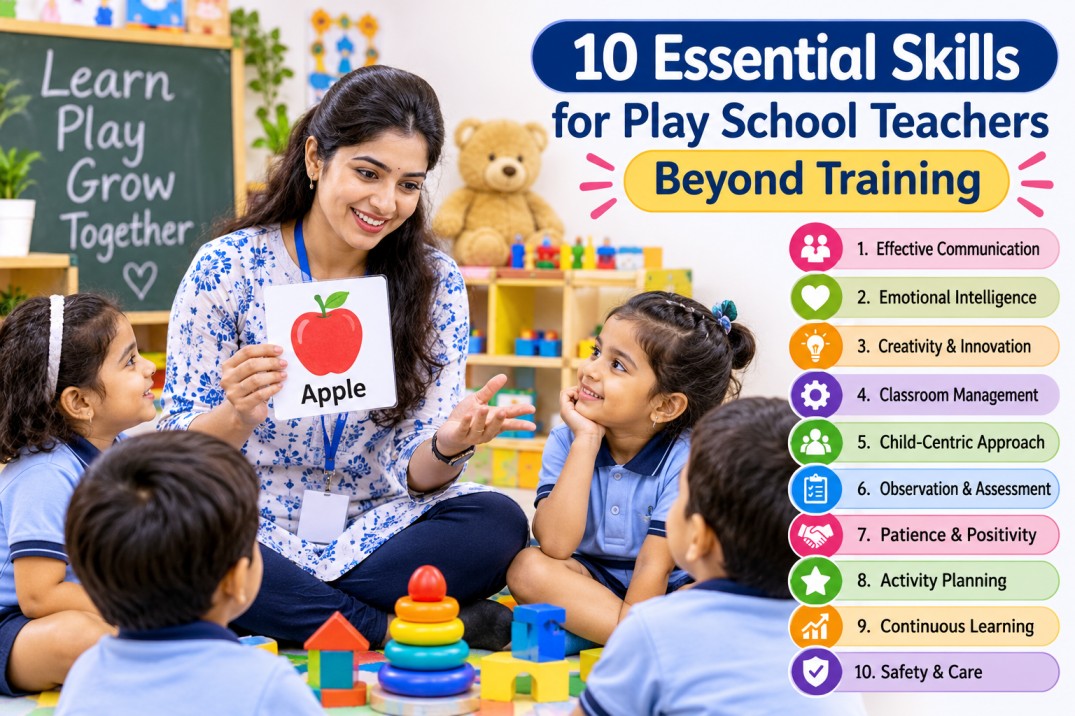
Direct answer: Indian play schools hire for ten skills that NTT/PTT certificates rarely teach in depth: communication, patience, creativity with low-cost materials, observation, large-group management, NEP 2020 alignment, parent partnership, teamwork, digital comfort, and cultural responsiveness. Training gets you shortlisted. These skills keep you employed and promoted.
This guide maps each skill to real Indian job descriptions and policy expectations. No fluff. Every claim is sourced or marked “industry estimate.”
Quick Answer: What Training Doesn’t Teach You
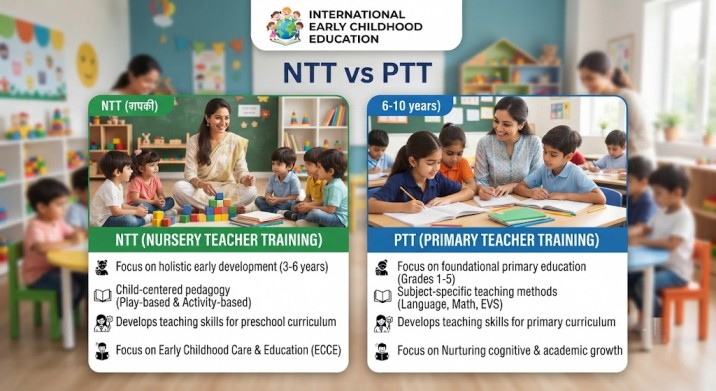
NTT and PTT programmes cover child psychology, play-based pedagogy, and activity design[. They do not cover how to handle 30 children alone, how to tell a parent their child needs a developmental assessment, or how to make a teaching aid from bottle caps when the budget is zero.
Research from Karnataka shows that teacher qualification matters — B.Ed-qualified teachers scored significantly higher in fostering socio-emotional development than D.Ed./SSLC teachers But qualification alone does not explain why some teachers thrive in Indian play schools and others burn out. The difference is the ten skills below.
Why this matters to you: If you stop learning after the certificate, you will hit a salary ceiling within 3 years. These skills are the ladder above that ceiling.
Why Skills Matter More Than Certificates in Indian Play Schools
Job listings for play school teachers in India do not ask only for NTT/PTT. They ask for “excellent verbal communication,” “patience and empathy,” “creativity in designing teaching aids with minimal resources,” and “basic digital literacy” A Jaipur school listing explicitly asks for “understanding of child development milestones” and “early education curriculum and pedagogy” alongside NTT/ECCE
Government-adjacent recruitment is moving the same way. The Balvatika teacher syllabus includes NCF-FS 2022, inclusive education, classroom management, ICT, and socio-emotional development — not just subject knowledge.
Why this matters to you: Your certificate proves you completed a course. Your skills prove you can run a classroom. Employers pay for the second one.
Skill 1: Communication With Children and Parents
Communication with children is not “talking nicely.” It is storytelling that holds attention, instructions that a 3-year-old can follow, and a tone that de-escalates instead of threatens. Naukri listings ask for “expressive storytelling ability” and “clear diction”
Communication with parents is a different skill. NCERT teacher education resources stress listening “in an accepting way,” articulating responses so parents feel convinced, and building partnership rather than one-way reporting
Why this matters to you: Parents judge you by how you speak about their child, not by your diploma. One careless sentence can undo months of good classroom work.
Skill 2: Patience and Empathy Under Pressure
Patience is not a personality trait. It is a practised response to repetition. A child will spill water five times. A parent will ask the same question every week. Empathy is the ability to see the behaviour as communication, not provocation.
Every Indian play school job listing reviewed for this guide names patience and empathy as essential. This is not filler language. High teacher turnover in Indian preschools is driven partly by emotional exhaustion from large classes and parent pressure.
Why this matters to you: You cannot fake patience for 6 hours a day, 6 days a week. You can build routines and self-regulation habits that make patience sustainable.
Skill 3: Creativity With Low-Cost Teaching Materials
NCF-FS 2022 explicitly asks teachers to develop “capacities for creating simple TLMs from locally available materials”. Indian play schools rarely have generous budgets for imported toys and printed flashcards. The teachers who thrive are the ones who can turn bottle caps into counting beads, old socks into storytelling puppets, and cardboard into shape sortersNaukri listings describe this as “ability to design innovative teaching aids, charts, and activity setups with minimal resources”
Why this matters to you: A teacher who can create a full week of activities from ₹100 of local materials is more valuable to an Indian play school than one who needs a ready-made kit.
Skill 4: Observation and Documentation
Observation is not “watching children.” It is noticing a delay in fine motor skills, a pattern of social withdrawal, or a change in a child’s eating habits — and writing it down clearly. NCF-FS 2022 asks teachers to observe children in learning corners, note anecdotes, and document what children are doing.
Documentation matters for two reasons. First, it supports early identification of developmental needs. Second, it gives you evidence for parent conversations that would otherwise become emotional arguments.
Why this matters to you: “I feel something is different” is a weak parent conversation. “Here are three observations from the last two weeks” is a professional one.
Skill 5: Classroom Management for Large Groups
Indian play schools often run at 25–40 children per teacher with no aide Classroom management is not about discipline. It is about designing routines, transitions, and activity zones so the group manages itself. NCERT guidance for large Indian classes recommends running multiple activities simultaneously so no area is overcrowded
Jaipur and Mumbai job listings ask for “classroom management,” “planning and organisation,” and “ability to handle young children with care and responsibility”
Why this matters to you: With 30 children, your voice cannot be the primary management tool. The room design and routine must do the work.
Skill 6: NEP 2020 and NCF-FS 2022 Implementation
This is the skill that separates an “old playschool teacher” from a “foundational-stage educator.” NEP 2020’s 5+3+3+4 structure makes ages 3–8 the Foundational Stage. NCF-FS 2022 defines how that stage should be taught: play-based, activity-based, inquiry-driven, with attention to socio-emotional development and inclusive education
Mumbai and Jaipur job listings now explicitly ask for “good working knowledge of NEP 2020 and foundational-stage teaching methods” and ability to “deliver the preschool curriculum in line with NEP 2020 and NCF-FS”
Why this matters to you: Schools are being inspected against NCF-FS. A teacher who cannot speak that language is a compliance risk, no matter how loving she is with children.
Skill 7: Parent Partnership and Difficult Conversations
Most teacher training covers child development, not adult conversations. In an Indian play school, you will regularly tell parents things they do not want to hear: their child may need a speech assessment, their child is biting, their child is not yet toilet-trained.
NCERT resources frame parent communication as partnership: listen, accept, highlight the positive first, and take the parent into confidence as a collaborator Mumbai job listings ask for “constructive, empathetic updates” and prompt handling of parental concerns
Why this matters to you: Parent complaints are the number one reason play school teachers are asked to leave. Handling one difficult conversation well protects your job more than a perfect lesson plan.
Skill 8: Team Collaboration With Aides and Co-Teachers
Play schools run on teams: class teacher, aide, dance teacher, special educator, admin. If you cannot coordinate, the classroom splits into competing instructions. Shri Ram Universal School (Jaipur) lists “teamwork and collaborative thinking” as a key skill
Collaboration includes sharing observation notes, aligning on behaviour responses, and covering for each other during transitions. It is not a soft skill in a play school. It is operational survival.
Why this matters to you: A teacher who cannot work with the aide will be scheduled with the most difficult class — and then blamed when it fails.
Skill 9: Digital and Tech Comfort
Digital comfort no longer means “can use a laptop.” It means using school communication apps for parent updates, digital attendance, online teaching platforms during closures, and DIKSHA/NISHTHA training modules. Naukri listings ask for “basic digital literacy for handling digital attendance, school communication apps, and smart classroom tools”.
Government training is moving digital too. NISHTHA 2026–27 includes ECCE and FLN modules delivered online, and SCERT Jammu has trained teachers on DIKSHA 2.0 and AI-enabled tools like read-aloud and translation.
Why this matters to you: A teacher who avoids the parent app becomes the teacher who is always chasing paper. Digital comfort saves you 30–45 minutes a day.
Skill 10: Cultural Responsiveness and Local Context
Indian play schools serve children from diverse linguistic, religious, and economic backgrounds. Cultural responsiveness means using local stories, festivals, food, and family structures in the classroom — not a generic Western curriculum. NCF-FS 2022 encourages using locally available materials and context
It also means communicating with parents in the language they trust. A Mumbai listing asks for Hindi and Marathi communication alongside working English. A Patna or Indore play school may prioritise Hindi and local dialect comfort over English fluency.
Why this matters to you: A teacher who can connect with the family’s world earns trust faster than a teacher with perfect English and no local context.
Skills vs Certificates: What Employers Actually Check
The table below compares what a certificate proves versus what these ten skills prove, using Indian job-listing language.
| What the Certificate Proves | What the Skill Proves | How Employers Check It |
|---|---|---|
| Completed NTT/PTT coursework | Can you manage a real classroom? | Demo lesson, trial day, reference check |
| Knows child development theory | Can you observe and document a delay? | Scenario questions in interview |
| Learned play-based pedagogy | Can you design low-cost TLM? | Portfolio of teaching aids, practical task |
| Studied NEP 2020 in theory | Can you deliver NCF-FS-aligned lessons? | Lesson plan review, curriculum questions |
| Knows parent communication models | Can you handle an angry parent calmly? | Role-play in interview, past reference |
Based on Indian play school job listings reviewed for this guide (Naukri, SimplyHired, school career pages, 2027).
Why this matters to you: Certificates get you the interview. The demo lesson and trial day test the ten skills. Prepare for both.
Checklist: Rate Yourself on the 10 Skills
- ☐ Communication: I can hold a 5-minute storytelling session that keeps 15 children engaged.
- ☐ Patience: I can repeat the same instruction five times without raising my voice.
- ☐ Creativity: I have made at least three teaching aids from waste or low-cost materials in the last month.
- ☐ Observation: I write one anecdotal record per child per week, not just when something goes wrong.
- ☐ Large-group management: I use at least three activity zones simultaneously, not whole-class instruction.
- ☐ NEP 2020/NCF-FS: I can explain the Foundational Stage and play-based pedagogy in plain language.
- ☐ Parent partnership: I have handled one difficult parent conversation without escalating it to the principal.
- ☐ Teamwork: I share observation notes with the aide and co-teacher weekly.
- ☐ Digital comfort: I can use the school parent app, digital attendance, and at least one online training platform.
- ☐ Cultural responsiveness: I use local stories, festivals, or materials in at least one activity per week.
Why this matters to you: Tick 7 of 10 and you are above average in the Indian play school market. Tick 10 and you are ready for a head teacher or curriculum coordinator role.
How to Build These Skills (Without Quitting Your Job)
- Pick one skill per month: Do not try to fix all ten at once. Start with observation (easiest to build) or classroom management (highest impact).
- Use your own classroom as the training ground: Record one storytelling session on your phone and review it. Make three low-cost TLMs per week. Write one anecdotal record per child per week.
- Take a short, focused course: A 4–8 hour module on NCF-FS 2022 or parent communication is more useful than a 1-year diploma that repeats what you already know.
- Ask for a demo lesson in interviews: Even if not asked, offer a 10-minute demo. It signals confidence and lets you practise the skills employers actually test.
- Find a mentor: One experienced play school teacher who can review your lesson plan or observation notes once a month is worth more than three certificates.
Why this matters to you: Skills are built in the classroom, not in a lecture hall. Use the job you have to prepare for the job you want.
Final Verdict: The Certificate Gets You In. The Skills Keep You In.
NTT/PTT is the entry ticket. The ten skills above are the career. Indian play schools are moving toward NEP 2020 and NCF-FS 2022 compliance, and they are hiring teachers who can observe, document, manage large groups, create from nothing, and talk to parents like partners.
You do not need a new degree to start building these skills. You need one skill per month, practised in your current classroom, documented in a simple portfolio. That portfolio will matter more in your next interview than the certificate that got you the first one.
FAQ Section
Q1. What skills should a play school teacher have?
Ten skills matter most in Indian play schools: communication with children and parents, patience, creativity with low-cost materials, observation and documentation, large-group classroom management, NEP 2020/NCF-FS 2022 implementation, parent partnership, teamwork, digital comfort, and cultural responsiveness. Certificates get you shortlisted; these skills get you hired and promoted.
Q2. What are the 10 essential skills of a preschool teacher?
The ten are: 1) communication, 2) patience and empathy, 3) creativity with low-cost TLM, 4) observation and documentation, 5) large-group management, 6) NEP 2020/NCF-FS implementation, 7) parent partnership, 8) teamwork, 9) digital comfort, and 10) cultural responsiveness. Indian job listings consistently name these as key competencies.
Q3. What soft skills do preschool teachers need in India?
Patience, empathy, communication, creativity, observation, and teamwork are the core soft skills. Indian play school job listings from Naukri, SimplyHired, and school career pages repeat these phrases consistently. NEP 2020-aligned schools also expect the ability to explain play-based pedagogy and child development milestones.
Q4. How do I become a good play school teacher?
Build one skill per month in your current classroom. Start with observation: write one anecdotal record per child per week. Then practise low-cost TLM creation and large-group activity zones. Take a short NCF-FS 2022 module. A portfolio of lesson plans and observation notes will matter more than an extra diploma.
Q5. What skills are needed beyond NTT certification?
Beyond NTT, teachers need observation and documentation, low-cost TLM design, NEP 2020/NCF-FS implementation, parent communication (including difficult conversations), large-group classroom management, teamwork with aides, digital comfort for school apps and online training, and cultural responsiveness to local context.
Q6. Do Indian play schools prefer skills over certificates?
They need both, but skills decide the hiring. Certificates get you the interview. The demo lesson, trial day, and scenario questions test the ten skills above. Schools will hire a skilled NTT holder over a less-skilled B.Ed holder for a play school classroom, because the job is classroom execution, not theory.
Apply Now