
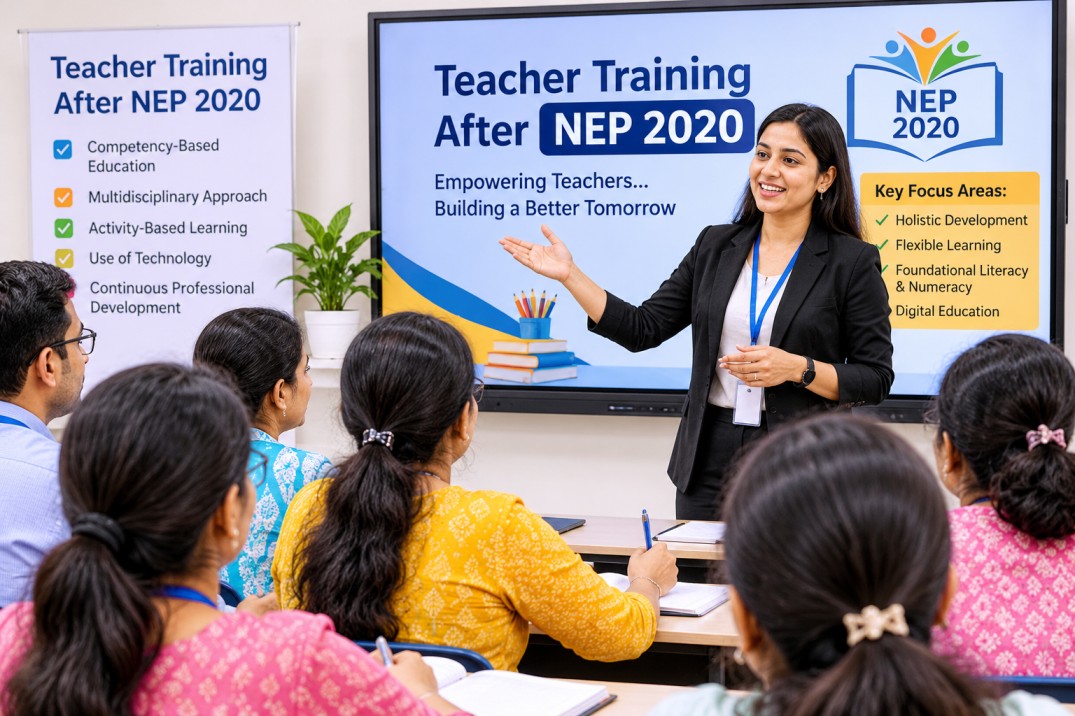
Teacher Training After NEP 2020: New Opportunities for NTT/PTT Students (2027)
Direct answer: NEP 2020 did not make NTT/PTT useless — it moved early childhood education into the formal school structure and created new government-adjacent roles. But by 2030, ITEP (a 4-year integrated degree) becomes the minimum qualification for school teaching, so NTT/PTT students must upgrade within the next 4–5 years.
This guide explains the three big shifts, the ECCE 2027 deadline, new job openings, and a practical roadmap. No fluff. Every claim is sourced or marked “industry estimate.”
Quick Answer: What Actually Changed for NTT/PTT Students
Three things changed. First, ECCE (early childhood care and education) is now a policy-mandated stage, not an optional pre-school add-on. Second, ITEP replaces B.Ed as the minimum teaching qualification by 2030 — and NTT/PTT alone will not meet that bar. Third, the ECCE qualification deadline in 2027 is pushing Anganwadi and preschool teachers to get certified now.
Why this matters to you: If you are holding an NTT/PTT diploma and doing nothing, you are on a 4-year clock. If you act now, NEP 2020 opens doors that did not exist in 2019.
The Three Big NEP 2020 Shifts Every NTT/PTT Student Must Know
These shifts are structural. They affect eligibility, salary ceilings, and government recruitment.
Shift 1: ECCE Is Now Part of the Formal School System
NEP 2020 replaced the 10+2 structure with 5+3+3+4. The first five years — ages 3 to 8 — are the Foundational Stage, and ECCE is formally part of it . This means pre-primary teaching is no longer “playschool work.” It is foundational-stage teaching, governed by NCF-FS 2022 and aligned with the formal curriculum.
Shift 2: ITEP Becomes the Minimum Qualification by 2030
The Ministry of Education has notified that teacher engagement from 2030 onwards will be only through ITEP — a 4-year dual-major bachelor’s degree (B.A. B.Ed., B.Sc. B.Ed., or B.Com. B.Ed.) . ITEP includes ECCE, foundational literacy and numeracy, and inclusive education in its curriculum Extramarks (2027) confirms ITEP replaces B.Ed as the minimum qualification by 2030 .
For NTT/PTT students, this is the critical line: a 1-year diploma is an entry-level credential. It is not a 2030-compliant qualification for formal school teaching.
Shift 3: The ECCE 2027 Qualification Deadline
NEP 2020 mandates that Anganwadi workers and ECCE teachers with 10+2 qualifications receive a 6-month ECCE certificate programme Extramarks (2027) flags the ECCE qualification deadline as 2027 States are already acting: UP Basic Education opened ECCE Educator recruitment in October 2027 for candidates with a 2-year NTT or DPSE recognised by NCTE
Why this matters to you: The 2027 deadline is not a threat. It is a hiring window. Certified ECCE professionals are being absorbed into government-adjacent roles right now.
Is Your NTT/PTT Certificate Still Valid? The Recognition Check
NTT/PTT certificates are issued by state SCERTs, private universities, and standalone institutes. For government school teaching positions, only NCTE-recognised qualifications are accepted Many private NTT programmes are not NCTE-recognised — they are valid for private preschools and playschools only.
Your certificate is valid for private preschool jobs if the institute is recognised by your state SCERT or a recognised university. It is not a substitute for ITEP or B.Ed for formal school teaching from 2030 onwards.
Why this matters to you: Before you pay for an NTT/PTT upgrade, check NCTE recognition. A cheap diploma from a non-recognised institute will not survive the 2030 transition.
New Job Opportunities for NTT/PTT Students (2027)
NEP 2020 did not shrink the early years job market. It formalised it. Three job lanes are growing.
Government-Adjacent Roles: Anganwadi and Balvatika
NEP 2020 and schemes like Saksham Anganwadi and Poshan 2.0 are upgrading Anganwadi centres into pre-school style hubs with ECCE training [reference:16]. States are recruiting ECCE Educators with NTT/DPSE qualifications. UP Basic Education’s 2027 recruitment explicitly accepts a 2-year NTT recognised by NCTE [reference:17]. Balvatika (the pre-primary class attached to government schools) is another emerging route.
Private Preschool and Daycare Boom
Since NEP 2020, certified pre-primary educators are “among the most sought-after professionals in the Indian education sector” . Private preschools in Mumbai, Indore, Jaipur, and Patna continue to hire NTT/ECCE-trained teachers, and online job boards list thousands of pre-primary vacancies requiring NTT/NPTT/ECCE certificates .
EdTech and Online Early Years Teaching
EdTech platforms are hiring early years educators for online phonics, numeracy, and school-readiness programmes. These roles value ECCE/ITEP grounding and pay for digital delivery skills, not just classroom management. Top EdTech “rockstar” teachers and curriculum leads can earn ₹1–5 crore at the senior end (industry estimate), but entry-level online roles typically start at ₹2–5 LPA .
Why this matters to you: The NTT/PTT diploma is a door-opener, not a ceiling. The ceiling depends on what you add — ECCE certification, ITEP, or digital teaching skill.
Salary Reality: NTT vs PTT vs ECCE vs ITEP
Salary depends on employer type, city, and qualification level. The table below uses 2027 data where available and marks estimates.
| Qualification | Typical Monthly Salary (₹) | Employer Type | Source / Note |
|---|---|---|---|
| NTT (1-year diploma) | 12,000–25,000 | Private preschool, playschool | Extramarks 2027 |
| PTT (1-year diploma) | 18,000–35,000 | Private primary school (Classes 1–5) | Extramarks 2027 |
| NPTT (combined) | 15,000–35,000 | Preschool to Class 5 | Extramarks 2027 |
| ECCE-certified (Anganwadi/Balvatika) | State pay scale (varies) | Government-adjacent | UP recruitment 2027; state-dependent |
| ITEP graduate (from 2030) | Formal school pay scale | Government/private formal schools | NCTE/ MoE notification |
Annual ranges: NTT ₹2–4 LPA; PTT ₹3–5 LPA (Shiksha 2025) Fees and salaries vary by city and institution.
Why this matters to you: An NTT diploma caps you around ₹3 lakh per year in most private preschools. ECCE government-adjacent roles and ITEP open higher pay scales. Plan the upgrade before the market forces it.
What NTT/PTT Students Should Do Next (5-Step Roadmap)
- Check your certificate’s recognition: Verify whether your NTT/PTT institute is NCTE-recognised or at least SCERT-recognised. If not, plan an upgrade.
- Add ECCE certification now: The 2027 deadline is active. A 6-month ECCE certificate opens Anganwadi/Balvatika recruitment and makes your NTT/PTT current under NEP 2020.
- Prepare for ITEP or a B.Ed route: ITEP admissions run through NCET 2027 . If you are 12th-pass, ITEP is the cleanest 4-year route. If you already have a degree, a B.Ed plus ECCE specialisation works.
- Build one digital teaching skill: Online phonics, numeracy apps, or parent-communication tools. EdTech hiring managers look for this alongside ECCE grounding.
- Target Tier-2/3 city preschool chains: Indore, Jaipur, and Patna have growing preschool demand and less competition than Mumbai. Use your NTT/ECCE certificate to enter, then upgrade while employed.
Why this matters to you: You do not need to abandon your NTT/PTT diploma. You need to stack it with ECCE now and ITEP/B.Ed before 2030.
ITEP vs NTT: Which Route Should You Choose?
Choose ITEP if you are a 12th-pass student planning a long-term formal school career. It is a 4-year dual-major degree, saves one year compared with the old B.Ed route, and becomes the minimum qualification by 2030 .
Choose NTT/ECCE if you want to enter the workforce quickly — within 1 year — and work in private preschools or Anganwadi/Balvatika roles. Then add ITEP or B.Ed while working, if your long-term goal is a formal school post.
Why this matters to you: NTT and ITEP are not competitors. NTT is a fast entry ticket. ITEP is the long-term licence. The smartest NTT/PTT students hold both.
Checklist: Is Your NTT/PTT Career NEP-Ready?
- ☐ Recognition: You know whether your NTT/PTT institute is NCTE- or SCERT-recognised.
- ☐ ECCE plan: You have a 6-month ECCE certificate timeline (before the 2027 deadline pressure).
- ☐ ITEP/B.Ed awareness: You know the NCET 2027 route or the B.Ed route and have a target year.
- ☐ Government-adjacent job search: You are tracking Anganwadi/Balvatika ECCE Educator recruitment in your state.
- ☐ Digital skill: You can use at least one digital tool for early years teaching (phonics app, parent communication, or online story session).
- ☐ City strategy: You know whether your city (Mumbai, Indore, Jaipur, Patna) has more private preschool demand or government-adjacent ECCE hiring.
- ☐ Salary reality: You know your current NTT/PTT salary ceiling and the ITEP/ECCE ceiling you are aiming for.
Why this matters to you: Tick 5 of 7 and you are ahead of most NTT/PTT holders. Tick 7 and you are NEP-ready before the 2030 mandate hits.
FAQ Section
Q1. Is NTT valid after NEP 2020?
Yes, for private preschool and playschool jobs. But NTT alone will not meet the 2030 ITEP mandate for formal school teaching. NEP 2020 makes ECCE a formal foundational stage, so NTT holders should add a 6-month ECCE certificate now and plan an ITEP or B.Ed upgrade.
Q2. What is ITEP, and will it replace B.Ed?
ITEP is a 4-year integrated teacher education programme (B.A. B.Ed., B.Sc. B.Ed., or B.Com. B.Ed.). The Ministry of Education has notified that from 2030, teacher engagement will be only through ITEP. It replaces B.Ed as the minimum qualification for school teaching.
Q3. What is the salary after NTT?
NTT salaries typically range from ₹12,000 to ₹25,000 per month in private preschools. Annual ranges are ₹2–4 LPA. PTT salaries are higher, at ₹18,000–₹35,000 per month (₹3–5 LPA). ECCE government-adjacent roles pay state scales, which vary.
Q4. Can NTT teachers apply for government jobs?
Yes, for government-adjacent roles like Anganwadi ECCE Educator and Balvatika, where states accept NCTE-recognised NTT/DPSE qualifications. For formal government school teaching posts from 2030, ITEP will be the minimum qualification, so NTT alone will not be enough.
Q5. What is the ECCE 2027 deadline?
NEP 2020 mandates that Anganwadi workers and ECCE teachers with 10+2 qualifications complete a 6-month ECCE certificate programme. Extramarks (2027) flags 2027 as the ECCE qualification deadline. States are already recruiting certified ECCE Educators under this framework.
Q6. Should I choose NTT or ITEP?
Choose NTT/ECCE if you want to start working within a year in a private preschool or Anganwadi role. Choose ITEP if you are 12th-pass and want a formal school career, because ITEP becomes the minimum qualification by 2030. The smartest route is NTT/ECCE first, then ITEP while working.