Online vs Offline Teacher Training: Certificate Value, Practice and Career Impact (2027)
In India, an offline or NCTE-recognised blended teacher training certificate carries stronger hiring weight for school jobs. Online certificates work best for skill upskilling, online tutoring, and NEP 2020 CPD hours — but they cannot replace a B.Ed for government school eligibility.
This guide compares both modes on three things that matter: certificate recognition, real practice hours, and career ROI. No fluff. Every claim is sourced or marked “industry estimate.”
Quick Answer: Which Mode Actually Works in India?
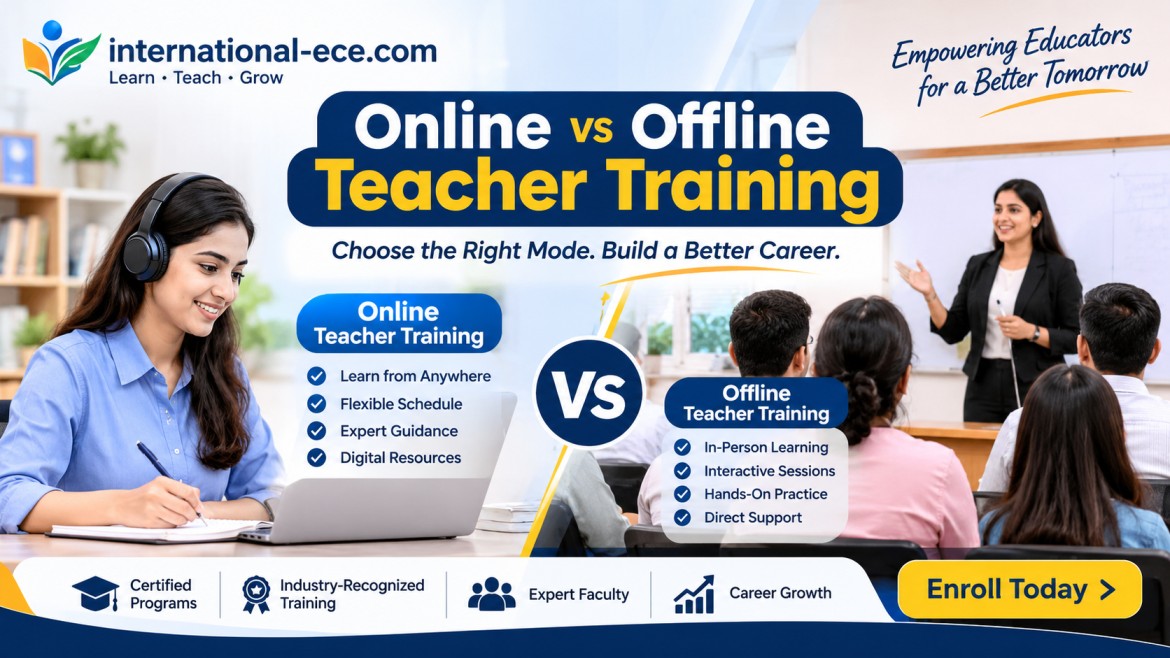
Offline wins for formal school jobs. Online wins for flexibility and digital teaching skills. The right choice depends on whether you want a government school post, a private school job, or an independent online teaching career.
Why this matters to you: Choosing the wrong mode can cost you ₹40,000–₹2,00,000 and 1–2 years — with a certificate that school boards reject at document verification.
Certificate Value: What Schools and Recruiters Actually Check
Recruiters do not ask “was your course online or offline?” They check one thing: is the qualification NCTE-recognised (for school teaching) or UGC/DEB-recognised (for distance education)?
NCTE Recognition: The Line That Decides Everything
The National Council for Teacher Education (NCTE) regulates which teacher training qualifications count for school jobs in India. A regular face-to-face B.Ed is open to any eligible graduate. A distance or ODL B.Ed is allowed only in blended mode — with compulsory face-to-face contact sessions and school-based practical work.
NCTE norms require at least one quarter of a distance B.Ed to be hands-on practicum and internship, not screen time. This is why a fully online B.Ed — zero attendance, zero practical — is not a recognised category at all.
Why this matters to you: If a school board checks your certificate and finds no NCTE recognition, you are disqualified after clearing the written exam — months of preparation and exam fees gone.
Why “Fully Online B.Ed” Is a Trap — and What Is Valid
Fully online B.Ed degrees advertised on social media are almost always distance/ODL programmes misrepresented as “online.” Even legitimate ODL B.Ed programmes (like IGNOU’s) are restricted mainly to in-service teachers, not fresh graduates.
What is valid online: short CPD courses, skill certificates (e.g., ACCT accredited by ASAP Kerala, a Government of Kerala undertaking), and NEP 2020-aligned micro-credentials delivered through DIKSHA/SWAYAM. These enhance your profile but do not replace a B.Ed for government school eligibility.
Practice and Classroom Readiness: Online vs Offline
Practice hours separate a certificate from a classroom-ready teacher. Offline programmes force supervised teaching practice. Online programmes vary wildly — some include live peer sessions, many do not.
How Many Practice Hours Does Each Mode Give You?
NCTE-recognised B.Ed programmes (offline or blended ODL) include supervised school internships. Short online certificates often include peer-to-peer practice or recorded teaching demos, but not supervised classroom hours.
The NEP 2020 Blended Reality: 30 Hours Offline + 20 Hours Online
India’s policy direction is blended, not fully online. Maharashtra’s school education department mandated 50 hours of annual teacher training — 30 hours offline and 20 hours online through approved platforms like DIKSHA and SWAYAM. Certificates are digitally recorded in service books.
NEP 2020’s NISHTHA programme delivers 50+ hours of annual CPD in both online and face-to-face modes via DIKSHA.]Government guidelines suggest an online-to-offline ratio of at least 50:50 for teacher training.
Why this matters to you: Even government policy does not treat “fully online” as sufficient. If policy requires offline practice, schools will value it too.
Investment and ROI: Fee Comparison Table (2026)
Sticker price hides the real cost. A cheap online course can be expensive if it does not unlock the job you want. A costly offline B.Ed can be cheap if it opens a government pay scale.
| Qualification | Typical Total Fee (₹) | Duration | Primary Outcome | Delivery |
|---|---|---|---|---|
| B.Ed (Govt) | 40,000–1,00,000 | 2 years | CTET/Govt school eligibility | Full-time, in-person |
| B.Ed (Private) | 1,00,000–2,00,000 | 2 years | Private school eligibility | Full-time, in-person |
| PgCTL (Online, part-time) | 1,70,000–2,50,000 | 10–12 months | International school eligibility | Online |
| Short CPD / Skill Certificate | 2,000–30,000 | Hours–weeks | Specific skill, CPD hours | Mostly online |
| ACCT (Online, 2-month) | 26,000 | 2 months | Online teaching readiness | Online + live sessions |
Hidden Costs Nobody Shows You
- Exam fees: B.Ed/M.Ed charge ₹2,000–₹5,000 per semester on top of tuition
- Travel and accommodation: Offline practicum in a metro city can double a CELTA-style budget.
- Opportunity cost: A 2-year full-time B.Ed means 2 years of lost salary. Online part-time programmes carry near-zero opportunity cost because you keep working.
Why this matters to you: The cheapest course is not the one with the lowest fee. It is the one that unlocks the income you want fastest.
Career Impact and Salary: What Changes After Certification
Private CBSE school teachers in India commonly earn ₹25,000–₹45,000 per month, with government-aided posts paying more under state pay scales. Entry-level teaching roles (primary teacher, tutor) sit at ₹2–5 LPA; experienced lecturers and curriculum developers reach ₹6–10 LPA+
Online teaching is a different income lane. Trained educators with direct-to-student pipelines can earn ₹50,000–₹1,00,000 per month, depending on digital execution and subject demand.
Online Teaching Income vs Offline School Salary
| Career Path | Monthly Income Range (₹) | What Drives the Number | Certificate That Helps |
|---|---|---|---|
| Private CBSE school teacher | 25,000–45,000 | School board, city, experience | B.Ed + CTET |
| Online tutor (trained, independent) | 50,000–1,00,000 | Student pipeline, subject, platform | Skill certificate + practice |
| EdTech master teacher trainee | Stipend during training, then full-time | Performance, subject demand | Online teaching certificate |
| International school teacher | Higher than domestic private | PgCTL/CELTA + international curriculum | PgCTL or equivalent |
Sources: Supatutor salary data 2027; SelectYourUniversity career guide Suraasa PgCTL outcome
Why this matters to you: If your goal is a government school post, offline B.Ed is non-negotiable. If your goal is online income, a focused online certificate plus a student pipeline can pay back faster.
City Reality Check: Mumbai, Indore, Patna, Jaipur
Metro cities (Mumbai) have more offline training institutes and higher living costs during practicum. Tier-2/3 cities (Indore, Patna, Jaipur) have fewer NCTE-recognised offline seats, making blended/ODL programmes more practical for working teachers — but you must verify NCTE recognition before paying.
Online certificates remove geography as a barrier. A teacher in Patna can complete an online skill course from a Kerala government-accredited provider without relocating. But for a school job in Jaipur, the recruiter will still check NCTE recognition, not the online convenience.
Why this matters to you: Your city should decide the mode, not the standard. Do not trade recognition for convenience.
Decision Checklist: Choose Your Mode in 5 Steps
- ☐ Step 1: Write your goal — government school, private school, online tutoring, or international school.
- ☐ Step 2: Check NCTE recognition if the goal involves a school job. Fully online B.Ed is not recognised.
- ☐ Step 3: Calculate total cost — fee + exam fees + travel + lost income.
- ☐ Step 4: Count practice hours. Offline/blended programmes include supervised internship; short online certificates usually do not.
- ☐ Step 5: Match certificate to salary path — B.Ed for school pay scale, skill certificate for online income.
FAQ Section
Q1. Is an online teacher training certificate valid in India?
Yes — if the course and institution are approved by UGC, NAAC, AICTE, or a government body like ASAP Kerala. Online certificates are valid for skill upskilling and CPD hours, but a fully online B.Ed is not NCTE-recognised for school teaching jobs.
Q2. Can I become a government school teacher with an online B.Ed?
No. NCTE does not recognise fully online B.Ed degrees for school teacher eligibility. A regular face-to-face B.Ed or a blended ODL B.Ed (for in-service teachers) is required for CTET/state TET and government school posts.
Q3. Which is better for salary — online or offline teacher training?
Offline B.Ed leads to school pay scales (₹25,000–₹45,000/month private CBSE). Online skill certificates lead to online tutoring income (₹50,000–₹1,00,000/month if you build a student pipeline). They serve different income paths, not the same one.
Q4. Does NEP 2020 prefer online or offline teacher training?
NEP 2020 mandates 50+ hours of annual CPD in both online and face-to-face modes. Government guidelines suggest at least a 50:50 online-to-offline ratio, and Maharashtra mandates 30 hours offline + 20 hours online.
Q5. How much does teacher training cost in India in 2027?
B.Ed ranges from ₹40,000 (government) to ₹2,00,000 (private) for 2 years. Short online CPD courses cost ₹2,000–₹30,000. Blended certificates like ACCT cost around ₹26,000 for 2 months.
Q6. Can online teacher training help me get a private school job?
It can strengthen your profile — especially for digital teaching skills and CPD hours — but most private schools still require a B.Ed for core teaching posts. Use online certificates as an add-on, not a replacement.