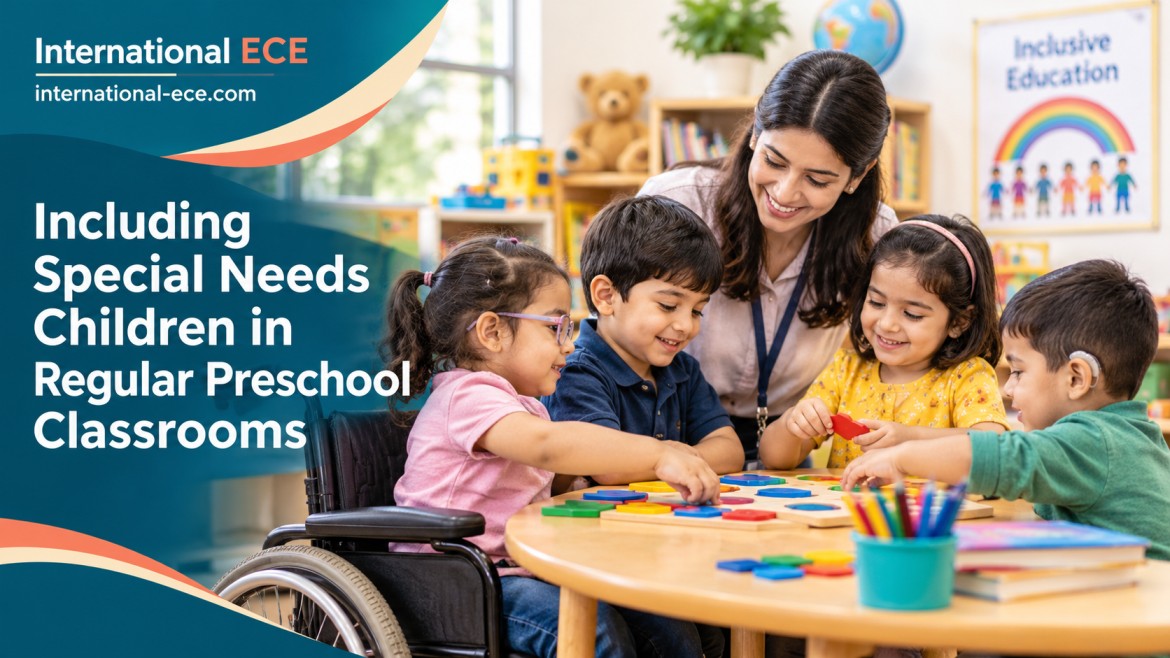
Including Special Needs Children in Regular Preschool Classrooms: A Teacher’s Guide (2027)
Including special needs children in regular preschool means adapting the classroom, lesson, and peer environment so every child participates — not just sits in the room. India’s RPwD Act 2016 and NEP 2020 make this a legal and policy expectation, not an optional teaching style.
This guide gives you the strategies, IEP process, classroom setup, and training roadmap for Indian preschools. No theory dump. Every claim is sourced or marked “industry estimate.”
Quick Answer: What Inclusive Preschool Really Means in India
Inclusion is not “letting a child with a disability attend.” It is changing how you teach, group children, arrange the room, and assess progress so the child can learn alongside peers. The RPwD Act 2016 defines inclusive education as a system where students with and without disabilities learn together, with teaching-learning processes adapted to diverse needs .
Why this matters to you: If you treat inclusion as “extra work for one child,” you will burn out. If you treat it as classroom design, it becomes a system that helps every child.
The Legal and Policy Framework Every Preschool Teacher Must Know
You do not need to memorise laws. You need to know three things: inclusion is a right, IEPs are expected, and teacher training is now mandatory in many states.
RPwD Act 2016: Inclusion Is a Right, Not a Favour
The Rights of Persons with Disabilities Act, 2016, requires educational institutions to admit children with disabilities without discrimination, provide equal opportunities, ensure accessible buildings, and provide reasonable accommodation . This applies to preschools as educational institutions.
India recognises 21 categories of disability under the RPwD Act . In a preschool classroom, you are most likely to see speech and language delays, autism spectrum conditions, hearing impairment, locomotor disability, and intellectual disability.
NEP 2020 and Haryana’s 2025 Guidelines: What Changed
NEP 2020 places equity and inclusion at the centre of educational planning, with flexible pedagogy and formative assessment . The practical shift is visible in state guidelines. Haryana’s Inclusive Education Guidelines, 2025 — notified on October 9, 2025 — apply from pre-primary to senior secondary and mandate early identification, Individual Education Plans (IEPs), resource rooms, and teacher training in inclusive education .
Haryana alone reports over 60,000 children with special needs enrolled in government and private schools . The guideline explicitly states inclusion must be both physical and pedagogical .
Why this matters to you: If your preschool is in a state that follows this model, documentation and training are no longer optional — they are part of compliance.
Classroom Strategies That Work in Indian Preschools
Three strategies deliver the highest impact with the least extra preparation: differentiation, UDL, and peer modeling.
Differentiated Instruction: One Lesson, Many Entry Points
Do not create a separate lesson. Change how the same lesson is delivered. NCERT guidance for early childhood inclusion recommends differentiated curriculum, UDL activities, and accessible learning materials for children aged 3–6 in preschools and Anganwadis .
For a child with speech delay, use picture cards and simplified instructions. For a child with locomotor disability, place materials within reach and use floor-level seating. For a child with attention difficulties, break the activity into 3-minute chunks.
Universal Design for Learning (UDL) for 3–6 Year Olds
UDL means designing activities so multiple senses and multiple response modes are built in from the start. Say the instruction, show a picture, and demonstrate the action. Let children respond by speaking, pointing, or showing.
For Indian preschools, UDL is practical because it works with low-cost materials. Textured numbers, coloured sorting cups, and audio recordings of rhymes serve both special needs and typically developing children.
Peer Modeling and Buddy Systems
Peer modeling is effective for preschool inclusion. Research on inclusive preschool classrooms shows both peer modeling and teacher modeling support special needs students, and teachers should choose the approach that fits the child’s ability level . Pair a child with a patient peer for routine transitions like handwashing and circle time.
Why this matters to you: These three strategies reduce one-on-one attention demands on you. The classroom system does the work, not just your energy.
IEPs in Preschool: A Simple 5-Step Process
An Individual Education Plan (IEP) is a working document, not paperwork for the file. Haryana’s 2025 guidelines mandate IEP preparation for children with disabilities from pre-primary level . But research in Indian schools finds IEPs are often maintained as records without adequate implementation, and technical jargon makes them unusable for classroom teachers .
Use this five-step process to keep the IEP practical:
- Observe and record: Note what the child can do independently, what they avoid, and what triggers distress. Use a simple 5-minute daily log.
- Pick one priority goal: Choose a functional goal — requesting help, transitioning to circle time, or holding a crayon — not an academic checkbox.
- Write it in plain language: Avoid jargon. Write what the child will do, with what support, and how you will know it worked.
- Assign who does what: Class teacher, special educator, parent, and peer buddy each get one action.
- Review every 6–8 weeks: Adjust based on observation, not on the form.
Why this matters to you: An IEP that lives in a file does nothing. An IEP that fits on one page and sits on your desk changes the classroom.
Building a Sensory-Friendly, Accessible Classroom
Physical access is the baseline. Haryana’s guidelines require disabled-friendly infrastructure — ramps, accessible toilets, Braille indicators, and visual signage — and encourage assistive devices and digital tools . For preschool, add sensory access.
- Reduce visual clutter: Keep wall displays to one theme at a time.
- Create a quiet corner: A soft mat, cushions, and one soft toy for dysregulated children.
- Use visual schedules: Pictures of “circle time → wash hands → snack → play” reduce anxiety.
- Check noise: Metal chairs, loud fans, and echoing halls overload children with sensory sensitivity.
- Keep materials at child height: Independence matters more than neat shelves.
Why this matters to you: A sensory-friendly room reduces meltdowns and behavioural incidents. That saves teaching time every single day.
Working With Parents and Special Educators
Inclusion is a team function. Parent-teacher collaboration ensures continuity between home and school, and regular communication builds trust . In India, special educators are scarce — Haryana’s guidelines acknowledge that resource centres exist but their reach remains limited, especially in rural areas .
If you do not have a special educator on staff, build a referral network. One special educator in your district can support 3–4 preschools through monthly visits and phone consultations. Parents can carry home strategies if you explain them simply.
Why this matters to you: You are not expected to be a special educator. You are expected to be a coordinator who uses available support.
Common Challenges in Indian Preschools (and Fixes)
| Challenge | What the Data Says | Practical Fix |
|---|---|---|
| Teacher training gap | Only 24% of ECE educators received in-service training in the past year; over 60% lack formal preparation | Start with one 4-hour module on UDL and visual supports; do not wait for a full course |
| Teacher availability | Only 9% of pre-primary schools have a dedicated ECE teacher | Train the most stable staff member; use peer modeling to reduce one-on-one load |
| High child-teacher ratio | Anganwadi ratio averages 33:1, above the recommended 20:1 | Use small-group rotations and buddy systems; do not rely on whole-class instruction |
| IEPs not implemented | IEPs often maintained as record work, not classroom tools | Use the one-page, plain-language IEP process above |
Sources: ORF 2027; NCERT-affiliated research on IEP implementation.
Why this matters to you: These challenges are structural, not personal. Fix the system, not your willpower.
Teacher Training: What You Need Before Day One
UNESCO 2022 data shows 51% of Indian teachers have inclusive education training, compared with a developed-country average of 81% . The gap is real, but it is closable.
Before day one, you need four competencies: (1) identifying developmental delays, (2) adapting activities without separate lesson plans, (3) writing a usable IEP, and (4) communicating with parents without blame. A 20-hour certificate course in early childhood special education can cover these basics; longer programmes like IGNOU’s Certificate in Early Childhood Special Education go deeper .
| Training Type | Duration | Best For | Typical Fee (₹, estimated) |
|---|---|---|---|
| Short certificate (early childhood special education) | 20–40 hours | Classroom teachers new to inclusion | 5,000–15,000 |
| IGNOU Certificate in Early Childhood Special Education | 6 months–1 year | Teachers wanting a recognised credential | 8,000–15,000 |
| ISITEP (4-year integrated special & inclusive teacher education) | 4 years | Career special educators | Varies by university |
| School-level in-service module | 4–8 hours | Whole staff orientation | 0–5,000 |
Estimated fees based on programme listings; confirm with institution.
Why this matters to you: You do not need a 4-year degree to start including children well. You need the four competencies above, practised consistently.
Checklist: Is Your Preschool Ready for Inclusion?
- ☐ Policy: Your admission form does not screen out or discourage children with disabilities.
- ☐ Physical access: A ramp or level entry, accessible toilet, and safe flooring.
- ☐ Visual schedule: Daily routine displayed with pictures at child height.
- ☐ Quiet corner: A designated low-stimulation space for regulation.
- ☐ One-page IEP: At least one child has a working, plain-language IEP reviewed every 6–8 weeks.
- ☐ Peer buddy system: Every child with significant support needs has a named buddy for transitions.
- ☐ Parent communication: A weekly 5-minute update routine for parents of children with special needs.
- ☐ Staff training: At least one staff member has completed a basic inclusion module in the last 12 months.
- ☐ Referral network: You know the name of one special educator or therapist you can call.
Why this matters to you: Tick 5 of 9 and you are already ahead of most Indian preschools. Tick 9 and you have a defensible inclusion programme.
FAQ Section
Q1. How do you include special needs children in a regular preschool classroom?
Adapt the same lesson for different entry points: simplify instructions, use pictures, allow extra time, and pair the child with a peer buddy. Change the classroom environment — visual schedules, quiet corner, accessible seating — so participation does not depend on one-on-one teaching all day.
Q2. What is the role of a preschool teacher in inclusive education?
The teacher is the primary agent who translates policy into daily practice: observing developmental delays, adapting activities, writing a usable IEP, coordinating with parents and special educators, and building peer acceptance. The RPwD Act 2016 places this responsibility on educational institutions, not only on special educators.
Q3. What are the biggest challenges of inclusive preschool education in India?
Teacher training gaps (only 24% of ECE educators received in-service training in the past year), high child-teacher ratios (33:1 in Anganwadis), scarce special educators in rural areas, and IEPs that exist on paper but are not implemented in the classroom.
Q4. What is an IEP, and why does it matter in preschool?
An Individual Education Plan is a one-page working document stating one priority goal, the support the child needs, who provides it, and how progress will be measured. Haryana’s 2025 guidelines mandate IEPs from pre-primary level, but they only work when written in plain language and reviewed every 6–8 weeks.
Q5. Do I need special education training to include a child with special needs?
You do not need a full degree to start. Four competencies matter most: identifying delays, adapting activities, writing a usable IEP, and communicating with parents. A 20–40 hour certificate in early childhood special education covers these basics.
Q6. What activities work for inclusive preschool classrooms in India?
Sensory play with textured materials, picture-based storytelling, sorting games with coloured cups, peer-buddy transitions, and music with actions. The key is UDL — the same activity allows multiple ways to participate, so special needs and typically developing children learn together.